
Tell Ai Ui Critic
FreeNot checkedAn MCP server that captures rendered UI, diagnoses design tells and consistency drift, and generates redesign diffs from natural language art direction, all wit

About
An MCP server that captures rendered UI, diagnoses design tells and consistency drift, and generates redesign diffs from natural language art direction, all within Cursor.
README
Tell Proof
Independent visual proof for AI-built interfaces.
Tell Proof captures the UI that users actually see, names the visual tells that make it feel generic or inconsistent, drafts a source-grounded repair, and verifies the result in a disposable checkout before anything touches your app.
Demo · Why Tell · Features · Quick Start · Cursor MCP · Architecture · Deploy
License: MIT Built for Cursor TypeScript Next.js 14 MCP
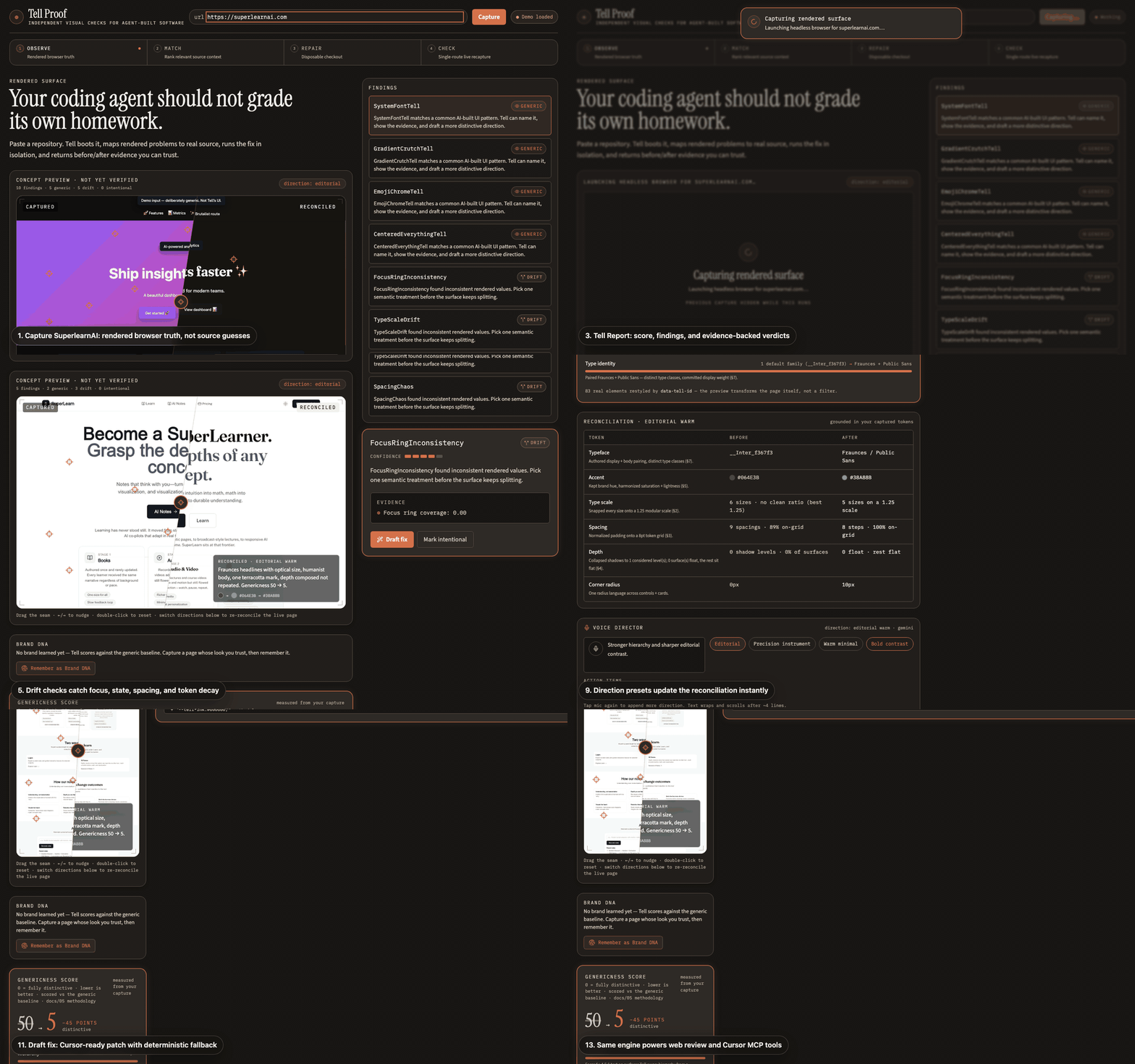
Demo
- Live app: tell-five.vercel.app
- Default scan target: superlearnai.com
- Offline fallback:
fixtures/reports/tell-report.json, so the product still opens with a complete report when live capture is unavailable. - Showcase GIF:
docs/media/tell-superlearnai-demo.gif, generated from the current UI flow.
Tell can scan a public URL directly, or locally clone a GitHub repository, install dependencies, boot the app on a free port, and capture localhost automatically.
Why Tell
AI agents can generate working interfaces quickly. The harder question is whether the result has taste: a distinctive hierarchy, consistent tokens, reachable states, readable contrast, and a visual language that does not collapse into the same gradient-card-template everyone else ships.
Tell Proof is the independent reviewer for that moment. It does not ask the authoring agent to grade its own output. It opens the page in a real browser, measures the rendered surface, identifies specific genericness and drift patterns, and turns the critique into a reviewable direction.
The authoring agent proposes. Tell measures, critiques, repairs, and verifies.
Features
| Capability | What ships today |
|---|---|
| Rendered capture | Playwright opens the route and records screenshot evidence, DOM summary, computed styles, CSS variables, contrast samples, and interactive-state probes. |
| 14 deterministic detectors | 8 genericness tells and 6 consistency-drift detectors catch system fonts, gradient crutches, shadow overuse, radius monotony, gray mush, token bypasses, spacing chaos, state gaps, focus inconsistency, and more. |
| Taste engine | Findings become plain-English verdicts: generic, drift, intentional, or uncertain, with confidence and rationale. Gemini can enrich judgment; deterministic fallback keeps the flow usable without keys. |
| Voice and text art-direction | Say or type directions like "warmer, more editorial, less shadow". Tell maps intent to a preset and concrete action items before model refinement. |
| Before/after reveal | The captured page is compared against a deterministic reconciliation that preserves content while improving hierarchy, contrast, depth, radius, and focus treatment. |
| Source-grounded redesign diffs | When a repo is available, Tell ranks real TSX/JSX/CSS files by rendered evidence and drafts a unified diff instead of guessing from a screenshot. |
| Visual worktree proof | Candidate patches run inside a disposable checkout. Tell applies, waits for HMR, recaptures, compares score/focus/structure, and auto-reverts failed attempts. |
| GitHub setup runner | Paste github.com/owner/repo; local Tell clones it, reads README and package.json, installs dependencies, starts the dev server, and captures the reachable URL. |
| Multi-page scanning | Routes discovered from the snapshot can be scanned individually, exposing drift that only appears on pricing, docs, onboarding, or secondary pages. |
| Cursor MCP | tell_capture, tell_diagnose, tell_redesign, and tell_apply expose the same engine inside Cursor Agent chat. |
Tell is not a replacement for functional, responsive, accessibility, or security testing. It is a focused visual evidence layer for one rendered route at a time.
How It Works
flowchart LR
    url["Public URL or local app"] --> capture["Browser capture"]
    capture --> fingerprint["Design fingerprint"]
    fingerprint --> detectors["Genericness + drift detectors"]
    detectors --> taste["Taste verdicts"]
    taste --> report["Tell Report"]
    report --> direction["Voice/text art-direction"]
    direction --> diff["Source-grounded diff"]
    diff --> proof["Disposable proof checkout"]
    proof --> recapture["Recapture + measured comparison"]
    recapture --> cursor["Review and apply in Cursor"]
Deterministic-first: capture, fingerprinting, detector output, baseline reconciliation, and score comparison do not depend on a model. Models are only used where judgment or drafting benefits from language.
Human-reviewed by design: Tell can prepare a patch and prove it in isolation, but the final change still lands through the developer's normal review workflow.
Quick Start
You need Node 20+ and pnpm 9+.
git clone <your-repo-url> tell
cd tell
pnpm install
pnpm dev
Open http://localhost:3000. The app starts with SuperlearnAI as the capture target and falls back to the committed report if live capture cannot run.
To use the seeded sample app in a second terminal:
pnpm dev:fixture # http://localhost:3001
Useful checks:
pnpm test
pnpm typecheck
pnpm capture:fixture
pnpm diagnose:fixture
pnpm verify:directions   # screenshot all 6 reconcile directions (requires Playwright)
Optional environment variables live in .env.example:
GEMINI_API_KEY=            # richer taste and voice parsing
CURSOR_API_KEY=            # Cursor-SDK-backed redesign drafts
CURSOR_MODEL=composer-2.5
CURSOR_AGENT_TIMEOUT_MS=75000
TELL_CAPTURE_API_URL=      # remote Playwright backend for hosted UI
Cursor MCP
Tell registers as a local MCP server via .cursor/mcp.json. Open this repo in Cursor and ask Agent chat to run the tools directly.
Run tell_diagnose on http://localhost:3001 and draft an editorial redesign.
| Tool | Purpose |
|---|---|
tell_capture |
Capture screenshot and computed-style evidence for a URL. |
tell_diagnose |
Return the full Tell report, findings, verdicts, and score. |
tell_redesign |
Draft a redesign proposal for a finding or whole report. |
tell_apply |
Return patch text and instructions; it never writes files for you. |
tell_proof_verify |
Apply a patch, recapture the URL, and return pass/review/fail with measured deltas. |
tell_proof_revert |
Revert the last proof patch in the workspace. |
Architecture
Tell is a pnpm monorepo with one shared engine behind both the web app and MCP server.
tell/
├── apps/web/           # Next.js product UI and API routes
├── packages/schema/    # Zod contracts shared across every boundary
├── packages/core/      # Capture, fingerprint, detectors, diagnosis
├── packages/taste/     # Verdicts, direction presets, voice/text parsing
├── packages/redesign/  # Reconciliation, source patches, proof measures
├── packages/mcp/       # Cursor MCP stdio server
├── fixtures/           # Generic input app and committed report artifacts
└── docs/               # Product, deployment, and design notes
Key API routes:
| Route | Responsibility |
|---|---|
POST /api/diagnose |
Capture and diagnose a URL, using a remote capture backend when configured. |
POST /api/redesign |
Produce a source-aware redesign proposal with deterministic fallback. |
POST /api/voice |
Convert transcript/text into direction presets and action items. |
POST /api/setup/start |
Local-only GitHub clone/install/run/capture workflow. |
POST /api/proof/apply |
Apply a candidate patch in the disposable checkout and verify it. |
POST /api/proof/revert |
Revert the proof checkout. |
POST /api/reports/share |
Persist a Tell report (Neon → Blob → disk) and return a shareable /report/[id] link. |
GET /api/reports/[id] |
Load a previously shared report JSON. |
GET /api/health/capture |
Check Playwright capture readiness. |
Deploy
The most reliable production shape is a hosted UI plus a separate Playwright capture backend.
| Layer | Platform | Role |
|---|---|---|
| UI | Vercel | Fast Next.js app, report, reveal, voice direction, redesign draft |
| Capture | Vultr, Render, or Docker host | Playwright + Chromium for live URL diagnosis |
| MCP | Local Cursor | Stdio tools for editor-native diagnosis and patch handoff |
Set TELL_CAPTURE_API_URL on the Vercel app to point at the capture backend. GitHub clone-and-run is local-only and should stay disabled on public hosts with TELL_DISABLE_REPO_SETUP=1.
For durable share links on Vercel, set DATABASE_URL from a Neon project (preferred) or link a Blob store (see DEPLOY.md). For PR preview diagnosis CI, set the GitHub repo variable TELL_PREVIEW_URL to your stable Vercel URL.
Deployment guides:
Product Status
Shipped:
- Deterministic capture, fingerprinting, and 14 detectors
- Taste verdicts with safe fallback
- Tell Report with before/after reveal
- Voice/text art-direction
- Cursor MCP tools
- Public URL capture with offline report fallback
- Local GitHub repo setup runner
- Source-grounded redesign proposals
- Contrast-grounded reconciliation
- Multi-page route discovery and per-page scans
- Disposable visual proof loop for candidate patches
Next:
- Broader detector golden corpus across more product categories (
fixtures/corpus/) - Multi-viewport capture matrix (tablet + mobile) — open Phase 3 PR
- Hosted proof sandboxes for Vercel deployments — open Phase 3 PR
- Open taxonomy / benchmark asset (Phase 4)
- Cursor automation hook to run proof-verify on every UI PR (Phase 4)
Shipped in Phase 2:
- Shareable report links (
/api/reports/share,/report/[id]) with Neon Postgres preferred, Blob fallback - State probe thumbnails on capture (default / hover / focus clips)
- DESIGN.md drift detector (
DesignSystemDrift) with automatic load in diagnose pipeline - Tell Proof verify Cursor skill (
.cursor/skills/tell-proof-verify) - Dogfood typography consolidation on Tell web UI
Shipped in Phase 1:
- Full 14-detector golden fixture corpus
tell_proof_verifyandtell_proof_revertMCP tools- PR preview diagnosis workflow (
.github/workflows/pr-diagnose.yml) - Dogfood script (
pnpm dogfood:web) — Tell UI reports zero generic tells and zero drift
Contributing
Contributions are welcome. The highest-leverage additions are new detectors, better evidence views, and stronger source mapping.
pnpm typecheck && pnpm test
The sample app under fixtures/generic-app/ is intentionally bland input data, not the product itself. See CONTRIBUTIONS.md for the attribution breakdown.
License
Released under the MIT License.
Installing Tell Ai Ui Critic
This server has no published package — it is built from source. Open the repository and follow its README.
▸ github.com/ashishpatill/tell-ai-ui-criticFAQ
Is Tell Ai Ui Critic MCP free?
Yes, Tell Ai Ui Critic MCP is free — one-click install via Unyly at no cost.
Does Tell Ai Ui Critic need an API key?
No, Tell Ai Ui Critic runs without API keys or environment variables.
Is Tell Ai Ui Critic hosted or self-hosted?
Self-hosted: the server runs locally on your machine via the install command above.
How do I install Tell Ai Ui Critic in Claude Desktop, Claude Code or Cursor?
Open Tell Ai Ui Critic on unyly.org, pick your client tab (Claude Desktop, Claude Code, Cursor) and press Install — the config is generated automatically, no JSON editing.
Related MCPs
LibreOffice Tools
Enables AI agents to read, write, and edit Office documents via LibreOffice with token-efficient design. Supports multiple formats including DOCX, XLSX, PPTX, a
 by passerbyflutter
dannote/figma-use
Full Figma control: create shapes, text, components, set styles, auto-layout, variables, export. 80+ tools.
 by dannote
Logo.dev
Search and retrieve company logos by brand or domain. Customize size, format, and theme to match your design needs. Accelerate design, prototyping, and content
 by NOVA-3951
PIX4Dmatic
Enables GUI automation for controlling PIX4Dmatic on Windows through MCP. Supports launching, focusing, capturing screenshots, sending hotkeys, clicking UI elem
 by jangjo123
Compare Tell Ai Ui Critic with
Not sure what to pick?
Find your stack in 60 seconds
Author?
Embed badge for your README
Browse similar
All design MCPs