Enables MCP-compatible AI agents to execute typed live-app actions over WebSocket, allowing agents to directly interact with real application state without brow
Enables MCP-compatible AI agents to execute typed live-app actions over WebSocket, allowing agents to directly interact with real application state without browser automation or scraping.
README
Typed live-app actions for MCP-compatible AI agents, over WebSocket.
NEW: Join our community on Discord at discord.gg/J3W9b5AZJR — protocol questions, feedback, and SDK-contribution chat all welcome.
Tesseron is an accessibility layer for AI agents. You instrument your app once — the way you'd add ARIA to a web page — and any MCP-compatible agent can drive it through typed actions you define. Think of it as an API for agents, written by the people who built the app.
The premise: the agent doesn't need to click a button, it needs to do the thing the button does. Say an agent wants to add five items to a list. Through the UI that's click add, type, submit, click add again — five round-trips through a brittle, re-render-happy interface. With Tesseron it calls one action:
Your handler runs against your real state. No clicking, no scraping, no brittleness.
Live applications (browser tabs, Electron/Tauri desktop apps, Node daemons, CLIs) declare actions with a Zod-style builder; agents (Claude Code, Claude Desktop, Cursor, Copilot, Codex, Cline, ...) call them as MCP tools. Your real handler runs in your real process, against your real state. No browser automation, no scraping, no Playwright.
It's a protocol, not just a TypeScript library — and not just for the web. The JS/TS SDKs are the reference implementation and already cover the browser, Node, and desktop (Electron/Tauri). But the wire protocol is CC BY 4.0 and language-agnostic: anything that can open a WebSocket and speak JSON-RPC 2.0 can host actions, so a Python daemon, a Rust desktop app, or a .NET line-of-business tool can speak it too. Web is simply where the first SDKs landed — not the boundary of what Tesseron is.
Why Tesseron
Typed actions, not scraped DOMs. Declare with Zod or any Standard Schema validator; the handler is a plain function against your real state.
Framework-agnostic. Same API for vanilla TS, React, Svelte, Vue, and Node. Pick your stack.
MCP-native. Every action, resource, and capability maps to a standard MCP primitive. Users pick their agent.
Click-to-connect. Six-character claim code handshake. No API keys, no OAuth dance, no per-client configuration.
First-class capabilities.ctx.confirm for yes/no, ctx.elicit for schema-validated prompts, ctx.sample for agent LLM calls, ctx.progress for streaming updates, subscribable resources for live reads.
Cross-client delivery. First-class install paths for Claude Code, Codex, OpenCode, and Pi — each one a single command or short config snippet that wires the MCP gateway in. No bundled binary; the gateway is npx -y @tesseron/mcp@<version> on demand.
Install
Tesseron has first-class install paths for four agent clients. Pick the one you use:
pi-mcp-adapter discovers and exposes the Tesseron tools to Pi automatically. Use "directTools": true per server entry to surface each Tesseron action as a top-level Pi tool instead of going through the mcp proxy.
To pick up the skill bundle as well, point Pi's settings skills array at a clone of plugin/skills/ — the same folder Claude Code / Codex use.
OpenCode
OpenCode reads MCP servers from opencode.json rather than a plugin manifest. Save this as .opencode/opencode.json in your project root (or ~/.config/opencode/opencode.json for global use):
To also pick up the skill bundle, point OpenCode's skills.paths at a clone of plugin/skills/ — see plugin/README.md for the snippet.
Other MCP clients
Claude Desktop, Cursor, VS Code Copilot, Cline, and any other MCP-compatible client work too — the gateway is plain stdio MCP. See the one-time setup in examples/README.md.
Tesseron's action context gives handlers four capabilities beyond plain tool invocation, each backed by an MCP primitive. Whether a given call actually fires depends on what the user's MCP client advertises:
SDK surface
MCP primitive
tool(...) (action invocation)
tools
resource(...) (live reads, subscriptions)
resources (+ resources.subscribe)
ctx.sample(...)
sampling
ctx.confirm(...) / ctx.elicit(...)
elicitation
ctx.progress(...)
notifications/progress (client must pass _meta.progressToken on tools/call)
For the authoritative, continuously-updated list of which client supports which primitive, see the official MCP client compatibility matrix — filter by Sampling or Elicitation to see how narrow the field still is. A few points worth knowing before you pick a capability:
Tools are universal — every MCP client can invoke your actions.
Sampling is the rarest. Claude Code, Claude Desktop, and Claude.ai do not expose it; today's support is concentrated in VS Code + GitHub Copilot, goose, and fast-agent.
Elicitation (MCP 2025-06) landed in Claude Code (2.1.76, March 2026), Cursor, Codex, VS Code Copilot, goose, and fast-agent, but not Claude Desktop, Claude.ai, ChatGPT, Windsurf, or Zed.
When a capability is missing, Tesseron raises a typed error (SamplingNotAvailableError, ElicitationNotAvailableError) or collapses to the safe default (ctx.confirm returns false), so handlers can branch explicitly rather than silently misbehaving.
Status
v1.0 shipped April 2026; the SDK is at v2.10 as of writing. The protocol is stable at 1.0.0 and intentionally kept small: bidirectional JSON-RPC 2.0 over WebSocket, dynamic MCP tool registration, click-to-connect handshake, streaming progress, cancellation, sampling, confirmation, schema-validated elicitation, subscribable resources, session resume.
Published to npm: all nine packages — @tesseron/{core,web,server,react,svelte,vue,vite,mcp,docs-mcp} — ship in lockstep at the same version (currently 2.10.0). The JS/TS SDKs are the reference implementation; the protocol spec is CC BY 4.0 so anyone can write a compatible client or server in any language.
On the roadmap: a Streamable HTTP transport, a Python SDK, and bindings for desktop-native runtimes (Rust for Tauri, etc.).
Development
pnpm install
pnpm typecheck
pnpm test                            # vitest across core + mcp
pnpm lint                            # biome
pnpm sync-plugin-version --check     # CI guard: plugin manifests + Pi pin + skill mirror in lockstep
Contributing
Bug reports, protocol refinements, new framework adapters, and improvements to the reference implementation are welcome.
Open an issue first for anything larger than a small fix.
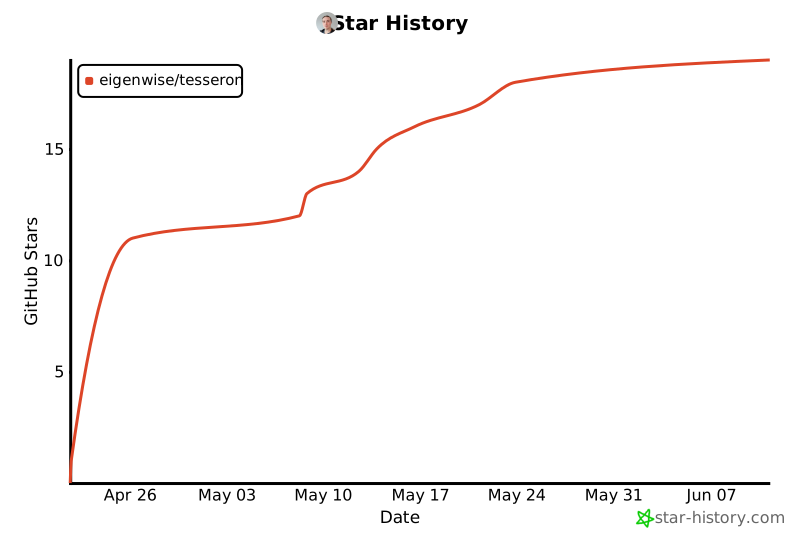
Star history
License
Reference implementation — Business Source License 1.1 (source-available). You may embed Tesseron in your own applications, use it internally, fork it, and redistribute it freely. You may not offer Tesseron or a substantial portion of it as a hosted or managed service to third parties. Each release auto-converts to Apache-2.0 four years after publication.
Protocol specification — CC BY 4.0. A compatible implementation in any language, for any purpose including commercial, is explicitly encouraged.