
Timps Swarm
FreeNot checked160 specialist AI agents for Claude Code, Cursor & Codex — one npm install puts them all into your IDE as MCP tools and parallel sub-agents. Local-first, BYOK,

About
160 specialist AI agents for Claude Code, Cursor & Codex — one npm install puts them all into your IDE as MCP tools and parallel sub-agents. Local-first, BYOK, works offline with Ollama.
README

One npm install puts 160 AI specialists into every coding tool you use — as parallel sub-agents, not just MCP tools.
npm License: MIT Python 3.11+ MCP Protocol Discord
Quick Start · Sub-agents · 160 Agents · MCP Setup · CLI · Architecture
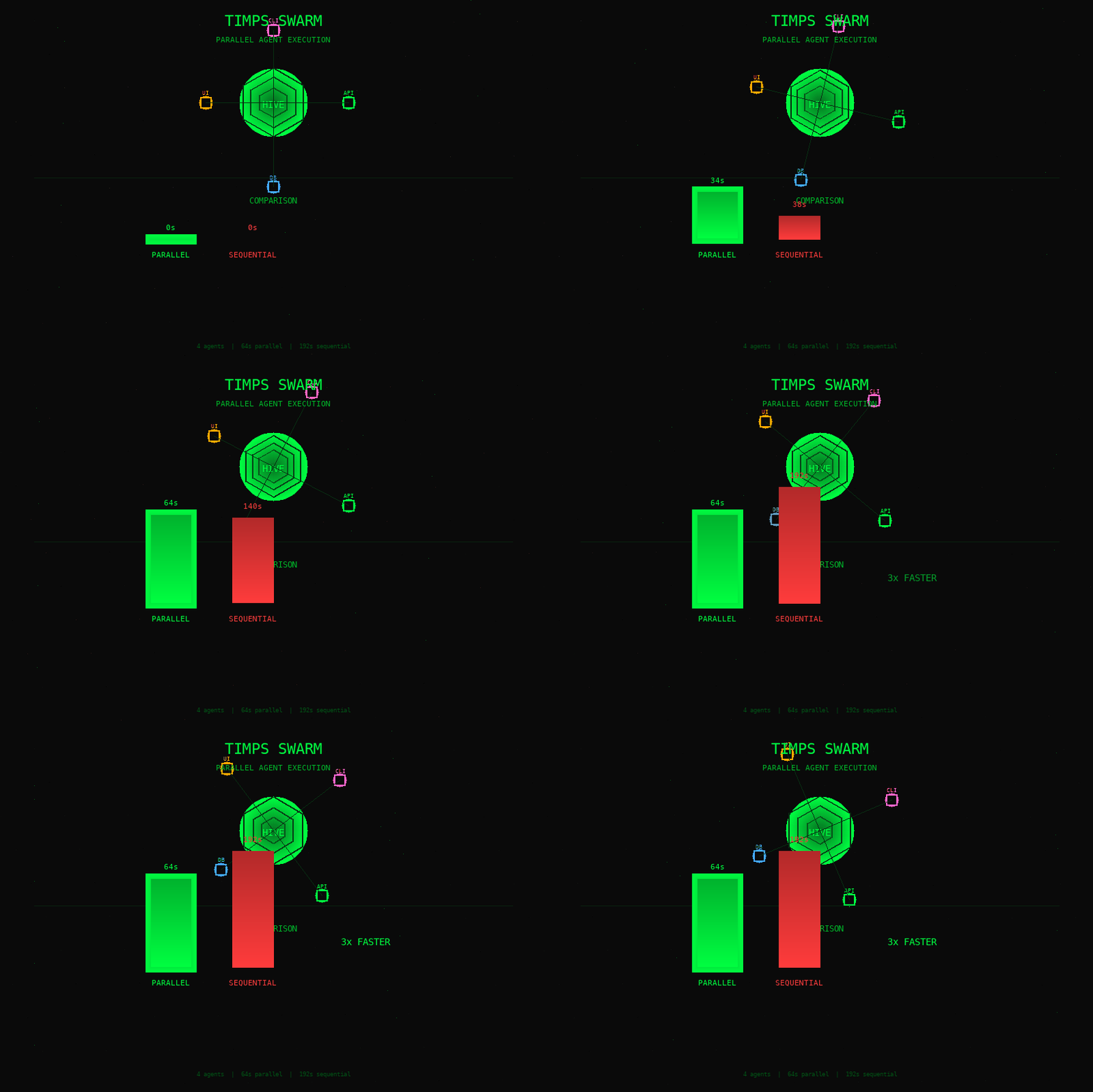 4 agents dispatched in parallel vs sequential — 3× speedup (64s vs 192s)
What it does
- Security audit any repo in 30 seconds —
npx timps-swarm audit ./finds CVEs, hardcoded secrets, and OWASP issues. No backend, no config, no API key. - 160 specialist agents in every AI tool — one
install-mcpcommand writes the MCP config for 9 IDEs (Claude Code, Cursor, Windsurf, Continue, Aider, Cline, Zed, VS Code, Gemini, Codex, Amp, Warp) and registers every agent as a native sub-agent so Claude Code / Cursor / Codex can dispatch them in parallel viaTask(subagent_type=...). - Local-first, BYOK — runs on Ollama with zero API cost; plug in Gemini/Anthropic/OpenAI/Groq when you want more power.
- Works without the Python backend —
npm install -g timps-swarmships a Node.js MCP stdio proxy (cli/lib/mcp-proxy.js) that talks to any running FastAPI server (local or remote viaTIMPS_API_URL). The Python repo is optional.
Quick Start
npm i -g timps-swarm
Postinstall auto-detects every AI tool on your machine and:
- Writes the
timps-swarmMCP server entry into every detected IDE config (with an explicitenv:block forwardingANTHROPIC_API_KEY,OPENAI_API_KEY,GEMINI_API_KEY,GROQ_API_KEY,TIMPS_API_URL,OLLAMA_HOST,REDIS_URL). - Writes one sub-agent
.mdfile per TIMPS tool into~/.claude/agents/,./.claude/agents/, and~/.codex/agents/.
Restart your tool — 160 agents appear as MCP tools and as parallel sub-agents.
Run without installing (zero setup):
npx timps-swarm audit ./ # security scan any repo — works immediately
What install actually does
install-mcp is the only command you need:
npx timps-swarm install-mcp                  # default: configure all detected tools
npx timps-swarm install-mcp --no-sub-agents  # MCP config only, skip the .md files
npx timps-swarm install-mcp --tool cursor    # configure one tool
npx timps-swarm install-mcp --dry-run        # preview without writing
npx timps-swarm uninstall-mcp                # remove all of the above
By default this writes:
- MCP server entries into 9 IDE config files (one entry per IDE, all pointing at
npx timps-swarm mcp). - 160 sub-agent
.mdfiles into~/.claude/agents/,./.claude/agents/,~/.codex/agents/(one per MCP tool) so Claude Code'sTask(subagent_type="timps_kubernetes_navigator"), Cursor Composer, and Codex can dispatch them in parallel.
All writes are idempotent (re-running updates the existing file) and reversible via uninstall-mcp (which only removes the timps-swarm key and the timps-*.md files — your other config is untouched).
The killer commands
# Security audit — secrets + CVEs + SAST, no backend, no API key
npx timps-swarm audit ./

# Full 10-agent SDLC pipeline on any codebase
npx timps-swarm fix ./src --language python

# Generate a complete OpenAPI spec from plain English
npx timps-swarm api-design "billing API with metered usage and Stripe webhooks"

# Design a DB schema with DDL, ER diagram, and migrations
npx timps-swarm db-design "multi-tenant SaaS with usage-based billing"

# Diagnose your machine (12 specialist agents)
npx timps-swarm health
MCP integrations
npx timps-swarm install-mcp            # auto-detect and configure all installed tools
npx timps-swarm install-mcp --tool cursor    # single tool only
npx timps-swarm install-mcp --dry-run        # preview without writing files
| Tool | Config written |
|---|---|
| Claude Code | ~/.claude/mcp.json |
| Cursor | ~/.cursor/mcp.json |
| Windsurf | ~/.windsurf/mcp.json |
| Continue | ~/.continue/config.json |
| Zed | ~/.config/zed/settings.json |
| Aider | ~/.aider.conf.yml |
| Goose | ~/.config/goose/config.yaml |
| Gemini CLI | ~/.gemini/settings.json |
| Codex CLI | ~/.codex/config.json |
| Amp | ~/.amp/mcp.json |
| Warp | ~/.warp/mcp_servers.json |
| VS Code / Cline / Copilot | .vscode/mcp.json (workspace) |
Manual config snippets (all tools)
install-mcp writes the snippet below into each IDE config. The env: block forwards whichever API keys you have set in your shell; it's optional (the IDE usually inherits env, but explicit is safer for sandboxed hosts).
Claude Code — ~/.claude/mcp.json
{
  "mcpServers": {
    "timps-swarm": {
      "command": "npx",
      "args": ["timps-swarm", "mcp"],
      "env": {
        "GEMINI_API_KEY": "...",
        "ANTHROPIC_API_KEY": "..."
      }
    }
  }
}
Cursor / Windsurf / Gemini CLI / Codex CLI / Amp — same format as above, different path.
VS Code / Cline / Roo Code / GitHub Copilot — .vscode/mcp.json
{
  "mcp": {
    "servers": {
      "timps-swarm": { "type": "stdio", "command": "npx", "args": ["timps-swarm", "mcp"] }
    }
  }
}
Continue — ~/.continue/config.json
{ "mcpServers": [{ "name": "timps-swarm", "command": "npx", "args": ["timps-swarm", "mcp"] }] }
Aider — ~/.aider.conf.yml
mcp-servers:
  timps-swarm:
    command: npx
    args: [timps-swarm, mcp]
    type: stdio
Zed — ~/.config/zed/settings.json
{
  "assistant": {
    "mcp_servers": {
      "timps-swarm": { "command": "npx", "args": ["timps-swarm", "mcp"] }
    }
  }
}
Goose — ~/.config/goose/config.yaml
extensions:
  - name: timps-swarm
    type: stdio
    cmd: npx timps-swarm mcp
    enabled: true
GitHub Actions — reusable workflow
jobs:
  generate:
    uses: Sandeeprdy1729/timps-swarm/.github/workflows/timps-swarm.yml@main
    with:
      task: "Build a microservice for JWT authentication"
      language: python
    secrets:
      GEMINI_API_KEY: ${{ secrets.GEMINI_API_KEY }}
LLM providers
Tries providers in priority order, uses the first available one.
| Priority | Provider | Env var | Notes |
|---|---|---|---|
| 1 | MCP Sampler | (auto) | Uses the host tool's model |
| 2 | Gemini 2.5 Flash | GEMINI_API_KEY |
Recommended — fast + generous free tier |
| 3 | Anthropic Claude | ANTHROPIC_API_KEY |
Best for complex reasoning |
| 4 | OpenAI GPT-4o | OPENAI_API_KEY |
|
| 5 | Groq Llama 3.3 70B | GROQ_API_KEY |
Fastest API inference |
| 6 | Ollama | (auto-detected) | Fully offline, no API key |
| 7 | TIMPS-Coder 0.5B | (built-in) | Always available |
export GEMINI_API_KEY=...      # free tier, fastest start
export ANTHROPIC_API_KEY=...   # optional
The 160 agents — full list
The MCP server exposes 160 specialist agents across 9 categories. Every one is also registered as a native Claude Code / Cursor / Codex sub-agent.
| Category | Count | Examples |
|---|---|---|
| Priority | 68 | research_agent, ab_testing_agent, abdm_agent, agent_composer, browser_automation, churn_predictor, demand_forecaster, dependency_agent, digilocker_agent, dpdp_act_auditor, federated_learning, finetuning_agent, fssai_compliance_agent, gst_compliance, indiehacker_agent, model_evaluator, model_perf_monitor, podcast_show_notes_writer, prompt_injection_scanner, quantum_ready, rag_designer, rag_evaluator, red_team_agent, release_manager, sbom_generator, security_remediation, service_mesh_configurator, sprint_planning_agent, storybook_story_generator, threat_intel_analyst, upi_agent, vector_db_agent, voice_agent_designer, wearable_health_coach, web3_agent, win_loss_analyst, … |
| Expert Diagnostics | 51 | dependency_rebel, kubernetes_navigator, docker_compose_architect, pipeline_healer, compliance_auditor, incident_response_coordinator, accessibility_tester, mcp_server_generator, observability_cost_optimizer, license_compliance_scanner, container_image_scanner, adr_writer, contract_reviewer, court_case_summarizer, data_pipeline, db_migration_pilot, disaster_recovery, game_day_facilitator, git_workflow_automator, graphql_agent, iac_drift_detector, load_testing, local_rag_builder, log_pattern_analyzer, phishing_simulator, postmortem_agent, test_intelligence, visual_regression_detective, web_scraping, web_search, … |
| Computer Health | 12 | system_optimizer, file_organizer, environment_doctor, security_guard, network_medic, battery_analyst, update_manager, log_interpreter, privacy_cleaner, media_librarian, backup_sentinel, context_switcher |
| Developer Workflow | 12 | issue_triager, boilerplate_architect, pr_reviewer, dependency_sentinel, unit_test_writer, docstring_generator, log_detective, sql_optimizer, sprint_reporter, flaky_test_hunter, api_contract_auditor, content_multiplier |
| Knowledge Worker | 7 | inbox_gatekeeper, meeting_condenser, research_scout, trend_monitor, data_wrangler, competitor_tracker, agri_commodity_forecaster |
| Meta | 6 | list_agents, dispatch, full_checkup, list_providers, connect_tools, tool_status |
| Context / Kernel | 3 | context_briefing, delegate, kernel_status |
| SDLC Pipeline | 1 | run_task (the 10-node LangGraph orchestrator: PM → Architect → Code → Review → QA → Security → Perf → Docs → DevOps) |
# Trigger the full SDLC pipeline
python3 give_work.py "Build a rate-limited REST API for user authentication"
# PM → Architect → Code → Review → QA → Security → Perf → Docs → DevOps

# Run a computer health checkup
npx timps-swarm health
python3 give_work.py "My laptop fan is always running"

# Delegate a multi-step goal
npx timps-swarm delegate "fix the auth bug and ensure 80% test coverage"

# Call any of the 160 directly from the CLI
npx timps-swarm mcp   # then use any MCP client
The Self-Critic Agent is the most valuable one — it scores any output 1–10 and re-runs the originating agent until the threshold is met, closing the quality loop across the entire swarm.
The 160 includes Phase 3 (12 priority), Phase 5 (7 more), Phase 6 nextgen (21 — security/DevOps/MLOps/emerging), and Phase 7 (32 — India verticals, compliance, content, sales/voice, research). The
src/tool_connectorsmodule has a separateTOOLSdict (24 IDE config shortcuts —claude_code,cursor, etc.) used at runtime bytimps_connect_toolsandtimps_tool_status; those are not part of the 160.
CLI
npm install -g timps-swarm # or: npx timps-swarm <command>
COMMANDS
  audit <path>           Security audit — secrets + CVEs + SAST (works offline)
  fix <path>             Run the full 10-agent SDLC pipeline
  research <topic>       Research a topic before writing code
  api-design <desc>      Generate an OpenAPI 3.1 spec from plain English
  db-design <desc>       Design a database schema with DDL + ER diagram
  n8n <desc>             Generate a complete n8n workflow JSON
  refactor [path]        Detect code smells + produce refactored version
  test-data <schema>     Generate realistic seed / fixture data
  monitor <service>      Prometheus + Grafana + alerting config
  ui <desc>              UI component spec + code + accessibility audit
  cost <arch>            Cloud cost estimate + savings recommendations
  critique <content>     Score output 1-10, auto-improve until threshold
  health                 Computer health checkup (12 agents)
  providers              Show configured LLM providers
  install-mcp            Auto-configure TIMPS in 9 AI tools + 160 sub-agents
  uninstall-mcp          Remove the MCP config and 160 sub-agent .md files
  start [--repo <path>]  Start the TIMPS Swarm API server (port 8000)
  mcp   [--repo <path>]  Start the MCP stdio server (Python or Node.js fallback)

FLAGS (install-mcp)
  --tool <id>            Only configure one IDE (claude-code, cursor, codex-cli, …)
  --no-sub-agents        Skip writing 160 sub-agent .md files (MCP config only)
  --dry-run              Preview without writing anything
  --silent               Suppress output (postinstall)

ENV VARS
  TIMPS_API_URL          API server URL (default http://localhost:8000)
                         Set to a remote URL to point every tool call at it.
  TIMPS_REPO             Explicit path to the Python repo (skip auto-detection)
  GEMINI_API_KEY         Free tier — fastest start
  ANTHROPIC_API_KEY      Optional
  OPENAI_API_KEY         Optional
  GROQ_API_KEY           Optional
  OLLAMA_HOST            Default http://localhost:11434
  REDIS_URL              Default redis://localhost:6379/0
If timps-swarm mcp is invoked but no Python repo is on disk, it transparently falls back to the bundled cli/lib/mcp-proxy.js — a Node.js JSON-RPC 2.0 stdio proxy that forwards every tool call to ${TIMPS_API_URL}/mcp/tools/call. So npm install -g timps-swarm is enough to get a working MCP server, as long as a FastAPI server is reachable.
Architecture
                          User / AI coding tool
                          (Claude Code, Cursor, Codex, …)
                                       │
              ┌────────────────────────┼────────────────────────┐
              │ stdio JSON-RPC 2.0     │                        │
              ▼                        ▼                        ▼
  ┌──────────────────────┐   ┌──────────────────────┐   ┌────────────────────┐
  │ mcp_server/server.py │   │ cli/lib/mcp-proxy.js │   │     src/main.py    │
  │  Python — 160 tools, │   │  Node.js fallback    │   │  FastAPI + WS      │
  │  full MCP sampling   │   │  (npm-only path)     │   │  /swarm/run,       │
  │                      │   │                       │   │  /agents/*,        │
  │                      │   │                       │   │  /mcp/tools,       │
  │                      │   │                       │   │  /mcp/tools/call,  │
  │                      │   │                       │   │  /health, /ws      │
  └──────────┬───────────┘   └──────────┬───────────┘   └──────────┬─────────┘
             │                          │                          │
             │      TOOLS / dispatch   │   POST /mcp/tools/call    │
             │ ◀───────────────────────┴──────────────────────────▶│
             │                                                     │
             │      mcp_server/server._TOOL_HANDLERS              │
             │              (160 tools, in-process)                │
             └─────────────────────────┬───────────────────────────┘
                                       │
                              Swarm Bridge
                                       │
       ┌───────────────────┬──────────┴──────────┬───────────────────┐
       ▼                   ▼                     ▼                   ▼
  SDLC DAG          Health Graph          Specialist Agents      Context / Kernel
  (10 nodes)        (12 nodes)            (120 direct calls)     (3 nodes)
       │                   │                     │                   │
       └───────────────────┴─────────────────────┴───────────────────┘
                                       │
                                  LLM Router
       ┌─────────────┬─────────────────┼─────────────┬───────────────┐
       ▼             ▼                 ▼             ▼               ▼
   Gemini        Anthropic         OpenAI         Groq          Ollama
   2.5 Flash      Claude           GPT-4o       Llama 3.3       (local)
                                                            + TIMPS-Coder 0.5B
Three transport paths converge on the same dispatch table:
- Python MCP stdio (
mcp_server/server.py) — full MCP sampling, in-process, 160 tools. Used when the Python repo is on disk. - Node.js MCP stdio proxy (
cli/lib/mcp-proxy.js) — pure stdio JSON-RPC 2.0 that proxiestools/list+tools/callto a running FastAPI server. Used when only the npm package is installed (no Python repo). - FastAPI REST + WebSocket (
src/main.py) —/swarm/run,/agents/*,/health,/ws, plus the bridge endpoints/mcp/tools(catalogue) and/mcp/tools/call(dispatch).
Layer 1 — Computer Manager (src/layer1_computer_manager.py) — isolated working directories, CPU/memory/disk caps per agent.
Layer 2 — Swarm Bridge (src/layer2_swarm_bridge.py) — agent lifecycle: spawning, team formation, LangGraph DAG execution, result collection.
Layer 3 — CLI (src/layer3_swarm_cli.py) — give_work.py and the npm CLI.
REST API
curl http://localhost:8000/health
curl http://localhost:8000/health/full   # deep check with provider status

curl -X POST http://localhost:8000/swarm/run \
  -H "Content-Type: application/json" \
  -d '{"request": "Fix SQL injection in my FastAPI endpoint", "language": "python"}'

curl -X POST http://localhost:8000/agents/refactor \
  -d '{"code": "...", "language": "python", "goals": ["reduce_complexity"]}'

curl http://localhost:8000/providers

# MCP bridge (used by cli/lib/mcp-proxy.js)
curl http://localhost:8000/mcp/tools                                       # full 160-tool catalogue
curl -X POST http://localhost:8000/mcp/tools/call \
  -H "Content-Type: application/json" \
  -d '{"name": "timps_list_agents", "arguments": {}}'                      # call any tool over HTTP

wscat -c ws://localhost:8000/ws   # real-time stream
Full interactive docs at http://localhost:8000/docs when the server is running.
Training custom adapters
The Code Generator uses TIMPS-Coder — a 0.5B model with 20 LoRA adapters, one per bug class. Add examples and push — GitHub Actions trains new adapters automatically.
cp my_bugs.jsonl datasets/custom/
git add datasets/custom/my_bugs.jsonl
git commit -m "feat: 40 new Python async bug examples"
git push origin main
Set HF_TOKEN and HF_REPO_ID in repo secrets. The pipeline merges your data, trains 20 adapters in parallel on Apple Silicon (MLX), benchmarks, and publishes to HuggingFace.
The 20 bug-class adapters: java_npe · java_ioob · java_concurrent · python_keyerror · python_typeerror · python_recursion · python_async · python_logic · javascript_null · javascript_scope · javascript_async · cpp_memory · cpp_bounds · go_routine · rust_borrow · sql_injection · xss_vuln · auth_bypass · performance_slow · api_design
Hardware
| Setup | RAM | Notes |
|---|---|---|
| Minimum | 8 GB | One Ollama model at a time |
| Recommended | 16 GB | All models loaded simultaneously |
| Fine-tuning | 8 GB Apple Silicon | MLX on M1/M2/M3/M4 |
Security
API key auth is off by default. Enable when sharing across a team:
TIMPS_AUTH=1 make up-local
python3 give_work.py --keygen "sandeep-laptop"   # generate key (shown once)
python3 give_work.py --revoke timps-sk-xxxx       # revoke a key
Keys stored as SHA-256 hashes in ~/.timps/.secrets (chmod 600).
Contributing
PRs welcome against main. Conventional commits, please.
git clone https://github.com/Sandeeprdy1729/timps-swarm
cd timps-swarm && pip install -e ".[dev]"
make up-local    # starts the FastAPI server on :8000
make testis currently a no-op —tests/is empty. Existing runnable test scripts are top-level (python3 mcp_server/test_server.py,python3 test_computer_allocation.py). Add atests/directory and wire it intopyproject.tomlbefore relying on pytest.
Lint: ruff check . (configured in pyproject.toml, no make lint target). Typecheck: none configured. Python ≥ 3.10, CI pins 3.11.
Built on TIMPS-Coder — a 0.5B model fine-tuned with 20 LoRA adapters for specific bug patterns.
Installing Timps Swarm
This server has no published package — it is built from source. Open the repository and follow its README.
▸ github.com/Sandeeprdy1729/timps-swarmFAQ
Is Timps Swarm MCP free?
Yes, Timps Swarm MCP is free — one-click install via Unyly at no cost.
Does Timps Swarm need an API key?
No, Timps Swarm runs without API keys or environment variables.
Is Timps Swarm hosted or self-hosted?
Self-hosted: the server runs locally on your machine via the install command above.
How do I install Timps Swarm in Claude Desktop, Claude Code or Cursor?
Open Timps Swarm on unyly.org, pick your client tab (Claude Desktop, Claude Code, Cursor) and press Install — the config is generated automatically, no JSON editing.
Related MCPs
GitHub
PRs, issues, code search, CI status
 by GitHub
Filesystem
Secure file operations with configurable access controls.
Memory
Knowledge graph-based persistent memory system.
Template MCP Server
A CLI tool to create a new Model Context Protocol server project with TypeScript support, dual transport options, and an extensible structure
 by mcpdotdirect
Compare Timps Swarm with
Not sure what to pick?
Find your stack in 60 seconds
Author?
Embed badge for your README
Browse similar
All development MCPs