
Trip Planner Server
FreeNot checkedA journey-planning MCP server that manages itineraries including journeys, city stops, and plan items with CRUD operations and weather lookup.

About
A journey-planning MCP server that manages itineraries including journeys, city stops, and plan items with CRUD operations and weather lookup.
README
A journey-planning MCP server built with FastMCP, plus a LangGraph agent that connects to it alongside two public MCP servers. The agent manages a traveller's itinerary: journeys (trips as a whole), the city stops within a journey, and the plan items (sights, meals, activities) within each stop.
Architecture
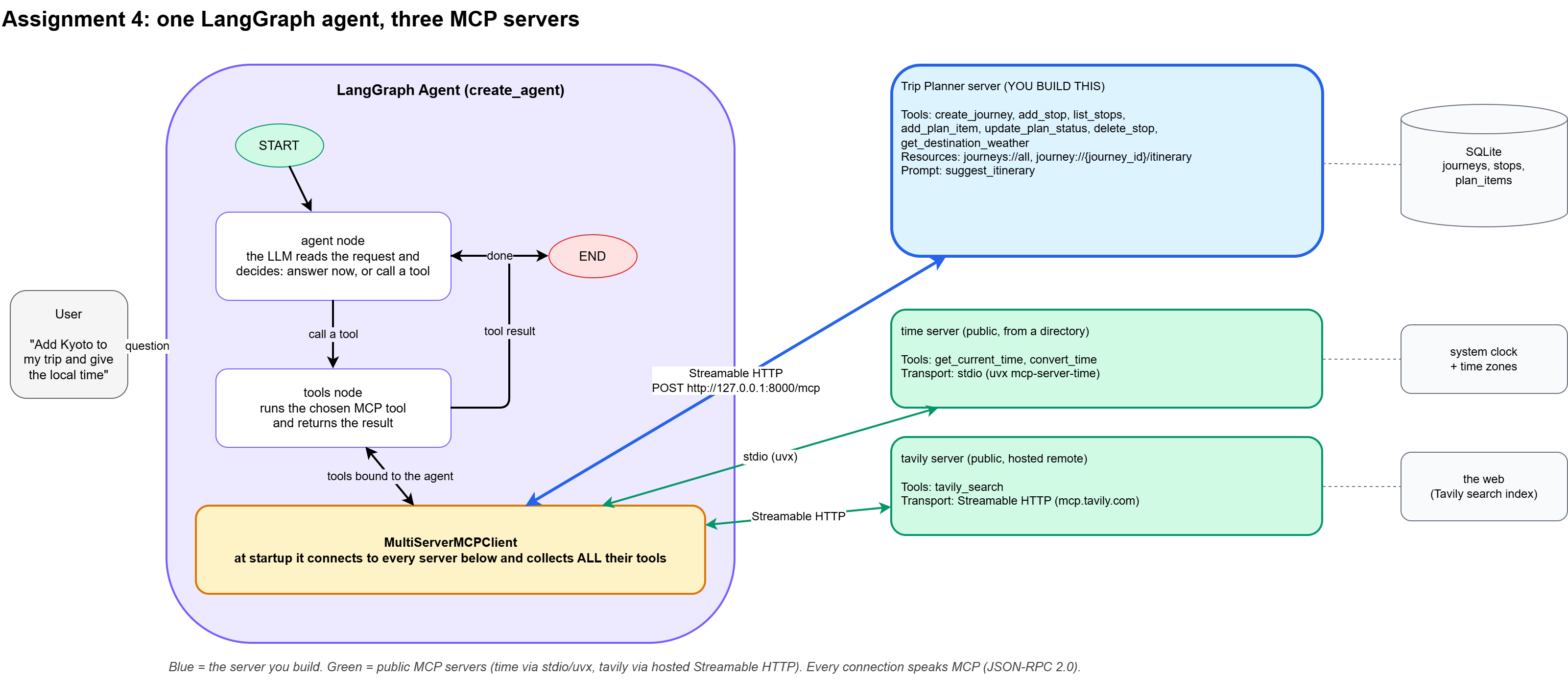
The user asks a question. The LangGraph agent thinks: if it needs a tool, it
calls one, gets the result, and thinks again — repeating until it has enough
to answer. MultiServerMCPClient connects to all three MCP servers when the
agent starts and hands every discovered tool to the agent. One server is
ours; two are public.
Data model, tools, resource, prompt
SQLite, three tables, one nesting level each:
| Table | Holds |
|---|---|
journeys |
A trip as a whole — title, home city, dates, budget |
stops |
A city leg within a journey — city, country, arrival date, nights, transport mode |
plan_items |
A sight/meal/activity within a stop — title, category, time window, priority, status |
Tools (backend/mcpserver/TripPlannerServer.py) — full CRUD plus a live weather lookup:
| Tool | CRUD |
|---|---|
create_journey |
Create |
add_stop |
Create |
add_plan_item |
Create |
list_stops |
Read |
update_plan_status |
Update |
delete_stop |
Delete (cascades to its plan items) |
get_destination_weather |
Calls the free Open-Meteo API (geocoding + current weather), no key needed |
Resources:
journeys://all— one-line summary of every journeyjourney://{journey_id}/itinerary— templated resource, a day-by-day itinerary for one journey (each stop with its plan items underneath)
Prompt:
suggest_itinerary(stop_id)— a reusable template that turns a stop's saved plan items into an hour-by-hour day plan
Public servers used, and why
time(uvx mcp-server-time, stdio) — official reference MCP server for timezone/local-time lookups. Trivial, zero-risk, no genuine remote alternative exists for this, so stdio is the right call here.tavily(Streamable HTTP,https://mcp.tavily.com/mcp) — a genuinely hosted remote MCP server (no local process at all) from Tavily, a reputable company in the LLM tooling space (the same search backend LangChain's own community tools use). It needs a free API key (tavily.com, no credit card). Picked over a plain page-fetchserver because it does real-time, ranked web search (attractions, travel advisories, local facts) rather than fetching one raw page — a much stronger fit for a trip planner. Deliberately avoided pulling a server from the public MCP registries (registry.modelcontextprotocol.io, Smithery, Glama) directly — those directories are unvetted, and searching them turned up entries with suspicious names during development. Tavily is a known, reputable company with a real product, not an anonymous registry listing.
Extras beyond the core CRUD flow
get_destination_weathercalls the free Open-Meteo API from inside a tool (geocoding + current weather, no key required).backend/integrations/fastapimcp_integration.pyserves REST (/health,/journeys) and MCP (/mcp) from one FastAPI ASGI app.add_stoplogs viactx.info(...), visible live in the MCP Inspector's notification panel.- A browser console (
backend/api/app.py+frontend/) — see below.
Console UI (bonus)
A small React console for driving the agent from a browser instead of the CLI: pick one of the 12 test questions (or type your own), watch each tool call and its result stream in live, tool by tool, as the agent runs.
backend/api/app.py wraps the same LangGraph agent from
backend/client/langgraphagent.py in a long-lived FastAPI process. It
connects to all three MCP servers once at startup, then streams each
question's step-by-step trace back to the browser as newline-delimited JSON.
Three processes, three terminals:
uv run backend/mcpserver/TripPlannerServer.py     # :8000 — the MCP server
uv run python -m backend.api.app                  # :8010 — streaming console API
cd frontend && npm install && npm run dev          # :5173 — the UI
Open the printed localhost URL. The left rail shows live server/tool
counts from /api/servers; the question list is the same 12-question set as
DocsAndDemo/question.md.
How to run it
Install dependencies (uses
uv):uv syncCopy
.env.exampleto.envand fill in:OPENAI_API_KEY=sk-... TAVILY_API_KEY=tvly-... # free key at https://tavily.comStart the server (terminal 1):
uv run backend/mcpserver/TripPlannerServer.pyLive at
http://127.0.0.1:8000/mcp(note the required/mcpsuffix).Optional — run the combined REST+MCP app instead:
uv run python -m backend.integrations.fastapimcp_integrationRun the agent (terminal 2):
uv run backend/client/langgraphagent.py "Add a 3-night stop in Kyoto to journey 1 and tell me the local time there"Optional — test the server directly in the MCP Inspector before running the agent:
npx @modelcontextprotocol/inspectorTransport: Streamable HTTP, URL:
http://127.0.0.1:8000/mcp.
Requires uv (Python/uvx) and Node.js (npx, for the Inspector) installed.
Example runs
Full tool-call traces are in screenshots/demo.txt. Summary:
- Write-only — "Create a new journey called 'Bali Getaway' from Mumbai, budget 1500, dates 2026-09-01 to 2026-09-10. Then add a 5-night stop in Bali, Indonesia to it." → Created journey #3 and stop #4 on our server.
- Write + public
time— "Add a 4-night stop in Reykjavik, Iceland to journey 3, and tell me the current local time there." → Added stop #5, and calledget_current_time(both tool calls fired in parallel in one turn) → 11:03, Saturday, Atlantic/Reykjavik (UTC+0). - Public
tavilyresearch — "What are the top attractions to see in Reykjavik right now, and are there any current travel advisories for Iceland?" → Real-time web search returned 8 ranked attractions and 3 current government travel advisories, with live sources.
Why an MCP server instead of plain Python functions in the agent?
Putting tools in an MCP server decouples what a tool can do from which
agent uses it. The same trip_planner server can be called by this
LangGraph agent, tested by hand in the MCP Inspector, or plugged into a
completely different agent or client later, all without touching the tool
code — because the server exposes a stable, self-describing contract
(schemas generated straight from function signatures and docstrings) over a
standard protocol, instead of being tangled into one agent's Python process.
It also means the server can run, scale, and fail independently of the
agent: if the trip-planner logic needs a different host, a different
language, or its own deployment schedule, that's an infrastructure change,
not a rewrite. Writing the same logic as inline Python functions works fine
for a single throwaway script, but it locks the tool to that one agent and
gives up all of that reuse, isolation, and discoverability for no benefit.
Video walkthrough
DocsAndDemo/12.07.2026_22.51.20_REC.mp4 — demo, architecture walkthrough, MCP connection config, and live tool calls across the local and public servers.
from github.com/Shivanilarokar/TripplannerAgent-langgraph-mcp-
Installing Trip Planner Server
This server has no published package — it is built from source. Open the repository and follow its README.
▸ github.com/Shivanilarokar/TripplannerAgent-langgraph-mcp-FAQ
Is Trip Planner Server MCP free?
Yes, Trip Planner Server MCP is free — one-click install via Unyly at no cost.
Does Trip Planner Server need an API key?
No, Trip Planner Server runs without API keys or environment variables.
Is Trip Planner Server hosted or self-hosted?
Self-hosted: the server runs locally on your machine via the install command above.
How do I install Trip Planner Server in Claude Desktop, Claude Code or Cursor?
Open Trip Planner Server on unyly.org, pick your client tab (Claude Desktop, Claude Code, Cursor) and press Install — the config is generated automatically, no JSON editing.
Related MCPs
GitHub
PRs, issues, code search, CI status
 by GitHub
Filesystem
Secure file operations with configurable access controls.
Memory
Knowledge graph-based persistent memory system.
Template MCP Server
A CLI tool to create a new Model Context Protocol server project with TypeScript support, dual transport options, and an extensible structure
 by mcpdotdirect
Compare Trip Planner Server with
Not sure what to pick?
Find your stack in 60 seconds
Author?
Embed badge for your README
Browse similar
All development MCPs