
YuniKorn Scheduler
FreeNot checkedMCP server for observing and interacting with the Apache YuniKorn Kubernetes batch workload scheduler.

About
MCP server for observing and interacting with the Apache YuniKorn Kubernetes batch workload scheduler.
README
A Model Context Protocol (MCP) server that interfaces with the Apache YuniKorn Scheduler, allowing AI agents to observe and reason about Kubernetes batch workload resource management, queue hierarchies, and application states.
Screenshots
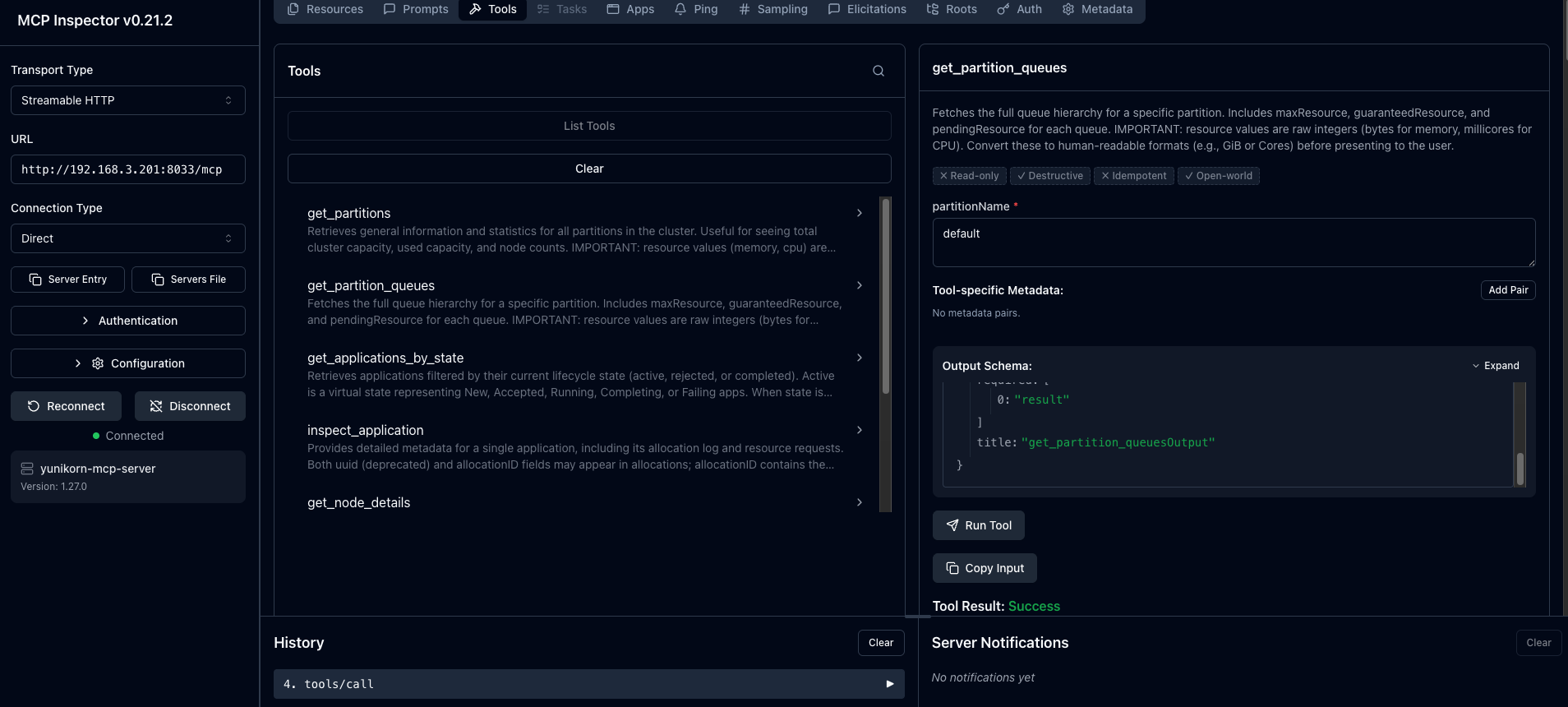
Inspecting Yunikorn tools using MCP inspector
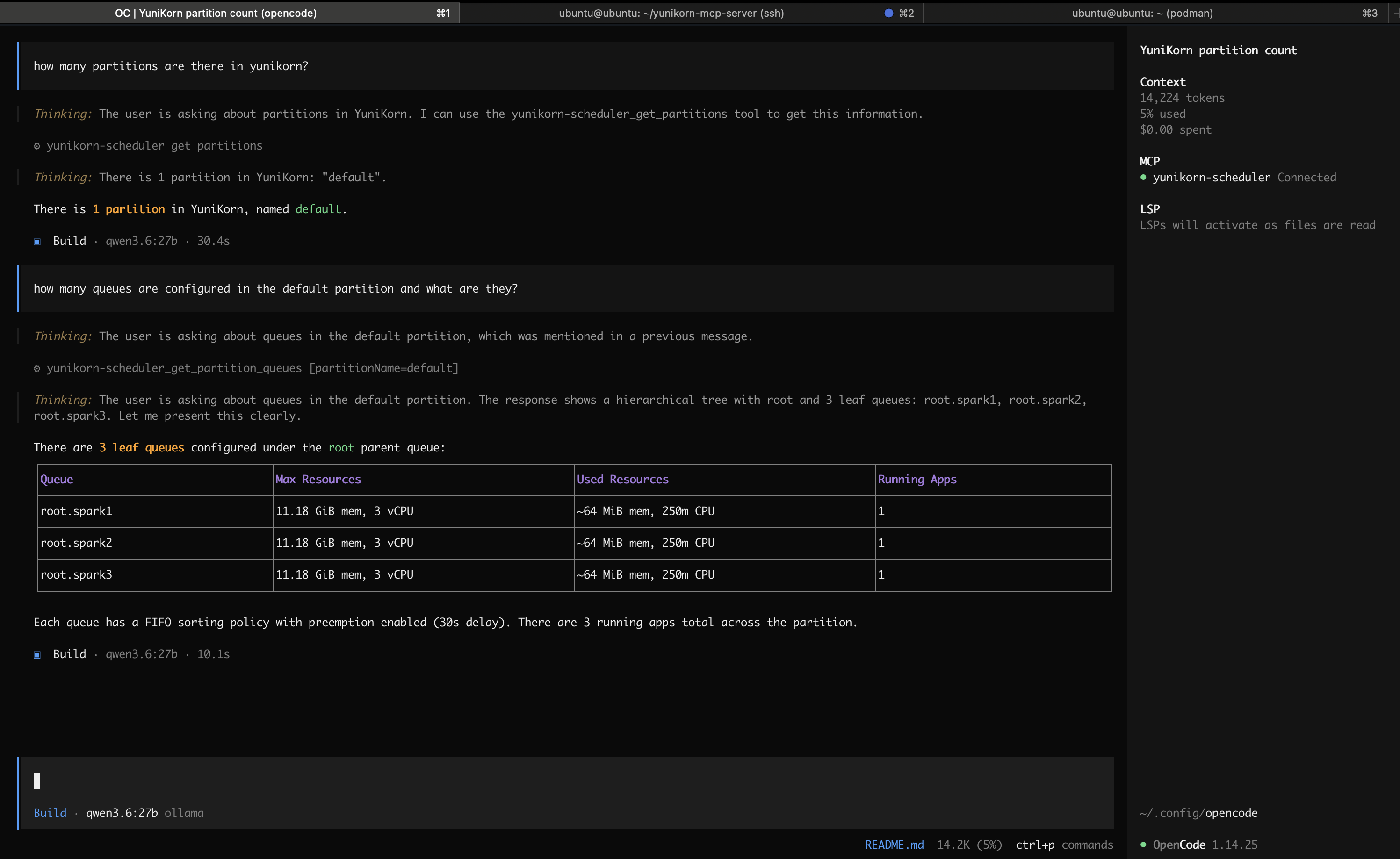
Querying the Yunikorn scheduler via MCP using Opencode
Features
- 7 MCP Tools: Query partitions, queues, applications, nodes, user usage, and scheduler health
- 2 MCP Resources: Static data access for partitions list and node utilization
- Async HTTP: Non-blocking API calls using
httpx - Proper Error Mapping: YuniKorn HTTP errors mapped to standard MCP error responses
- Resource Awareness: Handles YuniKorn's raw bytes and millicore values
- CORS Enabled: Allows connections from any origin for browser-based MCP Inspector
- Streamable HTTP: Default transport with stdio fallback for IDE integration
Installation
uv pip install -r requirements.txt
If you are using a virtual environment, make sure it is activated first:
source .venv/bin/activate
uv pip install -r requirements.txt
Usage
Running the Server
The default transport is Streamable HTTP on port 8000:
Run locally
uv run python -m main
Run with Docker
docker run -p 8000:8000 -e YUNIKORN_BASE_URL="http://<REPLACE_ME>/ws/v1" docker.io/frenoid/yunikorn-mcp-server:latest
Command line options
| Option | Description | Default |
|---|---|---|
--transport |
Transport protocol (stdio, streamable-http) |
streamable-http |
--host |
Host to bind (HTTP transport only) | 0.0.0.0 |
--port |
Port to listen on (HTTP transport only) | 8000 |
--log-level |
Logging level | INFO |
Examples:
# Streamable HTTP on custom port
uv run python -m main --transport streamable-http --host 127.0.0.1 --port 8080

# Stdio mode for Claude Code / IDE integration
uv run python -m main --transport stdio
Environment Variables
| Variable | Description | Default |
|---|---|---|
YUNIKORN_BASE_URL |
Base URL of the YuniKorn REST API | http://localhost:9089/ws/v1/ |
TLS_INSECURE |
Disable HTTPS certificate verification (true/false) |
false |
# Connect to a remote YuniKorn instance
YUNIKORN_BASE_URL=http://yunikorn.example.com:9089/ws/v1/ uv run python -m main

# Connect to an HTTPS endpoint with a self-signed certificate
YUNIKORN_BASE_URL=https://yunikorn.example.com:9089/ws/v1/ TLS_INSECURE=true uv run python -m main
Connecting with MCP Inspector
The Streamable HTTP endpoint is exposed at the /mcp path:
http://localhost:8000/mcp
Testing
Run the test suite against a live YuniKorn instance:
YUNIKORN_BASE_URL=http://your-yunikorn-host:9089/ws/v1/ uv run python test_server.py
To run a quick compliance check:
YUNIKORN_BASE_URL=http://your-yunikorn-host:9089/ws/v1/ uv run python test_updated_server.py
Data Format Notes
- Memory: Represented in raw bytes (64-bit signed integers).
- CPU (vcore): Represented in millicores (thousandths of a core, i.e. 1000m = 1 core).
- Other resources: No specific unit assigned.
- Active applications: The virtual "active" state represents New, Accepted, Running, Completing, and Failing statuses.
- allocationID vs uuid:
uuidis deprecated.allocationIDcontains the same base value asuuidwith a hyphen-counter suffix (e.g.,-0,-1). - allocationDelay: The difference between
allocationTimeandrequestTimefor an allocation.
API Conformance
This MCP server conforms to the Apache YuniKorn Scheduler REST API (v1.8.0). Each tool maps directly to a documented endpoint.
| Tool | YuniKorn Endpoint |
|---|---|
get_partitions |
GET /ws/v1/partitions |
get_partition_queues |
GET /ws/v1/partition/{partitionName}/queues |
get_applications_by_state |
GET /ws/v1/partition/{partitionName}/applications/{state}?status={status} |
inspect_application |
GET /ws/v1/partition/{partitionName}/application/{appId} |
get_node_details |
GET /ws/v1/partition/{partitionName}/nodes or /node/{nodeId} |
get_user_usage |
GET /ws/v1/partition/{partitionName}/usage/users or /usage/user/{userName} |
check_scheduler_health |
GET /ws/v1/scheduler/healthcheck |
Resources:
| Resource | YuniKorn Endpoint |
|---|---|
yunikorn://partitions/list |
GET /ws/v1/partitions |
yunikorn://nodes/utilization |
GET /ws/v1/scheduler/node-utilizations |
Error Mapping
| YuniKorn HTTP Code | MCP Error |
|---|---|
400 Bad Request |
INVALID_REQUEST |
404 Not Found |
INVALID_REQUEST |
500 Internal Server Error |
INTERNAL_ERROR |
Installing YuniKorn Scheduler
This server has no published package — it is built from source. Open the repository and follow its README.
▸ github.com/frenoid/yunikorn-mcp-serverFAQ
Is YuniKorn Scheduler MCP free?
Yes, YuniKorn Scheduler MCP is free — one-click install via Unyly at no cost.
Does YuniKorn Scheduler need an API key?
No, YuniKorn Scheduler runs without API keys or environment variables.
Is YuniKorn Scheduler hosted or self-hosted?
Self-hosted: the server runs locally on your machine via the install command above.
How do I install YuniKorn Scheduler in Claude Desktop, Claude Code or Cursor?
Open YuniKorn Scheduler on unyly.org, pick your client tab (Claude Desktop, Claude Code, Cursor) and press Install — the config is generated automatically, no JSON editing.
Related MCPs
GitHub
PRs, issues, code search, CI status
 by GitHub
Filesystem
Secure file operations with configurable access controls.
Memory
Knowledge graph-based persistent memory system.
Template MCP Server
A CLI tool to create a new Model Context Protocol server project with TypeScript support, dual transport options, and an extensible structure
 by mcpdotdirect
Compare YuniKorn Scheduler with
Not sure what to pick?
Find your stack in 60 seconds
Author?
Embed badge for your README
Browse similar
All development MCPs