
Skill Underworld Writer
БесплатноПоддерживаетсяDual-methodology skill for fictional underworld narratives and factually sourced true crime writing with systematic character development and editorial verifica

Описание
Dual-methodology skill for fictional underworld narratives and factually sourced true crime writing with systematic character development and editorial verification
README
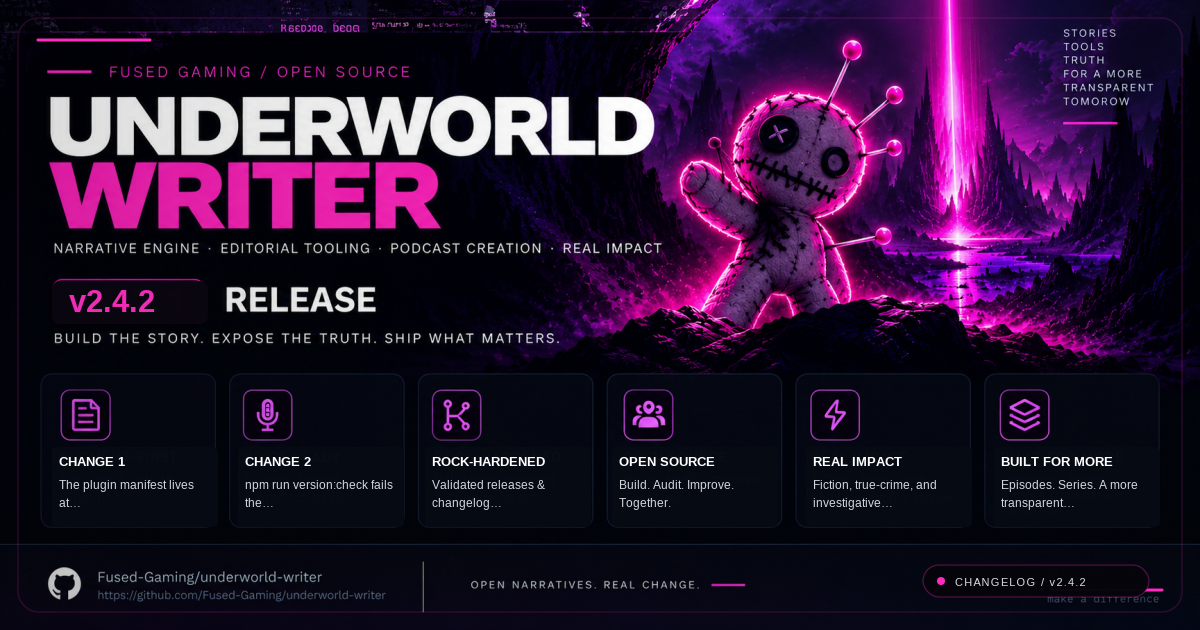
Release artwork: Rock-Hardened supplies changelog/release evidence; Underworld Writer owns the visual design contract in
assets/branding/release-brand.json. The immutable visual template isassets/branding/underworld-writer-release-changelog-template.svg, imported byte-for-byte from ArtPatch.npm run release:artregenerates only the declared changelog-driven text zones;npm run release:art:checkverifies the committed artwork is current.
Current version: 2.4.2
Multi-purpose character development, fact-sourced true-crime editorial tooling, and segment-first podcast/article production — with a full episode post-production pipeline.
Version License: Non-Commercial Node.js TypeScript
What Underworld Writer does
Underworld Writer supports three primary workflows:
- Creative fiction — three-phase character and narrative-world development.
- True-crime / investigative editorial work — evidence-aware narrative construction with source attribution and PACER-informed verification workflows.
- Podcast + article production — deterministic, segment-first editorial packages that can produce long-form scripts, articles, producer materials, and downstream audio inputs from a shared evidence package.
v2.4.1 highlights
- Plugin directory listing fields —
.claude-plugin/plugin.jsonnow declaresicon,documentationUrl,supportUrl,privacyPolicyUrl, andtermsOfServiceUrlfor Anthropic's plugin directory. - Smaller npm package —
package.jsondeclares afilesallowlist. The published tarball drops from 551 entries to 80; production episode material, voice reference clips, Modal scripts, and tests no longer ship. - Tarball guard before publish —
scripts/publish-npm.mjsrunsnpm pack --dry-runand aborts if output, projects, modal, tests, docs, or other non-runtime paths would be included. - Editorial-package converter —
scripts/build-script-output.mjsturns editorial-package output into the ScriptOutput shape thatmodal/app.pyconsumes, so Episode 1 audio renders from the current segment-first script. - Fixes — removed an
app.stop()call that the pinned Modal SDK does not provide; fixed a segment cleanup bug in the editorial converter; the Stable Audio Open SFX path now takes anHF_TOKENthrough a Modal secret (the model is gated), instead of retrying a 401 in a loop; the SessionStart hook in the plugin manifest declarescommandas a string. - Release evidence —
@h4shed/rock-hardenedis pinned to1.1.0, andnpm run rock:evidencereports provenance as verified. See docs/ops/ROCK_HARDENED.md.
v2.4.0 highlights
- Deterministic post-production mixer (
modal/audio/postproduction.py) — semantic cue markers so timing survives TTS duration changes, narration ducking, fades, music beds, stingers, and intro/outro cues; WAV master + 192 kbps MP3 delivery. - Fail-closed music/SFX rights-clearance registry — a release render refuses to run until every referenced asset is
approvedwith a recorded license/provenance record. Nothing fake ships as a placeholder. - Self-generated music/SFX pipeline (
modal/generate_production_audio.py) — a $0, open-weight alternative to licensing stock audio: ACE-Step 1.5 (Apache-2.0) for music, Stable Audio Open 1.0 (free under $1M annual revenue) for short SFX. Reproducible via committed prompt/seed manifests; a human still has to listen and approve before anything ships. See docs/ops/MODAL_PRODUCTION_AUDIO.md. - Verified voice-reference intake for Chatterbox narration, with checksum-enforced sync into Modal storage. See docs/guides/VOICE_INTAKE.md.
npxfix —dist/cli.jsnow ships with its executable bit set (npm run buildchmods it automatically), fixingnpx @h4shed/skill-underworld-writerand the linkedunderworld-writerbin.- Claude Code plugin secrets onboarding — Modal/npm tokens are entered through the plugin's
userConfigprompts (Claude's secure per-user storage), not committed placeholders; aSessionStarthook writes Modal credentials into~/.modal.tomlautomatically. See Claude Code plugin below. - Documentation reorganization: fixed broken links left by earlier moves, consolidated navigation, archived superseded plans.
v2.3.x highlights
The 2.3.x line hardens audio production, editorial quality, licensing, and the release/publish pipeline on top of the 2.2.x workspace contract.
- Two-pass loudness-normalized mastering — episode audio mastering now uses ffmpeg EBU R128
loudnormtrue-peak limiting (targets read frommodal/config/render_profiles/podcast-standard.json) instead of a sample-peak clip limiter. - Configurable editorial language linter (
src/editorial-lint.ts) — banned/discouraged/preferred-term checking, repeated-opening/transition/n-gram detection, driven bytemplates/editorial/style-dictionary.jsonand wired intonpm run editorial:lint. - Chunk-level synthesis cache (
modal/cache/chunk_cache.py) — resumable episode rendering after a partial failure, keyed on chunk text + voice profile + reference-audio hash + backend revision. - Local, scoped-token npm publish CLI (
npm run publish:npm) — git/npm-auth safety checks, full release-evidence pipeline, then publish and tag; authenticates via a scopedUW_NPM_TOKEN(falling back tonpm login). See docs/ops/PUBLISHING.md. - Relicensed from Apache-2.0 to a custom non-commercial license (Unlicense base + Fused Gaming Non-Commercial Rights Amendment) — see License.
PRIVACY.mdadded at the repository root and in.claude-plugin/, documenting the no-telemetry, mock-by-default PACER, and opt-in Modal audio posture.- Root-directory cleanup — operational docs moved into docs/ops/ and historical reports into docs/archive/; see Documentation structure below.
v2.2.x highlights
The 2.2.x line moves Underworld Writer from a collection of generation utilities into a structured editorial workspace that can be used consistently by humans and agents such as Claude, ChatGPT, Codex, Cursor, Copilot, and MCP-based automation.
Canonical output workspace
Generated and producer-facing artifacts now have one canonical root:
output/
├── SERIES_REGISTRY.json
├── examples/
└── <series-slug>/
    ├── SERIES_CONFIG.json
    ├── production/
    └── season-<n>/
        ├── SEASON_CONFIG.json
        └── episode-<n>/
            ├── EPISODE_CONFIG.json
            ├── planning/
            ├── scripts/
            ├── producer-briefs/
            ├── published-assets/
            ├── verification/
            └── provenance/
Repository boundaries are explicit:
projects/   source material, research, evidence, and editorial package specifications
output/     generated editorial and production artifacts
src/        runtime and library implementation
scripts/    generators, validation, release tooling, and workspace automation
Legacy/demo output belongs under output/examples/ instead of competing root-level output directories.
Cross-agent workspace contract
The repository carries both human-readable and machine-readable rules so future agents do not invent new directory conventions.
AGENTS.md— authoritative repository contractCLAUDE.md— Claude entry point referencing the shared contract.github/copilot-instructions.md— Copilot entry pointoutput/SERIES_REGISTRY.json— registered podcast seriesschemas/podcast/— registry, series, season, and episode schemasscripts/validate-output-structure.mjs— workspace validatorvalidation-tests/workspace-contract.test.mjs— fixture-based positive/negative validation
Run preflight before agent-driven editorial work:
npm run agent:preflight
Series / season / episode scaffolding
Agents should scaffold canonical workspaces instead of manually creating directories.
npm run podcast:new-series -- my-series "My Series"
npm run podcast:new-season -- my-series 1
npm run podcast:new-episode -- my-series 1 1
npm run validate:workspace
Generated manifests carry generator/version metadata so workspaces can be traced back to the contract that produced them.
Segment-first editorial packages
Long-form podcast and article output is now built from composable editorial blocks instead of treating one giant Markdown file as the source of truth.
projects/<series>/episode-packages/season-<n>/episode-<n>.json
                         │
                         ▼
               editorial package engine
                    /           \
                   /             \
        podcast segments       article segments
              │                      │
              ▼                      ▼
      scripts/segments/      published-assets/articles/
              │                      │
              └──── assembled derivative views ────┘
The episode package is authoritative. Assembled scripts/articles are derived producer-facing views.
Generate an editorial package:
npm run editorial:generate -- --series insight-corruption --season 1 --episode 1
Validate without writing output:
npm run editorial:check -- --series insight-corruption --season 1 --episode 1
Reusable blocks
templates/editorial/shared-segments.json provides reusable blocks for recurring production material such as:
- series intros
- evidence/source disclosures
- transitions
- sponsor / house-ad slots
- outros
- calls to action
- article deks and source notes
Case-specific evidence remains in the episode package while repeatable editorial structure can be shared across episodes and seasons.
Insight Corruption reference implementation
Insight Corruption is the first full series using the v2.2.x workspace and editorial-package model.
Canonical locations:
projects/insight-corruption/                         # source/research/configuration
projects/insight-corruption/episode-packages/        # editorial source packages
projects/insight-corruption/production/voice/        # reusable audio-generation specification
output/insight-corruption/                           # generated series output
output/insight-corruption/season-1/episode-1/        # generated Episode 1 package
Episode 1 validation baseline
The Episode 1 reference package currently validates at:
- 13 podcast segments
- 4,092 scripted words
- 29.52 estimated minutes at 145 WPM, including the fixed 90-second mid-roll
- Runtime validation: PASS against a 30 ± 1 minute target
- 1,864-word LinkedIn article
- Article validation: PASS against the configured 1,800–2,300 word target
The podcast and LinkedIn article reuse the same vetted evidence/claim package rather than independently rewriting the case facts.
Authorized voice-production architecture
The reusable synthetic-voice production specification lives at:
projects/insight-corruption/production/voice/VOICE_PODCAST_GENERATION.md
It documents the intended Modal-based production architecture, authorized reference-voice handling, segment-level synthesis/retries, ASR critical-token verification, mastering, provenance, benchmarking, and cost controls.
The specification is project-level infrastructure and is not tied to a single episode.
Quick start
Install
npm install @h4shed/skill-underworld-writer
Run without installing (npx)
npx @h4shed/skill-underworld-writer create --name "Hades" --role "Lord" --faction "Olympian"
Development
npm install
npm run build
npm test
Character workflows
underworld-writer create --name "Hades" --role "Lord" --faction "Olympian"
underworld-writer export --file character.json --output character.md
underworld-writer validate-script --character character.json
The original character-development, true-crime adaptation, PACER verification, MCP tooling, Markdown export, and relationship-validation APIs remain supported alongside the newer editorial workspace.
Claude Code plugin
Underworld Writer is published to the Fused Gaming Claude Code marketplace (.claude-plugin/marketplace.json).
Install
/plugin marketplace add Fused-Gaming/underworld-writer
/plugin install underworld-writer@fused-gaming
Claude Code auto-discovers the root SKILL.md as the plugin's skill; character creation, true-crime verification, and podcast-production workflows all work immediately with no configuration.
Optional: audio production secrets
Character/narrative/editorial features need no configuration. If you also want episode audio synthesis, mastering, or the self-generated music/SFX pipeline (all Modal-based), enabling the plugin prompts for three optional, individually-optional values, defined in .claude-plugin/plugin.json's userConfig:
| Value | Needed for | Where to get it |
|---|---|---|
modal_token_id / modal_token_secret |
Audio synthesis, mastering, self-generated music/SFX | modal.com/settings/tokens |
uw_npm_token |
Cutting an npm release (maintainers only) | A scoped npm automation token — see docs/ops/PUBLISHING.md |
These are entered through Claude Code's own secure per-user configuration prompt — never committed to this repo, never written into a shared settings file. A SessionStart hook (scripts/plugin-onboard-secrets.sh) writes the Modal credentials into ~/.modal.toml (the real file Modal's own CLI/SDK reads) automatically once entered, via modal token set. See docs/ops/MODAL_SETUP.md for the equivalent manual flow if you're not using the plugin.
Validation and benchmarks
Workspace validation:
npm run validate:workspace
npm run test:workspace
Episode 1 editorial fixture:
npm run test:episode1
Benchmarks:
npm run benchmark:workspace
The v2.2.0 baseline recorded on Node 22 measured approximately:
| Workspace operation | Baseline |
|---|---|
| Registry lookup | 0.000238 ms/op |
| Canonical path construction | 0.001439 ms/op |
| Config validation | 0.000249 ms/op |
These microbenchmarks are regression indicators, not cross-machine performance guarantees.
Release validation with Rock-Hardened
Underworld Writer uses @h4shed/rock-hardened for changelog validation and deterministic release evidence.
npm run version:check
npm run rock:validate
npm run rock:evidence     # manifest, SBOM, release cards, attestation
npm run rock:manifest
npm run release:art
npm run release:art:check
npm run validate:release
npm run release:evidence
npm run publish:npm       # local, scoped-token CLI publish (see docs/ops/PUBLISHING.md)
validate:release combines:
- release-version checks
- canonical workspace validation
- Rock-Hardened changelog validation
- workspace contract fixtures
- Episode 1 runtime/article validation
- TypeScript build
- Jest tests
- workspace benchmarks
Release artwork uses repository-owned branding: Rock-Hardened provides release/changelog data, while assets/branding/release-brand.json and the approved ArtPatch SVG control the Underworld Writer composition. Agents must not redraw the approved release design from primitive SVG shapes.
Versioning
The package follows Semantic Versioning.
- 2.2.0 — canonical workspace, cross-agent contract, scaffolding/validation, segment-first podcast/article packages, Rock-Hardened release evidence, and the Episode 1 long-form reference package.
- 2.2.1 — patch release branch for release-branding/version-alignment follow-up work and refreshed root documentation.
- 2.3.0 — two-pass loudness-normalized mastering, configurable editorial linter, chunk-level synthesis cache, local npm publish pipeline, relicense to a custom non-commercial license,
PRIVACY.md, and root-directory doc cleanup. - 2.3.1 — scoped
UW_NPM_TOKENpublish-auth support for the CLI publish pipeline. - 2.3.2 — root README refresh: current version tags, v2.3.x feature highlights, fixed doc links, documentation-structure overview.
- 2.4.1 — plugin directory listing fields,
filesallowlist and tarball guard for npm publish, editorial-package converter for Episode 1 audio, Modal and plugin-manifest fixes, rock-hardened 1.1.0 with verified provenance. - 2.4.0 — deterministic post-production mixer, fail-closed asset-clearance registry, self-generated music/SFX pipeline, verified voice-reference intake,
npxexecutable fix, Claude Code plugin secrets onboarding, documentation link cleanup.
Primary release metadata is tracked through package.json, .claude-plugin/plugin.json, VERSION.json, source exports, and the changelog. Use the version tooling rather than manually changing only one surface:
npm run version:check
npm run version:sync
Repository map
AGENTS.md                       agent contract
CHANGELOG.md                    release history / release-art source
VERSION.json                    release ledger and benchmark evidence
assets/branding/                release-brand contract/assets
docs/                           deeper documentation
output/                         canonical generated content
projects/                       source research and editorial packages
schemas/podcast/                workspace schemas
scripts/                        generation/validation/release tooling
src/                            TypeScript package implementation
templates/editorial/            reusable editorial blocks
validation-tests/               workspace contract tests
MCP / agent integration
Underworld Writer remains MCP-compatible and can be registered with agent ecosystems for character development, validation, export, and editorial workflows.
import { Orchestrator } from '@h4shed/mcp-core';
import { registerUnderWorldWriterTools } from '@h4shed/skill-underworld-writer/mcp';

const orchestrator = new Orchestrator();
await registerUnderWorldWriterTools(orchestrator);
For any agent operating directly in this repository, read AGENTS.md first.
Documentation structure
Root-level docs are load-bearing (SKILL.md and README.md are referenced by test/core.test.ts and the Dockerfile validator stage) or govern cross-agent behavior; everything else lives under docs/:
README.md, LICENSE.md, CHANGELOG.md, CONTRIBUTING.md,   root: load-bearing / entry-point docs
CLAUDE.md, AGENTS.md, SKILL.md, PRIVACY.md

docs/
├── INDEX.md                     documentation index and navigation
├── USE_CASES_OVERVIEW.md        Fiction / True Crime / Podcast Production overview
├── PODCAST_PROJECT_ARCHITECTURE.md
├── AUDIO_GENERATION_PLAN.md
├── EPISODE_PUBLISHING_SCHEMA.md
├── LENGTH_SPECIFICATIONS.md / TEMPLATES_LENGTH.md
├── MODAL_MCP_INTEGRATION.md
├── performance-guide.md
├── guides/
│   └── GETTING_STARTED.md       installation and quick start
├── ops/                         operational/setup runbooks
│   ├── PUBLISHING.md            npm publish CLI (UW_NPM_TOKEN, dry-run, tagging)
│   ├── DOCKER.md
│   └── MODAL_SETUP.md
├── use-cases/                   per-use-case docs (fiction, true-crime, podcast-production)
└── archive/                     historical reports, superseded plans, past release notes
- Getting Started
- Documentation Index
- Use Cases Overview
- Publishing (CLI, UW_NPM_TOKEN)
- Docker · Modal Setup
- Contributing
- Agent Contract
- Privacy
- Changelog
- Output Contract
- Insight Corruption Setup (archived)
License
Free for non-commercial use under the Fused Gaming Non-Commercial Unlicense Amendment. Commercial use requires a separate license from Fused Gaming LLC — contact [email protected]. See LICENSE.md.
Support
Built by Fused Gaming.
Установить Skill Underworld Writer в Claude Desktop, Claude Code, Cursor
unyly install skill-underworld-writerСтавит в Claude Desktop, Claude Code, Cursor и VS Code — сам разбирается с npx, uvx и сборкой из исходников.
Впервые? Поставь CLI: curl -fsSL https://unyly.org/install | sh
Или настроить вручную
Выполни в терминале:
claude mcp add skill-underworld-writer -- npx -y @h4shed/skill-underworld-writerПошаговые гайды: как установить Skill Underworld Writer
FAQ
Skill Underworld Writer MCP бесплатный?
Да, Skill Underworld Writer MCP бесплатный — установка в пару кликов через Unyly без оплаты.
Нужен ли API-ключ для Skill Underworld Writer?
Нет, Skill Underworld Writer работает без API-ключей и переменных окружения.
Skill Underworld Writer — hosted или self-hosted?
Self-hosted: сервер запускается локально на твоей машине командой из раздела установки.
Как установить Skill Underworld Writer в Claude Desktop, Claude Code или Cursor?
Открой Skill Underworld Writer на unyly.org, выбери вкладку своего клиента (Claude Desktop, Claude Code, Cursor) и нажми Install — конфиг сгенерируется автоматически, без правки JSON.
Изменения
Версии и запрашиваемые доступы со временем.
- Новая версия опубликована
- Новая версия опубликована
- Новая версия опубликована
- Новая версия опубликована
- Новая версия опубликована
- Новая версия опубликована
- Новая версия опубликована
- Новая версия опубликована
Похожие MCP
GitHub
PRs, issues, code search, CI status
 автор: GitHub
Filesystem
Secure file operations with configurable access controls.
Memory
Knowledge graph-based persistent memory system.

Unyly Deploy
Deploy sites and MCP servers to Unyly straight from your AI agent
 автор: Unyly
Template MCP Server
A CLI tool to create a new Model Context Protocol server project with TypeScript support, dual transport options, and an extensible structure
 автор: mcpdotdirect
Server Sequential Thinking
MCP server for sequential thinking and problem solving
 автор: GitHub Actions
Amap Maps Mcp Server
MCP server for using the AMap Maps API
 автор: duxiaohui
PayMCP
Lightweight payments layer for MCP servers: turn tools into paid endpoints with a two-line decorator. [PyPI](https://pypi.org/project/paymcp/) · [npm](https://w
 автор: blustAI
demo
demo — MCP server via Smithery
 автор: yoojoohans-jpg
Server For Power BI
Enables exploring Microsoft Fabric / Power BI workspaces and semantic models, and executing ad-hoc DAX queries.
 автор: Mitsubishi-Fuso
Compare Skill Underworld Writer with
Не уверен что выбрать?
Найди свой стек за 60 секунд
Автор?
Embed-бейдж для README
Похожее
Все в категории development