
Azure Impact Reporter
FreeNot checkedEnables AI to report Azure infrastructure issues by authenticating with Azure credentials and submitting standardized workload impact reports through the Azure

About
Enables AI to report Azure infrastructure issues by authenticating with Azure credentials and submitting standardized workload impact reports through the Azure Management API
README
Overview
The Azure Impact Reporting MCP (Model Context Protocol) server enables large language models (LLMs) to report impacts to Azure resources. This tool allows LLMs to automatically parse user requests, understand the required parameters, and submit reports to Azure when customers are facing issues with Azure infrastructure.
Functionality
The impact-reporter.py script provides a Model Context Protocol server that:
- Exposes a tool to report resource impacts to Azure
- Automatically authenticates with Azure using DefaultAzureCredential
- Creates workload impact reports via the Azure Management API
- Handles parameter extraction from natural language requests
- Can ask for additional details if the request is missing required information
Impact Categories
The tool supports the following impact categories:
Resource.Connectivity- For connectivity issues with Azure resourcesResource.Performance- For performance degradation issuesResource.Availability- For availability or downtime issuesResource.Unknown- When the specific issue type is not known
Requirements
- Python 3.8+
mcp[cli]- Model Context Protocol package with CLI supportazure-identity- For Azure authenticationhttpx- For making HTTP requests to Azure API
Setup Instructions
1. Clone the repository
git clone https://github.com/yourusername/MCP-Server-Azure-Impact-Reporting.git
cd MCP-Server-Azure-Impact-Reporting
2. Install dependencies
pip install -r requirements.txt
Or install them manually:
pip install mcp[cli] azure-identity httpx
3. Azure Authentication Setup
The tool uses DefaultAzureCredential for authentication. Ensure you're logged in to Azure with one of the following methods:
- Azure CLI (
az login) - Visual Studio Code Azure Account extension
- Azure PowerShell (
Connect-AzAccount) - Environment variables for service principal authentication
4. Configure your MCP client
Add the following configuration to your MCP client configuration file (e.g., claude_desktop_config.json):
"impactreporter": {
    "command": "uv",
    "args": [
        "--directory",
        "ABSOLUTE_PATH_TO_ROOT_FOLDER",
        "run",
        "impact-reporter.py"
    ]
}
Replace ABSOLUTE_PATH_TO_ROOT_FOLDER with the absolute path to where you cloned this repository.
For example:
"impactreporter": {
    "command": "uv",
    "args": [
        "--directory",
        "C:\\Users\\username\\source\\repos\\MCP-Server-Azure-Impact-Reporting",
        "run",
        "impact-reporter.py"
    ]
}
Understanding the uv Command
The uv command in the configuration uses pyproject.toml to manage dependencies:
- Virtual Environment:
uvcreates and manages its own internal virtual environment separate from any.venvyou may have created - Dependency Management: Dependencies are automatically installed based on
pyproject.tomlspecifications - Isolation: The
uvcache system ensures no interference with your local Python environment
Alternative: Direct Python Execution
If you prefer not to use uv, you can run the MCP server directly:
Create and activate a virtual environment:
python -m venv .venv
# On Windows
.venv\Scripts\activate
# On macOS/Linux
source .venv/bin/activate
Install dependencies:
pip install -r requirements.txtRun the server directly:
python impact-reporter.py
5. Running the MCP Server
If you're using Claude with Desktop or another MCP-enabled client, the server will start automatically when needed.
Usage Examples
Once configured, your LLM can report impacts with natural language requests like:
- "Report connectivity issues with my VM named 'web-server' in resource group 'production-rg'"
- "Let Azure know my SQL database 'customer-db' in 'data-rg' is experiencing performance issues"
- "Report that my App Service 'api-service' is down"
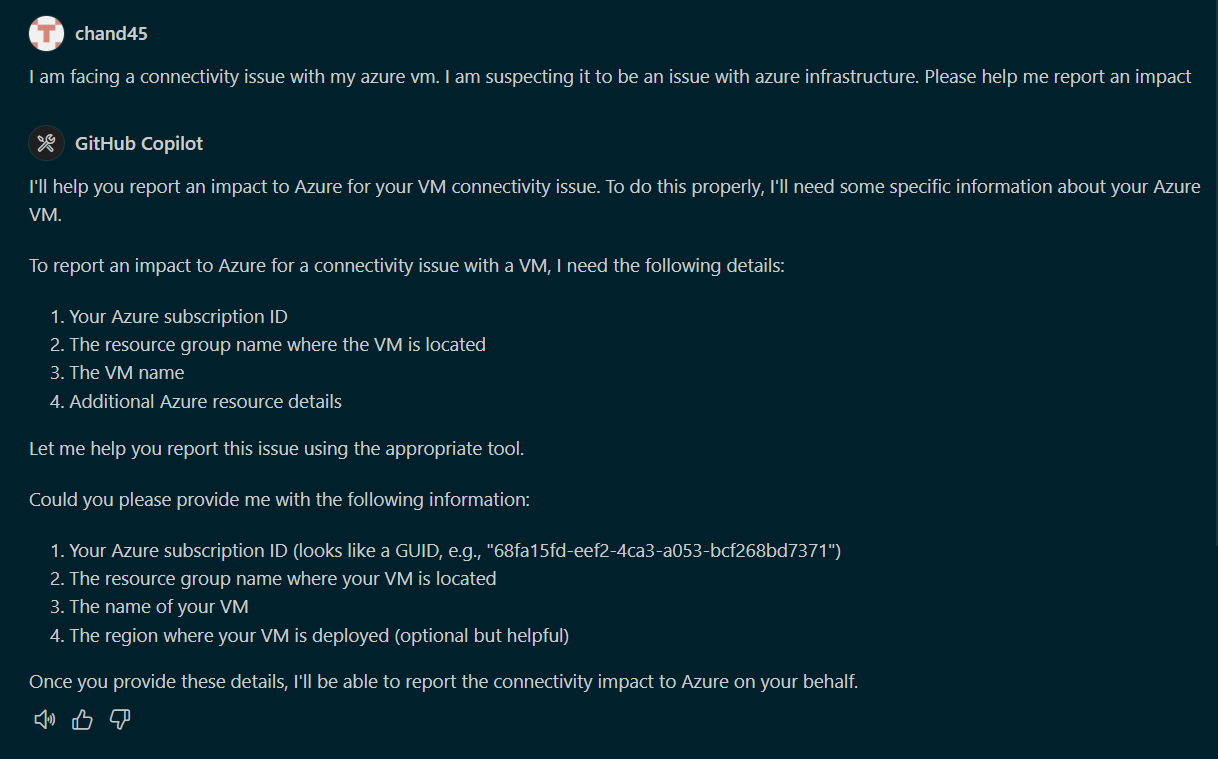
The MCP server will automatically parse these requests and ask for any missing parameters before submitting the report to Azure.
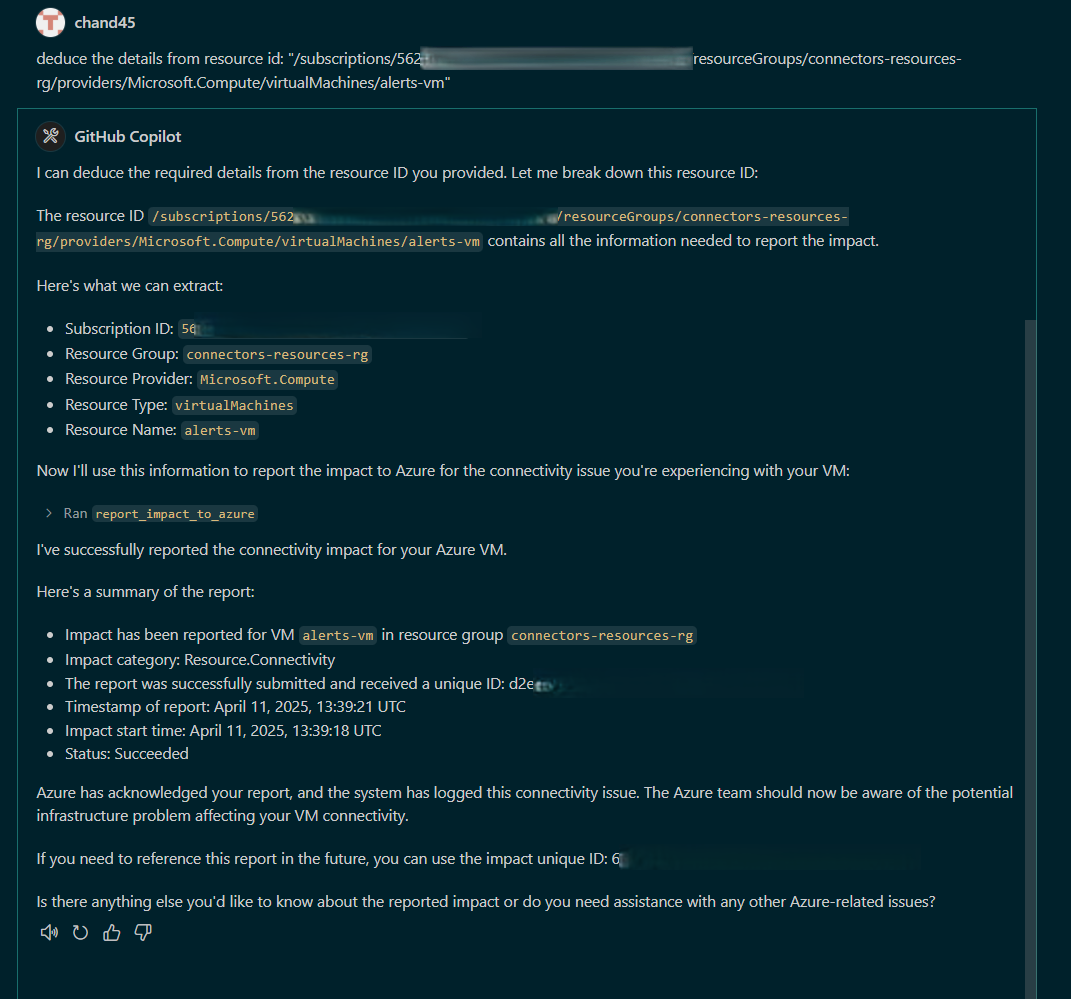
Example Converstations:
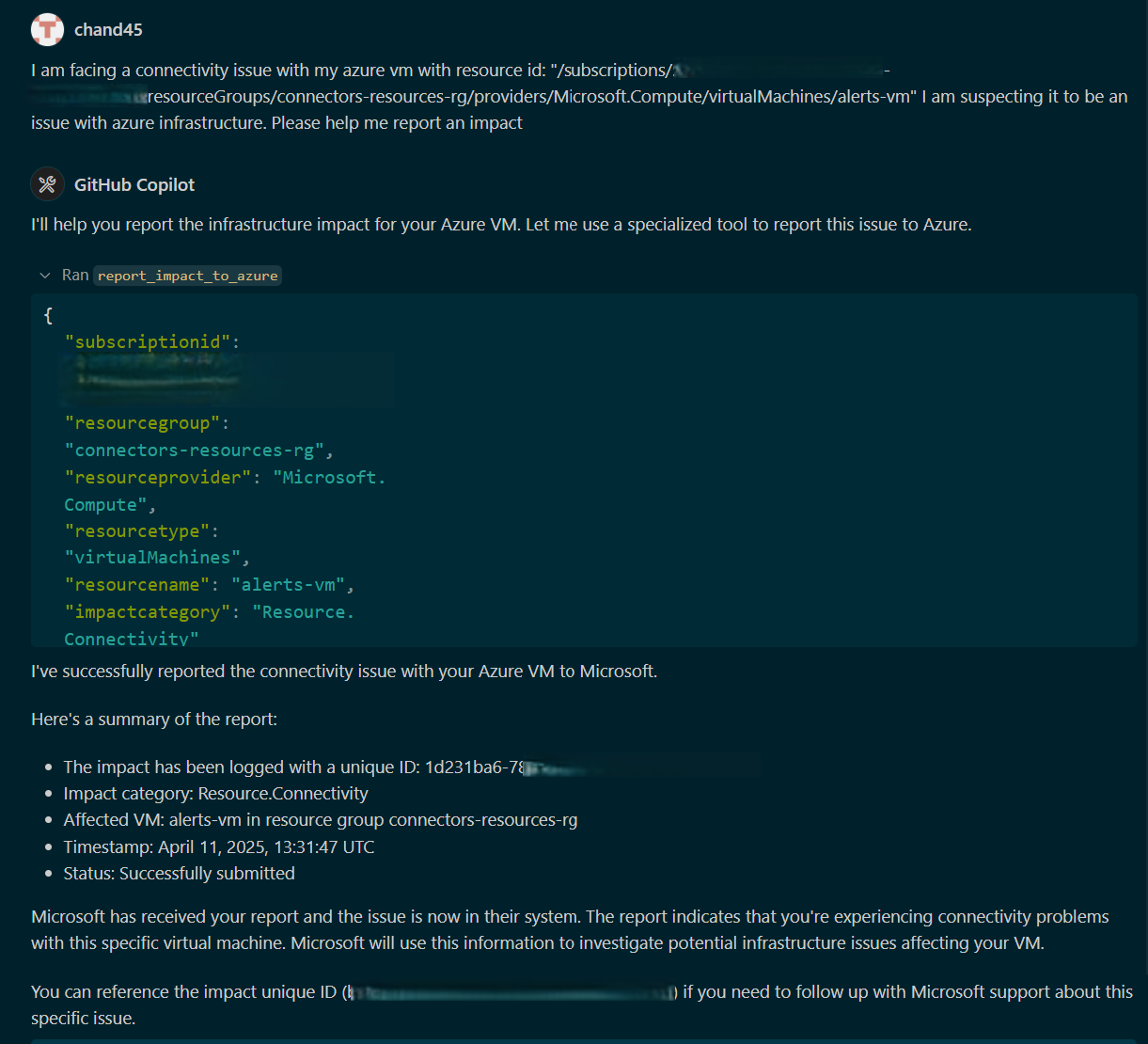
When additional information is required
Request for additional details
Infer the details and report impact
API Details
The impact reporting tool uses the Azure Management API (2023-12-01-preview) to create workload impact reports.
Troubleshooting
- Authentication issues: Ensure you're logged into Azure and have proper permissions
- Missing parameters: The tool will ask for additional details if needed
- API errors: Check Azure portal to ensure your subscription and resources exist
License
Installing Azure Impact Reporter
This server has no published package — it is built from source. Open the repository and follow its README.
▸ github.com/chand45/mcp-server-azure-impact-reportingFAQ
Is Azure Impact Reporter MCP free?
Yes, Azure Impact Reporter MCP is free — one-click install via Unyly at no cost.
Does Azure Impact Reporter need an API key?
No, Azure Impact Reporter runs without API keys or environment variables.
Is Azure Impact Reporter hosted or self-hosted?
Self-hosted: the server runs locally on your machine via the install command above.
How do I install Azure Impact Reporter in Claude Desktop, Claude Code or Cursor?
Open Azure Impact Reporter on unyly.org, pick your client tab (Claude Desktop, Claude Code, Cursor) and press Install — the config is generated automatically, no JSON editing.
Related MCPs
Fetch
Web content fetching and conversion for efficient LLM usage.
AWS KB Retrieval
Retrieval from AWS Knowledge Base using Bedrock Agent Runtime.
 by modelcontextprotocol
Spring AI MCP Server
Provides auto-configuration for setting up an MCP server in Spring Boot applications.
llm-analysis-assistant
A very streamlined mcp client that supports calling and monitoring stdio/sse/streamableHttp, and can also view request responses through the /logs page. It also
 by xuzexin-hz
Compare Azure Impact Reporter with
Not sure what to pick?
Find your stack in 60 seconds
Author?
Embed badge for your README
Browse similar
All ai MCPs