
Brain OS
FreeNot checkedPersistent operational state for AI agents. Decisions, plans, priorities, and patterns that survive across sessions. Not conversation logs; structured project s

About
Persistent operational state for AI agents. Decisions, plans, priorities, and patterns that survive across sessions. Not conversation logs; structured project state with enforcement.
README
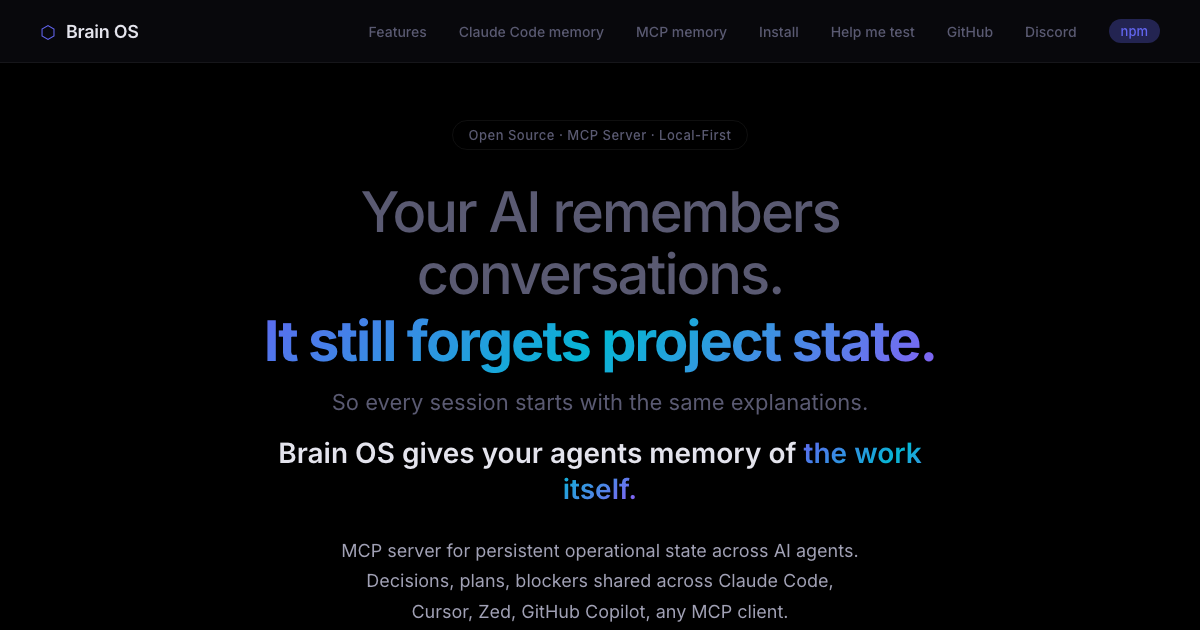





Local-first MCP memory server for operational project state: decisions, blockers, plans, patterns, and next moves.
Brain OS
Your AI remembers conversations. It still forgets project state.
Brain OS gives agents operational state: decisions, plans, blockers, and priorities that survive across sessions.
What is this?
AI agents are powerful inside a session, but long-running work has more state than any one chat: what you decided, what's blocked, what's active, and what should not be reopened. Brain OS gives agents operational state, not conversation logs:
- Entities — track projects, deals, initiatives with status, momentum, blockers, and next moves
- Decisions — log what was decided, why, what alternatives were rejected, and when to revisit
- Patterns — detect recurring blockers, stale work, avoidance signals, and theme convergence
- Focus — prioritize what to work on based on urgency, momentum, leverage, and staleness
- Semantic recall — search memory by meaning, not just ID
Brain OS is an MCP server that works with any MCP-compatible client: Claude Code, Cursor, Zed, GitHub Copilot, OpenAI Codex, Windsurf, or any agent that speaks the protocol.
What it looks like in use
Before the agent acts, it can check whether a proposed move conflicts with an existing decision:
> decision_check({ proposal: "switch to Postgres for the new service" })

{
  "verdict": "conflict",
  "conflicting_decision": {
    "id": "dec_2026_03_14_db_choice",
    "decision": "Use SQLite for all local-first projects",
    "reason": "Lower ops burden, no infra to run, fits single-user scope",
    "rejected_alternatives": ["Postgres", "DuckDB"],
    "logged_at": "2026-03-14"
  },
  "guidance": "Re-litigating a settled choice. Surface the prior reasoning to the user before proceeding."
}
That's the wedge: structured state with enforcement, so agents stop re-opening questions you already answered.
Quick start
# In your project
npx brain-os init
This does three things:
- Creates a
.brain/directory with your entity, decision, and pattern stores. - Installs slash commands into
.claude/commands/so you can run/brain,/brain:focus,/brain:decide, etc. directly in Claude Code. Bare aliases (/focus,/decide, etc.) install alongside for brevity. - Drops agent-instructions pointer files so any MCP-compatible client behaves consistently:
AGENTS.md(canonical, cross-tool) plus thin pointer files for Claude Code (CLAUDE.md), GitHub Copilot (.github/copilot-instructions.md), Cursor (.cursor/rules/brain-os.mdc), Zed (.zed/rules.md), and Windsurf (.windsurfrules).
Flags:
npx brain-os init --minimal— install onlyAGENTS.md+CLAUDE.md, skip the other client pointers (clean-repo mode)npx brain-os init --no-commands— skip slash commands (MCP server only)npx brain-os init --no-agent-instructions— skip all agent-instructions pointer files
Connect to Claude Code
claude mcp add brain-os -- npx brain-os serve
Connect to Cursor / other MCP clients
Add to your MCP config:
{
  "brain-os": {
    "command": "npx",
    "args": ["-y", "brain-os", "serve"]
  }
}
Configure semantic search (optional)
The semantic_recall tool needs an embeddings provider. Everything else (entity_update, decision_log, plan_*, etc.) works without one.
Pick a provider by adding BRAIN_EMBEDDINGS to your MCP server env:
{
  "brain-os": {
    "command": "npx",
    "args": ["-y", "brain-os", "serve"],
    "env": {
      "BRAIN_EMBEDDINGS": "local"
    }
  }
}
| Mode | What it does | Setup |
|---|---|---|
local |
Downloads a ~100MB on-device model (Xenova/all-MiniLM-L6-v2). Runs on your CPU. No data leaves your machine. |
Just set BRAIN_EMBEDDINGS=local. First call to semantic_recall triggers the model download (~30s on good wifi). |
openai |
Uses text-embedding-3-small via the OpenAI API. Faster than local. Costs ~$0.02 per million tokens. |
Set BRAIN_EMBEDDINGS=openai, then reference your key as "OPENAI_API_KEY": "${OPENAI_API_KEY}" (see security note below). |
If BRAIN_EMBEDDINGS is unset, semantic_recall returns a clear error with this config snippet. No silent downloads, no surprise API calls.
Never paste a raw
sk-...key into your MCP config.~/.claude.jsonand similar MCP config files are plaintext and easy to expose on screen or in backups. Instead, export the key once in your shell (export OPENAI_API_KEY=sk-...in~/.zshrc) and reference it in theenvblock as"OPENAI_API_KEY": "${OPENAI_API_KEY}". Better yet, useBRAIN_EMBEDDINGS=local, which needs no key and keeps all embedding work on your machine.
Tools
| Tool | Description |
|---|---|
entity_read |
Read operational state of one or all tracked entities |
entity_update |
Update entity state — status, momentum, blockers, next moves |
decision_log |
Log a strategic decision with reasoning and alternatives |
decision_check |
Check a proposed action against active decisions — returns clear/caution/conflict |
decision_refresh |
Refresh an existing decision: bump review_date, append evidence, change status. Metadata only — does not mutate decision content. |
decision_review |
Review-debt inbox: buckets overdue decisions (still-true / changed / archive / needs-evidence) and recommends an action for each. Read-only — proposes, you confirm. Auto-detects duplicate-stub decisions. |
context_resolve |
Resolve which entity the current work belongs to, from explicit mention / alias / files / lexical signals. Deterministic and confidence-scored — routes known context, never guesses intent. |
focus_get |
Get prioritized recommendations on what to work on |
project_evidence_scan |
Read-only scan of a repo's native operating state (STATE.md, FLAGS, HANDOFF, ROADMAP/PLAN/TODO, git activity, dirty files) for human gates, next moves, and do-not-touch — grounds focus in repo reality. |
pattern_detect |
Analyze patterns across all entities |
memory_check |
Audit memory quality — flags stale data, contradictions, noise |
memory_commit |
End-of-session commit — save all state changes |
semantic_recall |
Search memory by meaning using natural language |
audit_log |
Read the full mutation history — what changed, when, by whom |
wrap_check |
Detect whether meaningful state changes have accumulated since the last wrap |
wrap_auto |
Non-interactive safety-net wrap: applies low-risk fields and stages high-risk changes for review |
plan_set |
Set an ordered plan for an entity — step 1 becomes active next_move |
plan_advance |
Complete or skip a step (requires evidence/reason) — auto-promotes next |
plan_add |
Add steps to an existing plan |
plan_read |
View plan progress and current step |
risk_assess |
Classify risky actions before execution, including public-release and destructive-operation risks |
action_guard |
Apply built-in guard templates to common high-risk actions before proceeding |
Slash commands
brain-os init installs slash commands into .claude/commands/ so the agent has a clear vocabulary for working with operational state. Each command installs in two forms: /brain:* (canonical, documented form) and a bare alias (/decide, /focus, etc.) for power-user brevity. /brain is the namespace root and installs once.
It also installs:
BRAIN_OS_PROTOCOL.mdat.claude/brain-os/PROTOCOL.md(project) and~/.claude/brain-os/PROTOCOL.md(user). The protocol governs tool routing: when an agent runs a Brain OS slash command, it reads the protocol first, then callsentity_read/plan_read/focus_get/etc. as primary. Pulse files become fallback only.brain-os-modesubagent at.claude/agents/brain-os-mode.md. When the main agent delegates Brain OS work to a subagent (e.g. Claude Code's Task tool), it picks up under the same protocol — no risk of subagents falling back to generic file search.- Optional routing-guard hook at
templates/hooks/brain-os-routing-guard.py. Opt-in PreToolUse hook that warns if pulse files are read while a.brain/workspace exists. Install instructions are printed bybrain-os init.
| Command | Alias | What it does |
|---|---|---|
/brain |
— | Project scanner: overview of all entities, freshness, decisions, alerts |
/brain:focus |
/focus |
"What should I work on today, and why?" with evidence |
/brain:decide |
/decide |
Capture a strategic decision (with conflict check before logging) |
/brain:strategy |
/strategy |
Strategic thinking partner: think a decision through before building |
/brain:wrap |
/wrap |
Session wrap: update entity state, capture decisions, detect momentum shifts |
/brain:patterns |
/patterns |
Detect patterns across entities: recurring blockers, avoidance, themes |
/brain:retro |
/retro |
Weekly or monthly retrospective: what shipped, what stalled, what's hidden |
/brain:graph |
/graph |
Show how entities connect, leverage opportunities, shared decisions |
Idempotent install
Re-running init is safe and repair-aware: existing Brain OS commands are preserved, and any missing form is installed. If a command path is taken by another tool, that path is skipped and reported — your file is never overwritten. You can install Brain OS into a project with existing /decide or /focus commands and the namespaced /brain:* forms will still land.
How it works
Brain OS stores everything as local JSON files in a .brain/ directory:
.brain/
  entities/     — one file per tracked entity
  decisions/    — decision log
  patterns/     — detected patterns
  config.json   — workspace settings
No cloud. No database. No account. Your data stays on your machine.
Why no UI?
The interface is the agent. Brain OS is read and written through MCP tool calls — /brain, /focus, /decide, decision_check, etc. — surfaced inline by whichever client you use (Claude Code, Cursor, etc.). There's no separate dashboard to keep open, no second tab to context-switch into, no UI state that can drift from the underlying files.
This is a design choice, not a missing feature. Brain OS state lives at the same level as your code; the agent is already there, already in the conversation, already the right surface to ask "what's the priority right now?" Adding a human dashboard would split attention between two interfaces for the same data.
If you want a visual at-a-glance view, .brain/ is plain JSON — render it however you want. The public MCP server stays agent-native by design.
Teams & sync
Brain OS is single-user by design today. But because .brain/ is just local JSON files, teams can share a brain through any synced filesystem — no product changes needed:
| Approach | Pros | Cons |
|---|---|---|
Git — commit .brain/ to the repo |
Diff/merge tools, version history, intentional sync points | Manual git pull; merge conflicts on simultaneous edits |
| Dropbox / Drive shared folder | Real-time-ish, no manual steps | Concurrent writes can create conflict files; embeddings.json rewrites often |
| NFS / SMB / S3 mount | Truly real-time | Requires infrastructure setup |
This works without any built-in sync because every Brain OS tool call reads fresh from disk — there's no in-memory cache to invalidate. Whatever your filesystem syncs, the next tool call sees. Same applies cross-tool: log a decision from Claude Code on Monday, open Cursor on Tuesday — same brain, both agents.
Native encrypted team sync with proper merge semantics is on the roadmap. The local-first foundation today is what makes that federation additive, not a retrofit.
Auto-loaded status
When an MCP client connects, Brain OS exposes a brain://status resource with an operational overview — active entities, alerts, top priority, and recent decisions. The agent starts every session with context, not amnesia.
Testing
Brain OS ships a smoke test suite at tests/smoke.mjs, wired to npm test and run on every push by .github/workflows/audit.yml. Run locally:
npm test
Current coverage (regression + happy-path):
decision_log— type-collision no-supersede, explicitsupersedesworks, cross-entity supersession rejecteddecision_check— keyword-only flag stays caution without embeddings (no false STOPs), asymmetric semantic comparison (rejected vs chosen facet)decision_refresh— clears danglingsuperseded_bywhen status transitions away fromsupersededplan_advance— no over-promotion when an active step already existsentity_update— apply diff and record changes, create missing entity,mode_reasonrequired when parking, status-only updates apply, guarded ranking skips are visiblesemantic_recall— throwsEmbeddingsNotConfiguredError(not generic Error) whenBRAIN_EMBEDDINGSis unset- Store resolution — fails closed in a storeless cwd instead of silently creating an empty
.brain/
Known gaps (no direct coverage yet): focus_get scoring, pattern_detect heuristics, memory_*, plan_set/add/read, and the brain://status resource. Expanding the suite is on the roadmap.
If you hit a bug, please open an issue with the tool, input, and output — that's the fastest path to a fix.
Community
- Discord: discord.gg/9VBUGstjY — questions, feedback, what broke for you, what you're shipping with Brain OS
- Site: brainos-hq.com
- Issues: github.com/brainOS-HQ/brain-os/issues
License
MIT
Install Brain OS in Claude Desktop, Claude Code & Cursor
unyly install brain-osInstalls into Claude Desktop, Claude Code, Cursor & VS Code — handles npx, uvx and build-from-source repos for you.
First time? Get the CLI: curl -fsSL https://unyly.org/install | sh
Or configure manually
Run in your terminal:
claude mcp add brain-os -- npx -y brain-osFAQ
Is Brain OS MCP free?
Yes, Brain OS MCP is free — one-click install via Unyly at no cost.
Does Brain OS need an API key?
No, Brain OS runs without API keys or environment variables.
Is Brain OS hosted or self-hosted?
Self-hosted: the server runs locally on your machine via the install command above.
How do I install Brain OS in Claude Desktop, Claude Code or Cursor?
Open Brain OS on unyly.org, pick your client tab (Claude Desktop, Claude Code, Cursor) and press Install — the config is generated automatically, no JSON editing.
Related MCPs
Fetch
Web content fetching and conversion for efficient LLM usage.
AWS KB Retrieval
Retrieval from AWS Knowledge Base using Bedrock Agent Runtime.
 by modelcontextprotocol
Spring AI MCP Server
Provides auto-configuration for setting up an MCP server in Spring Boot applications.
llm-analysis-assistant
A very streamlined mcp client that supports calling and monitoring stdio/sse/streamableHttp, and can also view request responses through the /logs page. It also
 by xuzexin-hz
Compare Brain OS with
Not sure what to pick?
Find your stack in 60 seconds
Author?
Embed badge for your README
Browse similar
All ai MCPs