
Cogno
FreeNot checkedBridge an MCP (Model Context Protocol) server's tools to cogno-anima's tool contract — MCPDispatcher implements ToolDispatcher + ToolPolicyDispatcher so the EGO

About
Bridge an MCP (Model Context Protocol) server's tools to cogno-anima's tool contract — MCPDispatcher implements ToolDispatcher + ToolPolicyDispatcher so the EGO/cogno-soma see MCP tools as ordinary tools. SDK-free mapping; thin stdio/HTTP/SSE transports over the official mcp SDK.
README
Bridge an MCP server's tools to the Cogno tool contract.
The third tool source for the Cogno stack — alongside in-process skills
(cogno-cortex) and the host's native
functions. MCPDispatcher exposes any MCP server's
tools as a cogno-anima ToolDispatcher, so the EGO / cogno-soma see MCP tools as
ordinary tools and never speak the protocol.
The valuable part — schema conversion, CallToolResult → ToolResult mapping, and
policy (read-only / destructive) from MCP tool annotations — is SDK-free and
fully tested with fakes. The thin transport helpers (stdio / HTTP / SSE) are the
only place the official mcp SDK is used; transport is the SDK's job, not ours.
MCP server ──(stdio/HTTP/SSE)──▶ MCPDispatcher ──▶ ToolDispatcher ──▶ EGO / cogno-soma
                                  (implements cogno-anima's contract)
Install
pip install "cogno-mcp[mcp]" # [mcp] pulls the official MCP SDK (for transport)
cogno-anima(the contract) is a runtime dep not yet on PyPI — install it from git first; see.github/workflows/ci.yml. Without the[mcp]extra theMCPDispatcherstill works against any session you provide; the transport helpers raise a clearMCPUnavailableError.
Use
import sys
from cogno_mcp import MCPDispatcher, stdio_session

async with stdio_session(sys.executable, args=["my_server.py"]) as session:
    dispatcher = await MCPDispatcher.create(session)          # lists + caches tools

    dispatcher.tools_schema()            # OpenAI tool defs the EGO offers
    dispatcher.is_mutating("wipe")       # from the tool's readOnlyHint
    dispatcher.requires_confirmation("wipe")   # from its destructiveHint

    await pipe.run_turn(ctx, cfg, dispatcher=dispatcher)      # cogno-soma
Transports: stdio_session(command, args=...) (subprocess), http_session(url)
(Streamable HTTP), sse_session(url) (legacy SSE). Each is an async context manager
that connects, initialize()s, and tears down on exit — the host owns the lifecycle.
Mapping
| MCP | → cogno-anima |
|---|---|
Tool.name/description/inputSchema |
tools_schema() OpenAI function def |
CallToolResult.content (text blocks) |
ToolResult.output |
CallToolResult.isError = True |
recoverable ToolResult(ok=False) |
| transport / protocol exception | raises MCPDispatchError (EGO propagates) |
| unknown tool name | recoverable ToolResult(ok=False) |
annotations.readOnlyHint |
is_mutating (absent/false → conservative true) |
annotations.destructiveHint = True |
requires_confirmation (drives the EGO gate) |
Skills + MCP + native together
Each source is a ToolDispatcher; merge them per persona:
from cogno_anima.tools import CompositeDispatcher
dispatcher = CompositeDispatcher([cortex_dispatcher, mcp_dispatcher, native_dispatcher])
The ToolDispatcher contract is the unifier — skill / MCP / native are just sources.
The Cogno ecosystem
cogno-mcp is one organ of Cogno — a family of
small, composable, Apache-2.0 libraries that together form a complete
conversational-agent platform. Each library owns a single concern and stays
infra-agnostic; a host assembles them into a running agent:
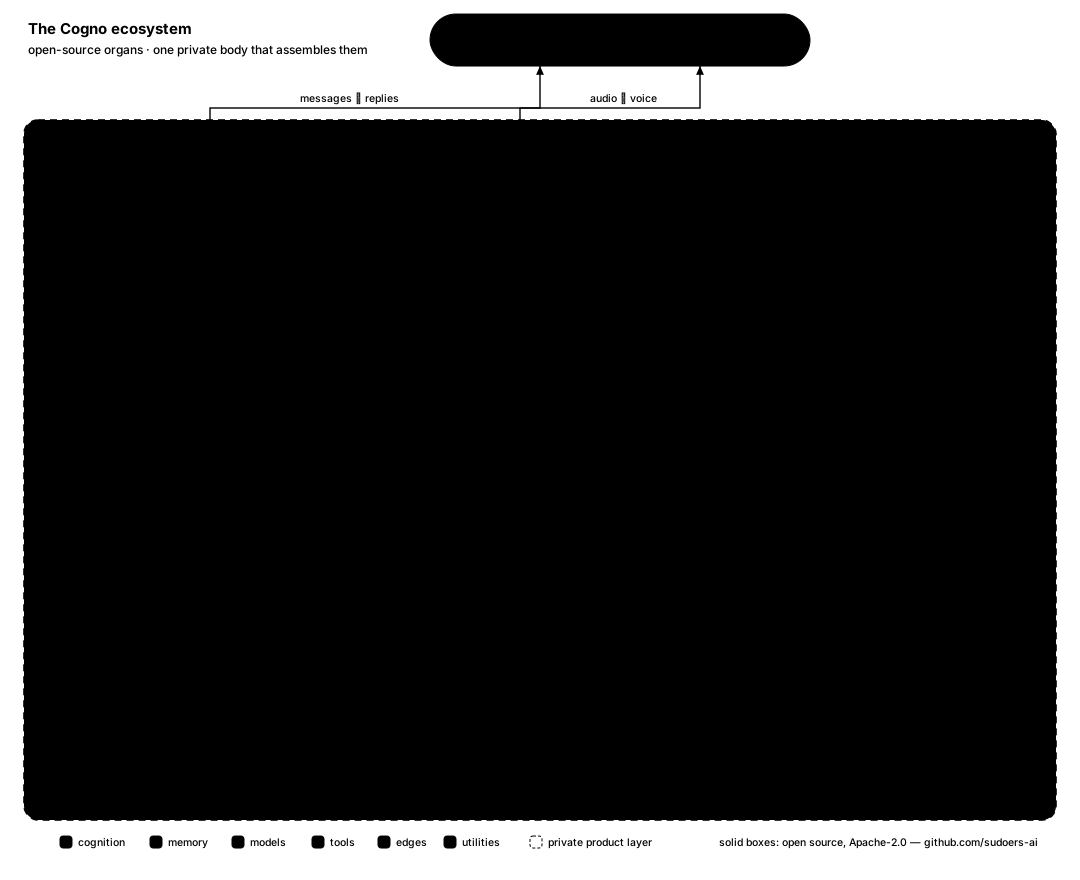
The open-source libraries are the organs; the host is the body that joins
them. Our reference host — cogno-host, with its cogno-ui dashboard — is the
private product layer, but it holds no special powers: everything it does rides
on the public seams documented in each library's docs/HOST_INTEGRATION.md, so
you can assemble a body of your own.
Development
pip install -e ".[dev]"
pytest tests/unit -q            # SDK-free dispatcher logic against fakes
pytest tests/integration -q     # MCPDispatcher vs a real FastMCP server over stdio
ruff check cogno_mcp tests && mypy cogno_mcp
python examples/host_min.py     # spawns a local MCP server and calls a tool
Apache-2.0.
Installing Cogno
This server has no published package — it is built from source. Open the repository and follow its README.
▸ github.com/sudoers-ai/cogno-mcpFAQ
Is Cogno MCP free?
Yes, Cogno MCP is free — one-click install via Unyly at no cost.
Does Cogno need an API key?
No, Cogno runs without API keys or environment variables.
Is Cogno hosted or self-hosted?
Self-hosted: the server runs locally on your machine via the install command above.
How do I install Cogno in Claude Desktop, Claude Code or Cursor?
Open Cogno on unyly.org, pick your client tab (Claude Desktop, Claude Code, Cursor) and press Install — the config is generated automatically, no JSON editing.
Related MCPs
Fetch
Web content fetching and conversion for efficient LLM usage.
AWS KB Retrieval
Retrieval from AWS Knowledge Base using Bedrock Agent Runtime.
 by modelcontextprotocol
Spring AI MCP Server
Provides auto-configuration for setting up an MCP server in Spring Boot applications.
llm-analysis-assistant
A very streamlined mcp client that supports calling and monitoring stdio/sse/streamableHttp, and can also view request responses through the /logs page. It also
 by xuzexin-hz
Compare Cogno with
Not sure what to pick?
Find your stack in 60 seconds
Author?
Embed badge for your README
Browse similar
All ai MCPs