
Lanchu
FreeNot checkedControl and trust layer for coordinating multiple AI agents. MCP, 100% local, open source.

About
Control and trust layer for coordinating multiple AI agents. MCP, 100% local, open source.
README
Lanchu
The control panel and the limits for the AI agents you already have running.
Coordinate them without collisions. Watch them in real time. Trust what they do.







What problem does it solve?
More and more people use several AI agents (like Claude or Cursor) to build apps or automate their company. But when you put several agents to work at once, two pains show up:
They don't coordinate — and they get in each other's way:
- They step on each other's work — two agents do the same thing.
- They work blind — one doesn't know what the other did.
You can't control them — or trust them:
- They stray out of their lane — an agent touches something it shouldn't.
- The documentation goes stale — nobody keeps the knowledge up to date.
- You can't see anything — you don't know who did what, or what they spent.
Most tools only tackle coordination, and they're built for programmers. Lanchu adds what's missing: control and trust for whoever supervises.
Lanchu does not orchestrate your agents (it doesn't decide their plan). It gives them a shared workspace so they coordinate without colliding, sets scope limits on them, keeps the documentation up to date, and gives you a panel + history to see and trust what they do — even if you're not technical.
How it works (the idea)
- You launch your agents as always (with the tool you already use).
- Each agent registers in your organization and takes on a role.
- From there, it only works on what it's responsible for: it claims tasks, reads the shared documentation, and Lanchu rejects and records any action outside its lane. The agents coordinate through Lanchu, not by talking to each other — that's why you can see and bound everything.
- You watch the real-time panel: who's active, what they're working on, what documentation they create, and a history of everything they did.
Lanchu sets cooperative, auditable limits: it blocks what passes through it and leaves everything in plain sight. It's not a system cage — the trust comes from seeing it all.
How it fits
Agents coordinate through Lanchu (a shared blackboard), never directly with each other — so every action is visible and can be bounded.
flowchart TB
    A1["Agent A"] -->|MCP| L
    A2["Agent B"] -->|MCP| L
    subgraph L["Lanchu — local server"]
        S["Shared state · roles · audit log"]
    end
    L --> P["Supervisor panel<br/>(real-time + history)"]
    L -. resource updates .-> A1
    L -. resource updates .-> A2
Quick start
npx lanchu "fix the login"
Note: Requires Node >= 22.5. See CHANGELOG.md for what's new, DEFINITION.md for the full picture and CLI.md for the command surface.
What's included today
Coordination
- Organizations, projects, roles and tasks — a shared blackboard with scope control; actions outside the role are rejected and recorded.
- Agent isolation —
lanchu spawngives each agent its own terminal, git worktree and branch, so parallel work can't collide.lanchu tilearranges the terminals into a mosaic. - Agent-to-agent messaging with conflict warnings — audited, never private; idle agents with queued notices are woken automatically.
- SDLC pipeline (assist mode) — the server owns the lanes (definition → build → review →
qa → done): attach a PR and the task routes to review; finish it and it routes to QA
verification. Agents can bounce underspecified tasks back to definition (
task_reject), with the reason audited.
Governance
- Roles you can edit — tag scopes, wildcard, a per-role token quota (claims warn at 80%,
block at 100%) and a preferred model tier;
lanchu spawn --modeloverrides per spawn. - Coordinator lease — one coordinating agent per org, enforced; the supervisor grants or
revokes it with
lanchu coordinator. - Greenzone restarts —
lanchu restart --greenzonecoordinates a maintenance window: every agent confirms a safe point before the server goes down. - Session security — per-session Bearer tokens (never in window titles or
psargs);lanchu rotate-tokensinvalidates every open session after an exposure.
Knowledge & memory
- Shared, traceable documentation — categorized docs with section and delta reads, read tracking and usage analytics.
- Persistent memory — three scopes (agent / project / org) stored in the org DB and auto-distilled into each agent's context across sessions.
Observability
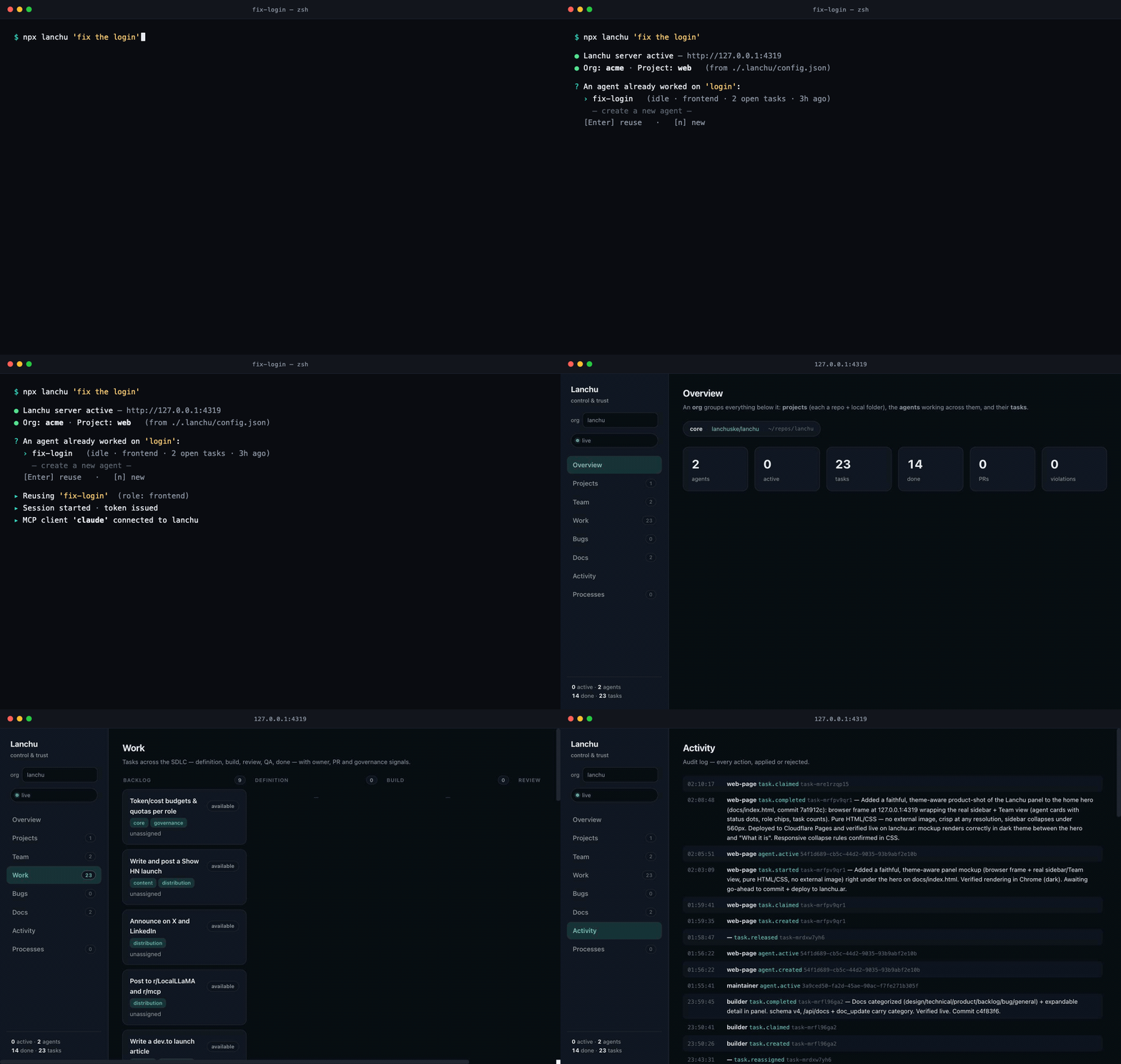
- Real-time panel — Overview home (who's working right now), Projects, Team, Work board, Org life (a force-directed graph of the org built from the audit log), Bugs, Docs, Memory, Tests, Activity, and Processes (server, agent terminals, live MCP transports).
- Full audit log — every action, applied or rejected.
- Terminal comfort —
lanchu statuslineshows the team's pulse inside Claude Code;lanchu completion installwires Tab-completion for commands, flags and live board values.
What comes next (recurring functions, skills, cloud organizations…) is in the roadmap.
Who it's for
For anyone who supervises several agents working toward a common objective: to build an app, automate processes, or coordinate a company's work. Lanchu sits on top of or alongside the tools you already use to launch agents.
In this first version there are two roles: an operator (semi-technical) who does the initial setup —running a command, connecting your agents—, and a supervisor who watches and trusts from the panel, without needing to be a programmer.
Contributing
Lanchu is open source and contributions are welcome in a controlled way. Start with the project definition, then the contributing guide. Have an idea? Open a feature request or start a thread in Discussions › Ideas.
License
Install Lanchu in Claude Desktop, Claude Code & Cursor
unyly install lanchuInstalls into Claude Desktop, Claude Code, Cursor & VS Code — handles npx, uvx and build-from-source repos for you.
First time? Get the CLI: curl -fsSL https://unyly.org/install | sh
Or configure manually
Run in your terminal:
claude mcp add lanchu -- npx -y lanchuFAQ
Is Lanchu MCP free?
Yes, Lanchu MCP is free — one-click install via Unyly at no cost.
Does Lanchu need an API key?
No, Lanchu runs without API keys or environment variables.
Is Lanchu hosted or self-hosted?
Self-hosted: the server runs locally on your machine via the install command above.
How do I install Lanchu in Claude Desktop, Claude Code or Cursor?
Open Lanchu on unyly.org, pick your client tab (Claude Desktop, Claude Code, Cursor) and press Install — the config is generated automatically, no JSON editing.
Related MCPs
Fetch
Web content fetching and conversion for efficient LLM usage.
AWS KB Retrieval
Retrieval from AWS Knowledge Base using Bedrock Agent Runtime.
 by modelcontextprotocol
Spring AI MCP Server
Provides auto-configuration for setting up an MCP server in Spring Boot applications.
llm-analysis-assistant
A very streamlined mcp client that supports calling and monitoring stdio/sse/streamableHttp, and can also view request responses through the /logs page. It also
 by xuzexin-hz
Compare Lanchu with
Not sure what to pick?
Find your stack in 60 seconds
Author?
Embed badge for your README
Browse similar
All ai MCPs