
Lumen
FreeNot checkedSelf-hostable agentic-AI LMS: catalog, RAG tutor, FSRS reviews, AI authoring, ingest.

About
Self-hostable agentic-AI LMS: catalog, RAG tutor, FSRS reviews, AI authoring, ingest.
README
Lumen
Type a one-sentence learning goal — an AI orchestrator builds you a private course in ~50 seconds, a RAG tutor with citations teaches it, and you can audit every agent decision it made.
Custom multi-agent system, no LangChain · public evals with the weak scores kept in · live in production
CI authoring eval 3.85/5 (n=10) MCP registry License: MIT
Live demo · Eval results · Architecture · MCP server

Real production recording (Groq Llama 3.3 70B). Intake trimmed 6×, the ~50 s build 16× — the brief and the finished course are real-time.
Try it yourself: the one-click demo pre-fills [email protected] / Demo!2026 and drops you into the tutor (free-tier box — give a cold page a few seconds).
What this is
A learner-owned, two-role e-learning platform — every signed-in user runs the whole loop themselves; admin only moderates and configures. The product is the loop; the point of the repo is the agentic system underneath it.
| Step | What happens |
|---|---|
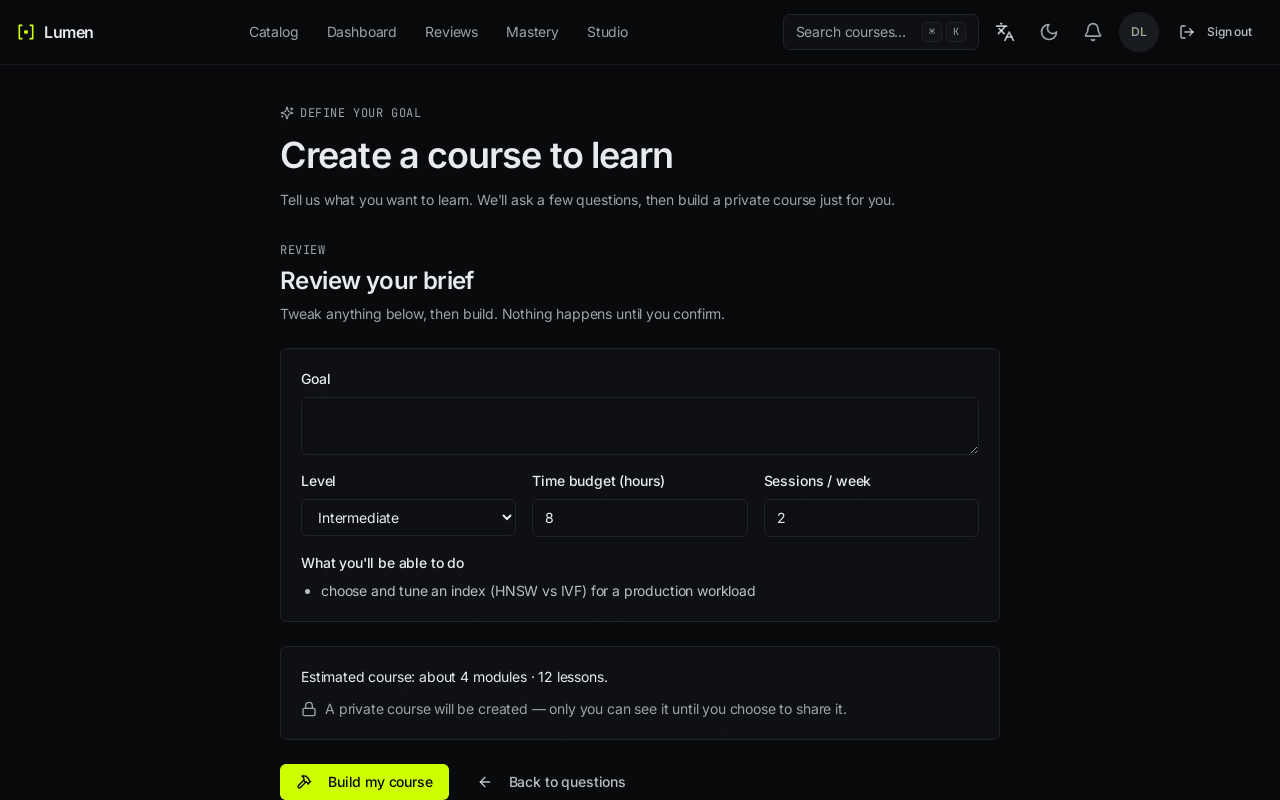
| Define | A guided AI intake (capped at six turns) turns a fuzzy goal into a structured learning brief — the source goal is field-encrypted at rest |
| Build | The authoring orchestrator builds a private course from the brief — honest status, no half-finished partials, re-runnable, cancellable (build.py, the durability/idempotency/quota shell) |
| Learn | A course-scoped RAG tutor answers with lesson citations and a visible tool-call trace |
| Share | Publishing stays private; public listing is an explicit share + admin moderation state machine with an immutable audit trail |
| Clone | Any listed course can be remixed into your own draft, with server-written "Based on …" provenance and a sanitized export (no enrollments, traces, or soft-deleted content) |
| BYOK | Bring your own model key (OpenAI / Anthropic / Groq / Mistral) — allowlisted providers, server-owned base URLs, envelope-encrypted write-only keys |
Shipped to production as 2.0.0-two-role (CHANGELOG) — built as a gated waterfall: requirements → design → 6 ADRs → seven build streams, each cleared a Codex challenge, an independent Claude review, and a live in-browser walk before merge.
The agentic layer
Every item below is on production today, with the code one click away.
Custom multi-agent orchestrator — no frameworks
The tutor picks per-turn among five sub-agents in tutor_subagents/ — retriever, web_searcher, code_runner, quiz_generator, concept_explainer — under a hard cap on tool-call rounds (streaming variant). The authoring side runs a six-stage pipeline — researcher → outliner → critic → reviser → lesson-drafter → final-critic — in authoring_orchestrator.py, capped at six revise/critic calls.

Production recording at 2× — the retriever fires (latency on-screen), then the answer streams.
Course-scoped RAG with citations, behind one authorizer
Retrieval is scoped per course and routed through a single ACL clause (visibility.py, ADR-0029) so private and cloned courses never leak chunks. Embeddings via Cloudflare Workers AI (bge-small-en-v1.5, 384-dim) into pgvector; answers cite specific lesson chunks.
Every agent decision is auditable
Each LLM call logs prompt/completion tokens, USD cost, latency, and outcome to the llm_calls table (llm_call_log.py); each agent step lands in agent_tracer.py. Learners get a per-turn "show me how you got this" drill-down — planner steps, tool calls, retrieval audits with similarity scores; authors get a step-by-step build replay.
| Tutor-turn trace | Authoring build replay |
|---|---|
 |
 |
Eval harness with LLM-as-judge — published whole
Three golden suites (30-item tutor, 10 authoring, 10 ingest) under evals/, judged 0–5 per axis, plus adversarial probes. A 3-item smoke gates every PR (workflow); results are public at /eval.
The point isn't the scores — it's the harness: LLM-as-judge applied honestly to one strong subsystem and two early ones, every number reproducible with make eval suite=… and smoke-gated in CI.
| Suite | Judged | LLM-judge score | Reading |
|---|---|---|---|
| Authoring | 10 / 10 | 3.85 / 5 | Strong — the headline number, backed by the raw JSONL |
| Tutor | 10 / 30 | 2.33 / 5 | Early — citation-format mismatch between the judge's expected citations and what the retriever pulls; 20 items skipped, cause documented |
| Ingest | 4 / 10 | 0.83 / 5 | Early — v1 chunker emits one module per video; 6 items failed upstream transcript fetch before judging |
The weak scores are published whole, on purpose. Methodology · raw reports.
MCP server on the official registry
app/mcp/ exposes nine tools (catalog, RAG tutor, FSRS reviews, AI authoring, ingest) over stdio + HTTP with OAuth client-credentials, published as io.github.ahmedEid1/lumen. Write tools gate on the can_author capability; URL ingest stays admin-only + flag-gated (ADR-0025).
Wiring it into an MCP client takes one JSON block:
Use it from Claude Desktop / Claude Code
// claude_desktop_config.json
{
  "mcpServers": {
    "lumen": {
      "command": "python",
      "args": ["-m", "app.mcp", "--transport", "stdio"],
      "env": {
        "LUMEN_MCP_AUTH_TOKEN": "<client-secret from `make mcp-token`>",
        "DATABASE_URL": "postgresql+asyncpg://lumen:lumen@localhost:5432/lumen"
      }
    }
  }
}
Or for Claude Code: LUMEN_MCP_AUTH_TOKEN=<secret> claude mcp add lumen -- python -m app.mcp --transport stdio, then ask "list my Lumen courses" and watch list_courses, ask_tutor, create_course_draft, … fire. Full operator guide: docs/mcp.md.
BYOK without the foot-guns
Per-credential 256-bit DEKs wrapped by a versioned server KEK (secrets_crypto.py); decryption only inside the dispatch path — never in logs, traces, exports, or admin views. A prod boot guard refuses to start with stored credentials but no real KEK (ADR-0027). Request-count quotas close the $0-BYOK bypass of the dollar budget guard.
Zero-downtime phased migrations with evidence gates
The two-role rebuild migrated student/instructor → user live: widen accepted roles → backfill → drop old values only after access tokens drained their 15-min TTL. The Alembic chain enforces one phase per run, and migration-level evidence gates refuse to tighten constraints over un-backfilled rows — one of them caught a real prod data condition (85 legacy chunks with NULL embedding model) at deploy time.
Architecture
The short version: one FastAPI service owns all invariants, the agents are plain service-layer code, and every LLM call crosses one provider seam and one cost meter.
flowchart LR
    user([User · authors + learns])
    admin([Admin · moderates + config])

    subgraph App[Application]
      web[Next.js 15 · RSC]
      api[FastAPI · Python 3.13<br/>capability-based authz<br/>central is_publicly_listed authorizer]
      worker[Celery worker + beat]
    end

    subgraph Agents[Agent layer]
      define[Goal intake → brief]
      authoring[Authoring orchestrator<br/>researcher → … → final-critic]
      tutor[Tutor orchestrator<br/>+ 5 sub-agents]
    end

    subgraph Data[Data]
      pg[(Postgres 17 + pgvector)]
      redis[(Redis 7)]
      s3[(MinIO S3)]
    end

    subgraph LLM[Swappable LLM layer]
      provider{LLM_PROVIDER dispatch}
      groq[Groq · Llama 3.3 70B]
      byok[BYOK allowlist<br/>OpenAI · Anthropic · Mistral · Groq]
    end

    subgraph Eval[Eval loop]
      golden[(Golden datasets)]
      judge[LLM-as-judge 0–5]
      meter[llm_calls<br/>tokens · cost · latency]
    end

    user --> web --> api --> pg
    admin --> web
    api --> redis & s3 & worker
    api --> define --> authoring
    api --> tutor --> pg
    mcp[MCP server · 9 tools] --> api
    authoring & tutor --> provider
    provider -.platform.-> groq
    provider -.per-user.-> byok
    api --> meter
    golden --> judge --> provider
Provider-agnostic by env var — the live demo runs Groq's free tier; users dispatch on their own allowlisted keys. Every call crosses the cost meter, so budgets, quotas, and observability behave identically across providers. Full topology: docs/architecture.md.
Stack: Python 3.13 · FastAPI · async SQLAlchemy 2 · Alembic · Celery — Next.js 15 · React 19 · TypeScript 5 · Tailwind 4 · TanStack Query — PostgreSQL 17 (pgvector + tsvector) · Redis 7 · MinIO — Docker Compose · GitHub Actions · Trivy + CodeQL + gitleaks · Caddy 2.
How it's built and tested
The process is the portfolio as much as the code. Every build stream cleared three gates before merge:
- Codex challenge — a second-brain CLI attacks the design, plan, and code; findings triaged and resolved.
- Independent Claude review — a gating review subagent re-checks against source until clean.
- Live evidence — drive the app as a real user in a browser, locally and on prod, on top of unit/E2E/a11y suites. Running-the-app evidence is required, not optional.
At the 2.0.0 release: backend 1,421 tests / frontend 468 tests, all green; WCAG 2.2 AA axe-core gate (11 surfaces, 0 violations); en + ar i18n parity; visual-regression baselines; Playwright E2E on Chromium and WebKit. The UI itself went through a 20-loop redesign (30+ Radix-backed primitives, ⌘K command palette, dark/light themes) with five in-loop Codex rescue passes plus a final Codex review. A green main auto-deploys to production.

⌘K — navigate, search courses, switch theme, sign out.
Run it locally
Prereqs: Docker Desktop 4.30+ (or Engine 27 + Compose v2).
git clone https://github.com/ahmedEid1/lumen.git
cd lumen
cp .env.example .env
make up && make migrate && make seed
Open http://localhost:3000 and sign in:
| Role | Password | |
|---|---|---|
| admin | [email protected] |
Admin!2026 |
| user | [email protected] |
Teach!2026 |
| user | [email protected] |
Learn!2026 |
Without an LLM key the AI features fall back to a deterministic noop provider — the rest of the app still works. For the real thing (define/build, tutor, evals), a free Groq key is enough:
LLM_PROVIDER=openai
OPENAI_API_BASE=https://api.groq.com/openai/v1
OPENAI_API_KEY=<your-groq-key>
LLM_MODEL=llama-3.3-70b-versatile
The same LLMProvider abstraction takes native Anthropic or OpenAI by env var — no code changes. Feature flags (FEATURE_BYOK_ENABLED, FEATURE_PRIVATE_PUBLISH_ENABLED, CLONE_ENABLED, FEATURE_TUTOR_STREAMING) default off; set them in .env once their prerequisites (e.g. a real BYOK master key) are in place. make demo-seed adds the richer agentic-demo bundle.
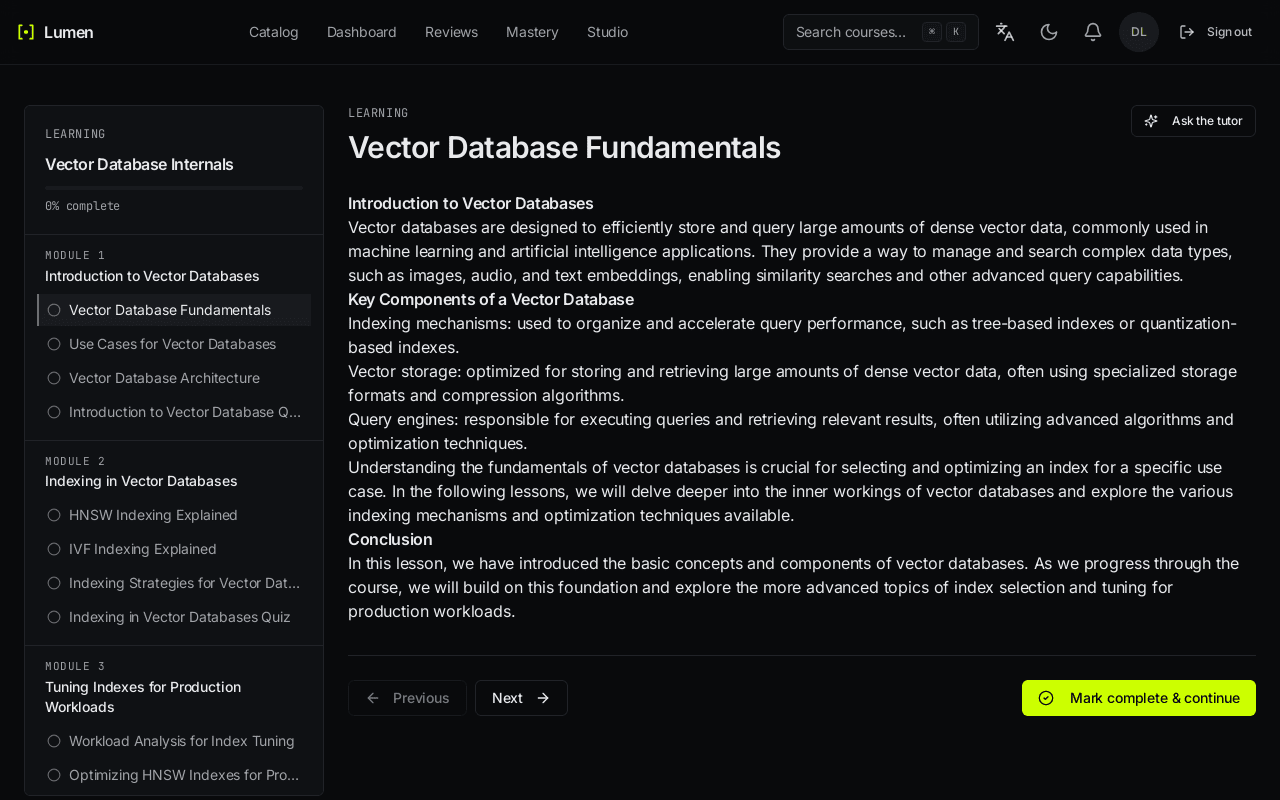
More screenshots — dashboard, catalog, the agent-replay home page, the public eval page, a freshly built course, the brief review
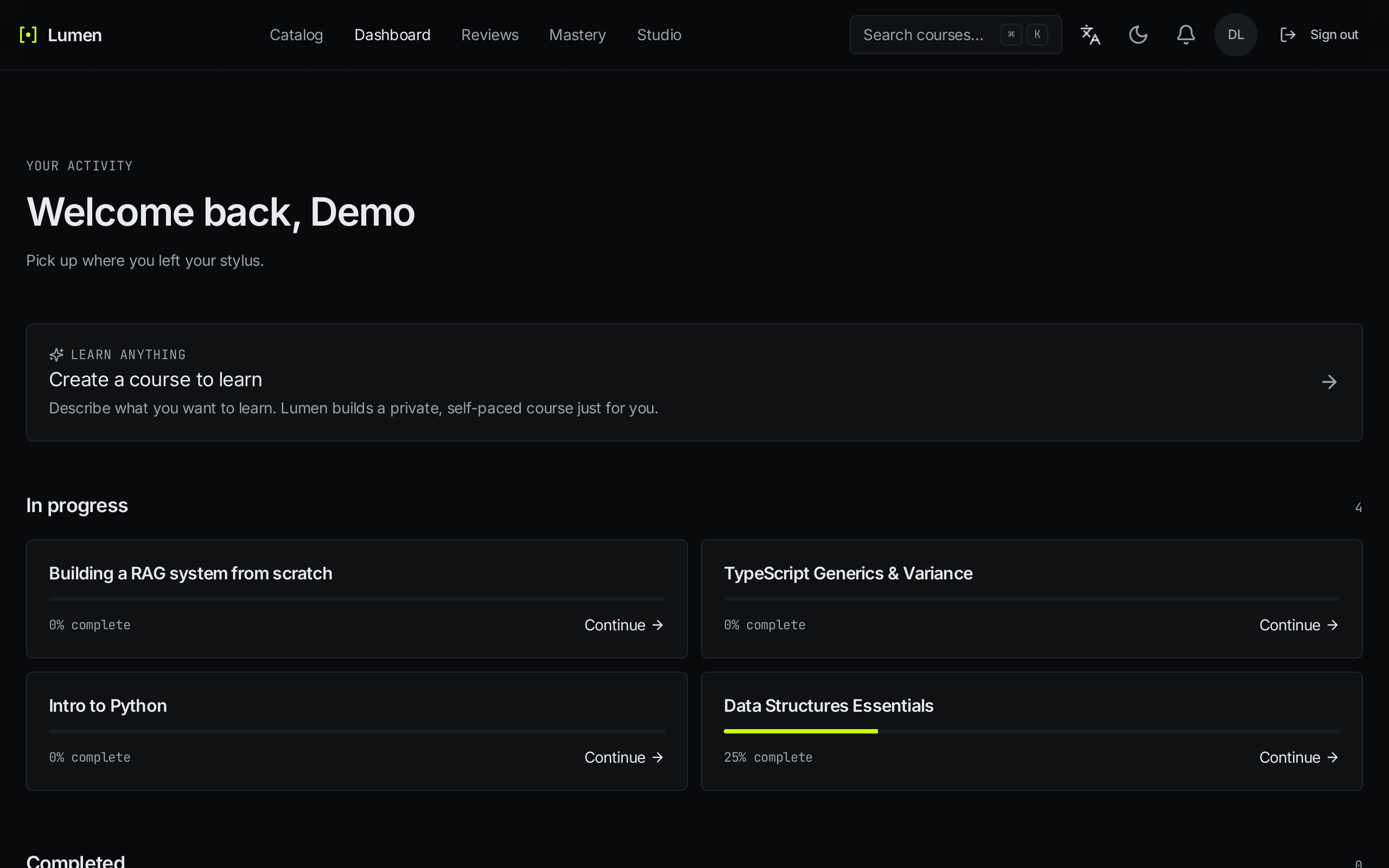 |
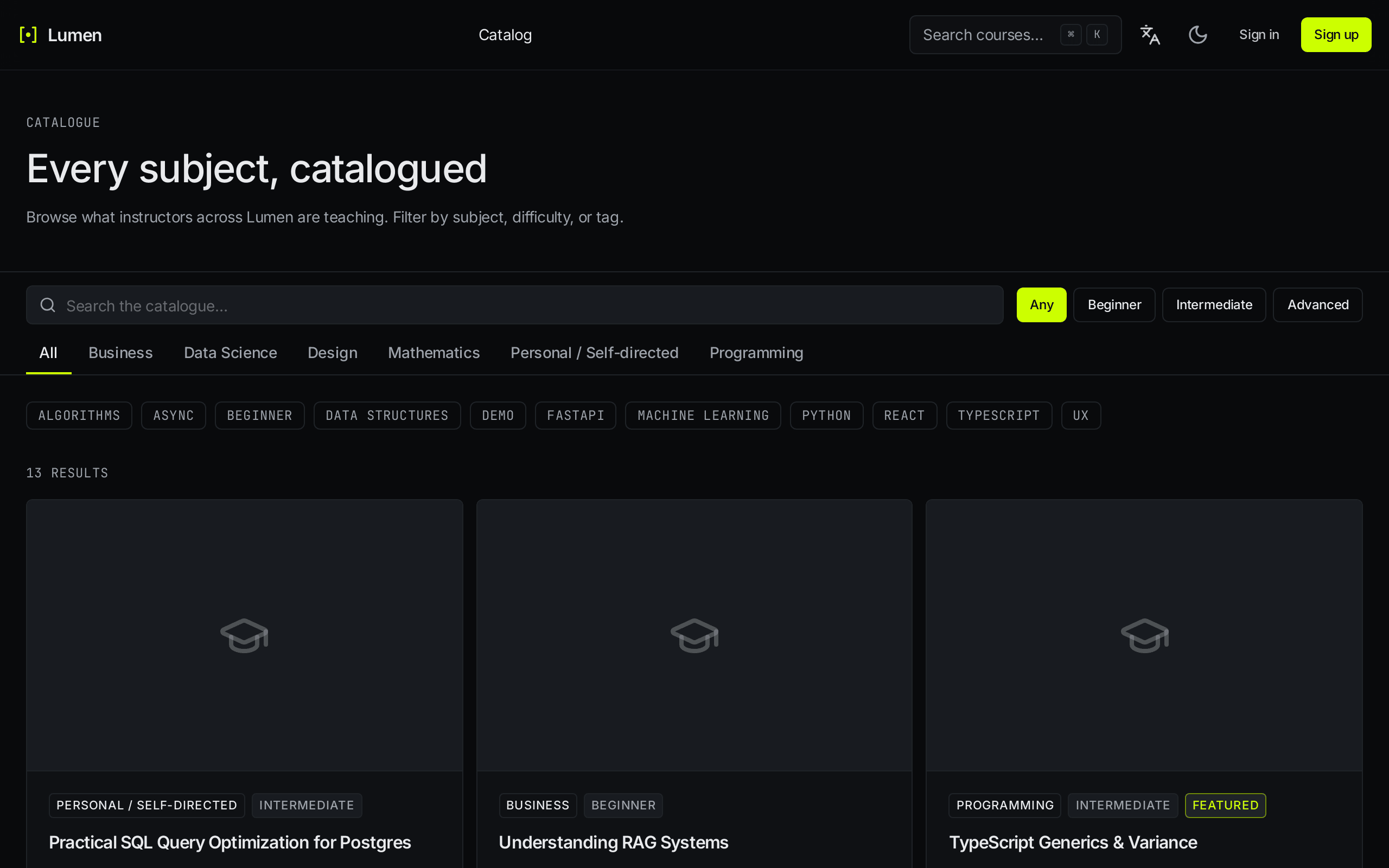 |
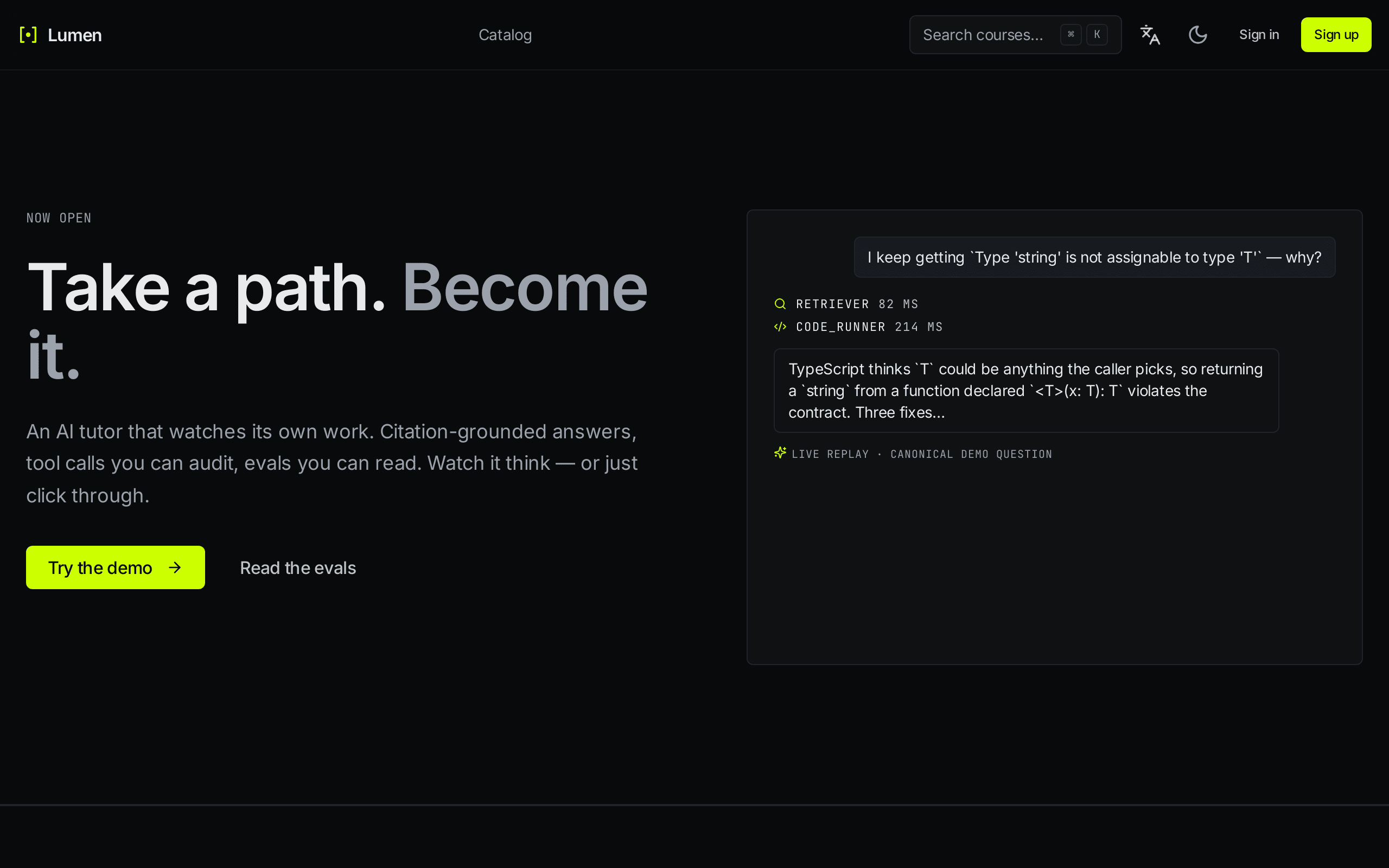 |
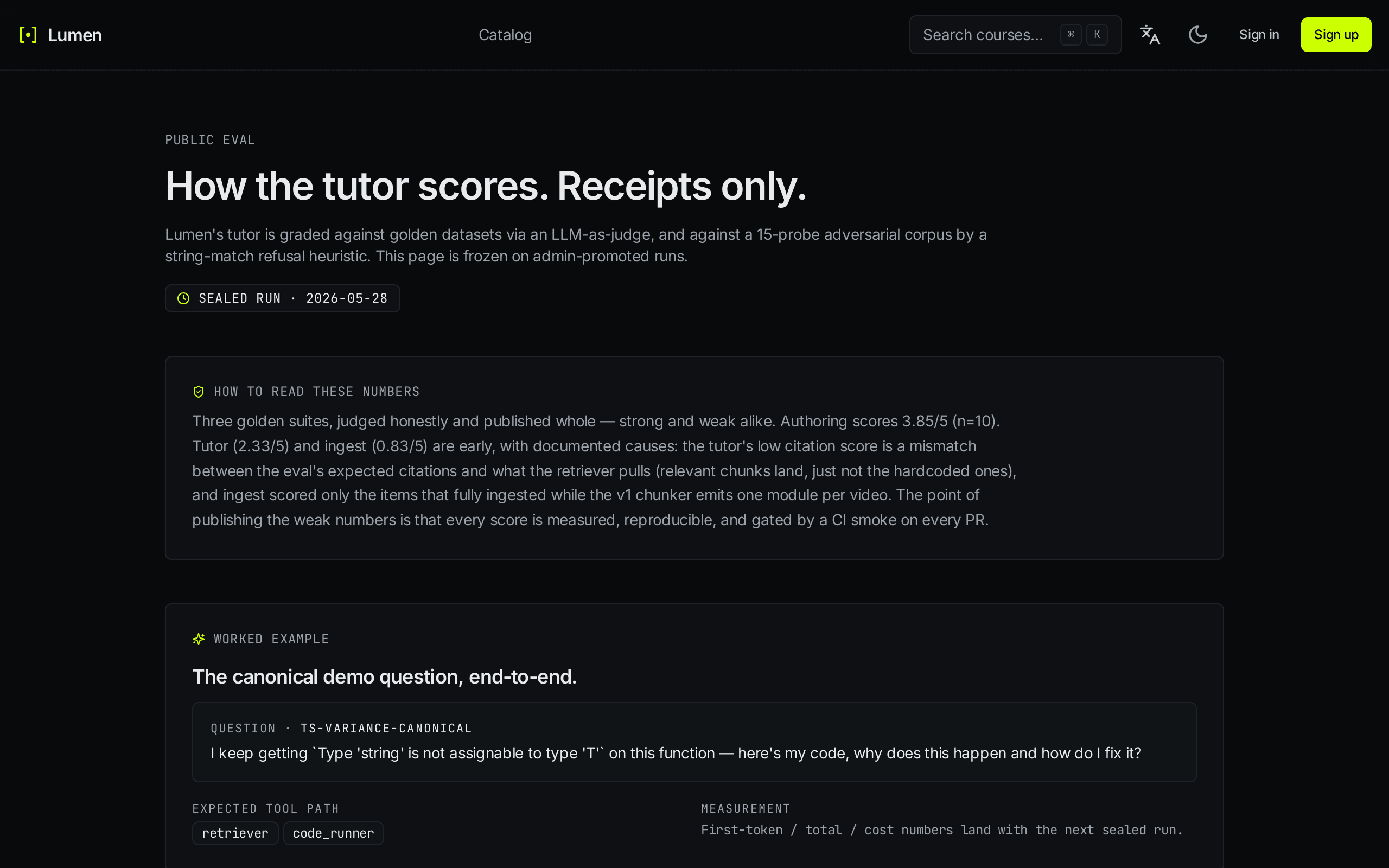 |
 |
 |
Status, limits, and honesty
- Live at lumen.ahmedhobeishy.tech — 2.0.0-two-role, shipped 2026-06-06. Free tier end-to-end: Groq + Cloudflare Workers AI + one AWS t4g.small (runbook: docs/deployment/aws-vps.md). Budget guards and request quotas cap spend; expect free-tier latency under load.
- Email verification is off in prod (
EMAIL_ENABLED=false— no SMTP configured). A flag, not a code limitation. - Eval scores include the weak ones, with causes documented — see the table above and docs/eval/ for raw JSONL.
- Test counts are release-time snapshots (the suites keep moving with
main); CI is the live source of truth.
Built by
Ahmed Hobeishy — AI / Agent Engineer in Essen, Germany. Lumen started as a 2020 Django side-project; five years and one model revolution later it's the centrepiece of my agentic-AI work: agents that are measured (golden evals, LLM-as-judge), auditable (per-call cost/latency traces, citation checks), and shipped (live, CI-gated, self-hostable).
Open to AI / Agent Engineer roles in Germany where evaluation and observability are first-class.
Installing Lumen
This server has no published package — it is built from source. Open the repository and follow its README.
▸ github.com/ahmedEid1/lumenFAQ
Is Lumen MCP free?
Yes, Lumen MCP is free — one-click install via Unyly at no cost.
Does Lumen need an API key?
No, Lumen runs without API keys or environment variables.
Is Lumen hosted or self-hosted?
Self-hosted: the server runs locally on your machine via the install command above.
How do I install Lumen in Claude Desktop, Claude Code or Cursor?
Open Lumen on unyly.org, pick your client tab (Claude Desktop, Claude Code, Cursor) and press Install — the config is generated automatically, no JSON editing.
Related MCPs
Fetch
Web content fetching and conversion for efficient LLM usage.
AWS KB Retrieval
Retrieval from AWS Knowledge Base using Bedrock Agent Runtime.
 by modelcontextprotocol
Spring AI MCP Server
Provides auto-configuration for setting up an MCP server in Spring Boot applications.
llm-analysis-assistant
A very streamlined mcp client that supports calling and monitoring stdio/sse/streamableHttp, and can also view request responses through the /logs page. It also
 by xuzexin-hz
Compare Lumen with
Not sure what to pick?
Find your stack in 60 seconds
Author?
Embed badge for your README
Browse similar
All ai MCPs