
No Slop
FreeNot checkedLocal-first AI writing detector and cleanup engine with REST APIs, CLI, Django/DRF, and native MCP tools.

About
Local-first AI writing detector and cleanup engine with REST APIs, CLI, Django/DRF, and native MCP tools.
README
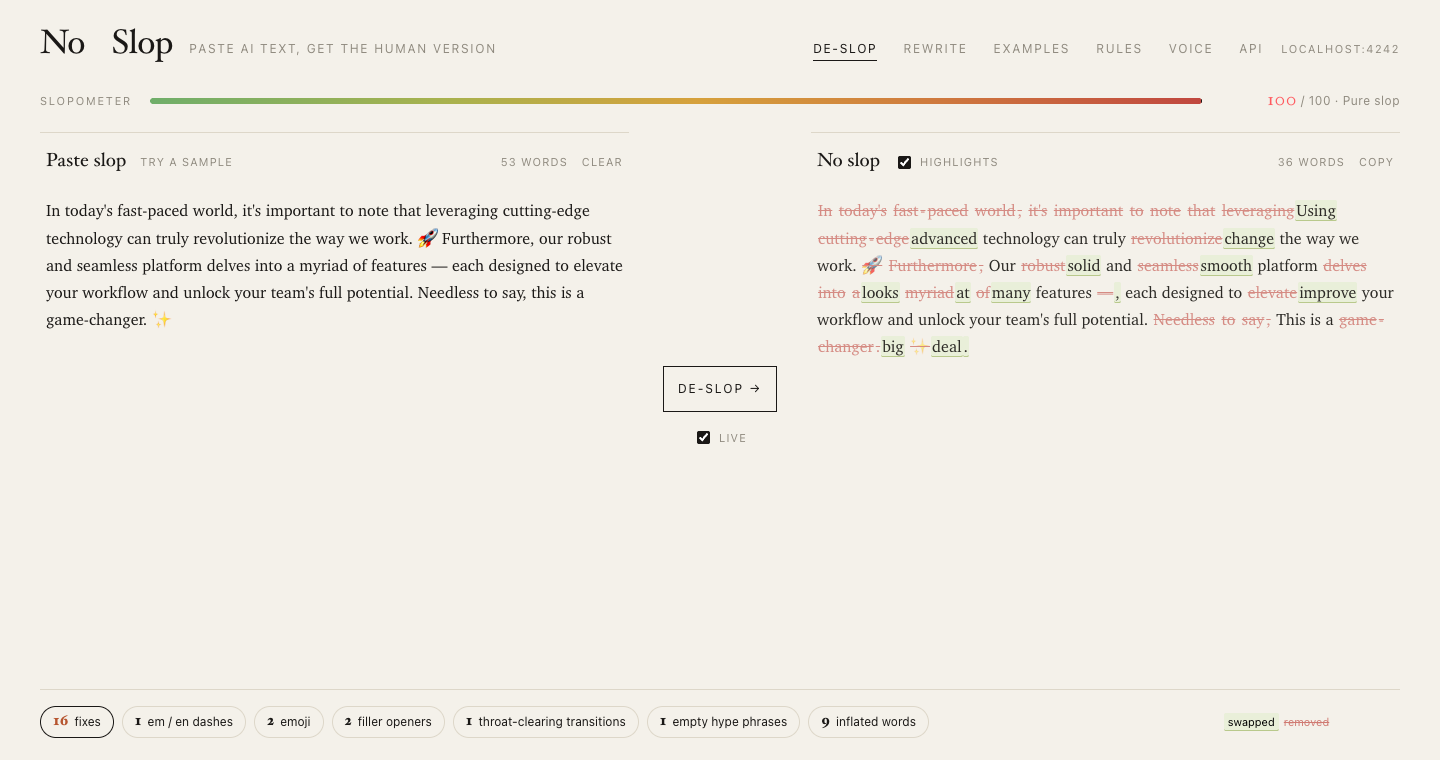
Local-first AI writing cleanup for humans and agents. No Slop detects common LLM-writing patterns, rewrites safe mechanical issues, scores the input, and flags structural problems that need human judgment.
The same deterministic text engine powers a browser UI, seven local API route families, a command-line tool, and a native Model Context Protocol (MCP) server. A Django REST Framework port provides the same core response contract for a Python backend.
Why it is useful
- Deterministic cleanup: remove em-dash overload, decorative emoji, filler openers, throat-clearing transitions, hype phrases, and inflated vocabulary.
- AI-writing detection: produce a 0-100 score with a signal breakdown.
- Human-in-the-loop review: flag risky structural patterns instead of pretending every rewrite can be safely automated.
- Agent integration: expose
deslopandslop_scoreas native MCP tools. - Multiple interfaces, one engine: browser, REST-style API, CLI, and MCP all call src/deslop.js.
- Local by default: the server binds to
127.0.0.1; the deterministic engine does not require a hosted service or API key.
Architecture
| Surface | Technology | Purpose |
|---|---|---|
| Web application | Vite + vanilla JavaScript | Live cleanup, diff, scoring, examples, and voice rules |
| Local API | Node/Vite middleware | Text cleanup, AI rewrite orchestration, style learning, examples, and editable docs |
| MCP server | Model Context Protocol over stdio | Native tools for Claude Code, Claude Desktop, Cursor, and other MCP clients |
| CLI | Node.js | Shell pipelines, files, clipboard workflows, and automation |
| Python API | Django + Django REST Framework | Alternative backend with validation, throttling, CORS controls, and 18 tests |
| Core engine | Dependency-free JavaScript | Shared cleanup, scoring, and structural flag detection |
Browser UI ─┐
Local API ──┼──> src/deslop.js <── CLI
MCP server ─┘          │
                      └── deterministic cleanup + score + flags

Django/DRF API ──> Python port with the same response contract
Quick start
Requires Node.js 20 or newer.
git clone https://github.com/eatusc/no-slop.git
cd no-slop
npm install
npm run dev
Open http://localhost:4242.
HTTP API
The main integration endpoint accepts raw text or JSON:
curl -s -X POST http://localhost:4242/api/deslop \
  -H "Content-Type: application/json" \
  -d '{"text":"Furthermore, our seamless platform leverages cutting-edge AI. 🚀"}'
Example response:
{
  "clean": "Our smooth platform uses advanced AI.",
  "slop": {
    "score": 100,
    "label": "Pure slop",
    "signals": {
      "transitions": 1,
      "emoji": 1,
      "words": 3
    }
  },
  "fixes": {
    "total": 5,
    "byCategory": [
      { "label": "Emoji", "count": 1 },
      { "label": "Throat-clearing transitions", "count": 1 },
      { "label": "Inflated words", "count": 3 }
    ]
  },
  "flags": [],
  "words": {
    "in": 8,
    "out": 6
  }
}
Return only clean text for shell pipelines:
curl -s -X POST "http://localhost:4242/api/deslop?clean=1" \
  --data-binary @draft.md > draft.clean.md
The application also has local routes for AI-assisted rewrites, learned style examples, rule consolidation, the example corpus, and editable documentation. See the complete route and security reference in API.md.
Native MCP server
No HTTP server is required for MCP. The stdio server imports the core engine directly and exposes two tools:
| Tool | Input | Result |
|---|---|---|
deslop |
{ "text": "..." } |
Clean text, score, fixes, flags, and a JSON report |
slop_score |
{ "text": "..." } |
Score and label without rewriting |
Register it with Claude Code:
claude mcp add -s user noslop -- node /ABSOLUTE/PATH/no-slop/mcp/server.mjs
Claude Desktop or Cursor configuration:
{
  "mcpServers": {
    "noslop": {
      "command": "node",
      "args": ["/ABSOLUTE/PATH/no-slop/mcp/server.mjs"]
    }
  }
}
Test the full MCP client/server exchange:
npm run test:mcp
See mcp/README.md for details.
CLI
The CLI works without a server:
echo "We leverage a robust solution." | npm run deslop -- --report
node cli/deslop.mjs draft.md > draft.clean.md
node cli/deslop.mjs --json < draft.md
Example macOS clipboard workflow:
pbpaste | node cli/deslop.mjs | pbcopy
Local AI rewrite and voice learning
The deterministic engine handles changes that are safe to automate. For heavier
rewrites, POST /api/rewrite orchestrates a locally installed Claude or Codex
CLI. How the pipeline works:
- Your CLI login, no API keys. The server spawns
claude -porcodex execas subprocesses and rides whatever authentication those tools already have. It never accepts, stores, or forwards a hosted API key. Codex runs in a read-only sandbox with an ephemeral session; both engines get a hard 180-second timeout with stdin closed. - Few-shot retrieval without dependencies. Every time you accept a rewrite
you like (or hand-edit one), the before/after pair is saved locally via
POST /api/style. On the next rewrite, the server tokenizes the input, builds term-frequency vectors, and ranks all learned pairs by lexical cosine similarity (with a stopword list, no embeddings, no libraries), then packs the seed examples plus the top 8 most relevant learned pairs into the system prompt. The style bank scales to hundreds of examples without bloating the prompt. - Consolidate voice. Once you have at least 3 saved edits,
POST /api/consolidatesends the whole before/after corpus back through the Claude CLI and asks it to distill 8-15 concrete imperative rules from your actual editing patterns. The result is written into a marker-bounded section of voice.md (<!-- LEARNED:START -->to<!-- LEARNED:END -->) with an atomic tmp-file rename, so repeated consolidations replace only that section and the hand-written voice guide around it is never touched. - Prompt hygiene. The system prompt sends a distilled "tells to avoid"
list instead of the full word-swap table (which pushes models toward literal
substitution instead of rewriting), and strips the quoted example sentences
from
voice.mdso the model cannot parrot them as openers.
The associated route families are:
POST /api/rewriteGET,POST, andDELETE /api/stylePOST /api/consolidateGET /api/examplesandPOST /api/examples/dismissGETandPOST /api/doc/{rules|voice|api}
Personal learned examples are gitignored. AI rewrite routes require a locally installed and authenticated CLI; the deterministic engine, API, CLI, and MCP tools do not.
Django REST Framework implementation
django_api/ ports the engine and API contract to Python, Django, and Django REST Framework. It includes:
- JSON and
text/plainrequest parsing - request validation and a 4 MB limit
- local-development CORS controls
- anonymous rate limiting
- 18 endpoint, regression, throttling, and parity tests
cd django_api
python3.12 -m venv venv
source venv/bin/activate
pip install -r requirements.txt
python manage.py test deslop
python manage.py runserver 127.0.0.1:8420
Parity between the JavaScript and Python engines is enforced in CI: scripts/parity-check.mjs runs both engines over shared fixtures plus the full example corpus and fails on any output difference. See django_api/README.md for implementation notes.
Development and validation
npm run build       # production Vite build
npm test            # Node engine regression tests
npm run test:mcp    # real MCP stdio client/server smoke test
npm run test:parity # diff Node and Python engine output on shared fixtures
npm run check       # all Node checks
CI runs the Node build, engine tests, MCP smoke test, cross-engine parity
check, and Django test suite on every push and pull request to main.
Security model
The local server can invoke installed AI CLIs and update local style/doc files,
so it intentionally binds only to loopback. API requests with a non-localhost
browser Origin are rejected. Do not reverse-proxy or expose port 4242 to a
network without adding authentication and authorization.
See SECURITY.md for reporting and deployment guidance.
License
Code is available under the MIT License. Example captions are sample content. Third-party essay text is not included; the long-form writing rules are general writing guidance.
Installing No Slop
This server has no published package — it is built from source. Open the repository and follow its README.
▸ github.com/eatusc-personal/no-slopFAQ
Is No Slop MCP free?
Yes, No Slop MCP is free — one-click install via Unyly at no cost.
Does No Slop need an API key?
No, No Slop runs without API keys or environment variables.
Is No Slop hosted or self-hosted?
Self-hosted: the server runs locally on your machine via the install command above.
How do I install No Slop in Claude Desktop, Claude Code or Cursor?
Open No Slop on unyly.org, pick your client tab (Claude Desktop, Claude Code, Cursor) and press Install — the config is generated automatically, no JSON editing.
Related MCPs
Fetch
Web content fetching and conversion for efficient LLM usage.
AWS KB Retrieval
Retrieval from AWS Knowledge Base using Bedrock Agent Runtime.
 by modelcontextprotocol
Spring AI MCP Server
Provides auto-configuration for setting up an MCP server in Spring Boot applications.
llm-analysis-assistant
A very streamlined mcp client that supports calling and monitoring stdio/sse/streamableHttp, and can also view request responses through the /logs page. It also
 by xuzexin-hz
MCP-Agent
A simple, composable framework to build agents using Model Context Protocol by [LastMile AI](https://www.lastmileai.dev)
 by lastmile-ai
Spring AI MCP Client
Provides auto-configuration for MCP client functionality in Spring Boot applications.
mcp.natoma.ai
A Hosted MCP Platform to discover, install, manage and deploy MCP servers by [Natoma Labs](https://www.natoma.ai)
MCPHub
Website to list high quality MCP servers and reviews by real users. Also provide online chatbot for popular LLM models with MCP server support.
MCP Servers Rating and User Reviews
Website to rate MCP servers, write authentic user reviews, and [search engine for agent & mcp](http://www.deepnlp.org/search/agent)
mkinf
An Open Source registry of hosted MCP Servers to accelerate AI agent workflows.
Compare No Slop with
Not sure what to pick?
Find your stack in 60 seconds
Author?
Embed badge for your README
Browse similar
All ai MCPs