
Omni NLI
FreeNot checkedProvides natural language inference (NLI) capabilities via the Model Context Protocol, allowing AI agents to verify factual consistency and detect contradiction

About
Provides natural language inference (NLI) capabilities via the Model Context Protocol, allowing AI agents to verify factual consistency and detect contradictions in text.
README

Omni-NLI
Tests
Code Coverage
Python Version
PyPI
Documentation
License
Examples
Docker Image (CPU)
Docker Image (CUDA)
A multi-interface (REST and MCP) server for natural language inference
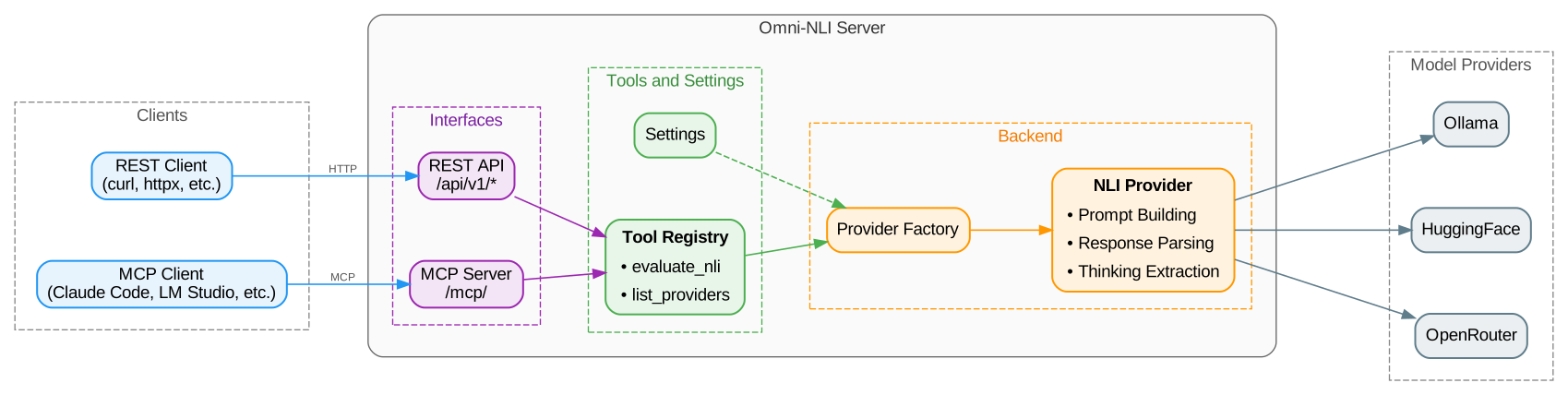
Omni-NLI is a self-hostable server that provides natural language inference (NLI) capabilities via RESTful and the Model Context Protocol (MCP) interfaces. It can be used both as a very scalable standalone stateless microservice (via the REST API) and also as an MCP server for AI agents to implement a verification layer for AI-based applications.
What is NLI?
Given two pieces of text called premise and hypothesis, NLI (AKA textual entailment) is the task of determining the directional relationship between them as it is perceived by a human reader. The relationship is given one of these three labels:
"entailment": the hypothesis is supported by the premise"contradiction": the hypothesis is contradicted by the premise"neutral": the hypothesis is neither supported nor contradicted by the premise
[!IMPORTANT] NLI is not the same as logical entailment. Its goal is to determine if a reasonable human would consider the hypothesis to follow from the premise. This checks for consistency instead of the absolute truth of the hypothesis.
Typical applications of NLI include:
- NLI can be used to check if a given piece of text is consistent with the rest of the text. For example, if a new response from a chatbot or AI assistant contradicts something that was said earlier in the conversation.
- It can be used to check if a summarization contradicts the original text in some way.
- It can be used to check if the documents in the ranked list of results entail the query.
- It can be used to check if a piece of text is supported by some facts. Note that this is not the same as using logic.
[!IMPORTANT] The quality of the results depends a lot on the model (the LLM) that is used. A good strategy is to first fine-tune the model using a dataset of premise-hypothesis-label triples that are relevant to your application domain.
Main Features of Omni-NLI
- Helps mitigate LLM hallucinations by verifying if the generated content is supported by facts
- Supports models provided by different backends, including Ollama, HuggingFace (public and private/gated models), and OpenRouter
- Supports REST API (for traditional applications) and MCP (for AI agents) interfaces
- Fully configurable and very scalable, with built-in caching
- Provides confidence scores and (optional) reasoning traces for explainability
See ROADMAP.md for the list of implemented and planned features.
[!IMPORTANT] Omni-NLI is in early development, so bugs and breaking changes are expected. Please use the issues page to report bugs or request features.
Quickstart
1. Installation
pip install omni-nli[huggingface]
2. Start the Server
omni-nli
3. Evaluate NLI (with REST API)
curl -X POST \
  -H "Content-Type: application/json" \
  -d '{
    "premise": "A football player kicks a ball into the goal.",
    "hypothesis": "The football player is asleep on the field."
  }' \
  http://127.0.0.1:8000/api/v1/nli/evaluate
Example response:
{
    "label": "contradiction",
    "confidence": 0.99,
    "model": "microsoft/Phi-3.5-mini-instruct",
    "backend": "huggingface"
}
4. Evaluate NLI (with MCP Interface)

Documentation
Check out the Omni-NLI Documentation for more information, including configuration options, API reference, and examples.
Contributing
Contributions are always welcome! Please see CONTRIBUTING.md for details on how to get started.
License
Omni-NLI is licensed under the MIT License (see LICENSE).
Acknowledgements
- The logo is from SVG Repo with some modifications.
Install Omni NLI in Claude Desktop, Claude Code & Cursor
unyly install omni-nliInstalls into Claude Desktop, Claude Code, Cursor & VS Code — handles npx, uvx and build-from-source repos for you.
First time? Get the CLI: curl -fsSL https://unyly.org/install | sh
Or configure manually
Run in your terminal:
claude mcp add omni-nli -- uvx omni-nliFAQ
Is Omni NLI MCP free?
Yes, Omni NLI MCP is free — one-click install via Unyly at no cost.
Does Omni NLI need an API key?
No, Omni NLI runs without API keys or environment variables.
Is Omni NLI hosted or self-hosted?
Self-hosted: the server runs locally on your machine via the install command above.
How do I install Omni NLI in Claude Desktop, Claude Code or Cursor?
Open Omni NLI on unyly.org, pick your client tab (Claude Desktop, Claude Code, Cursor) and press Install — the config is generated automatically, no JSON editing.
Related MCPs
Fetch
Web content fetching and conversion for efficient LLM usage.
AWS KB Retrieval
Retrieval from AWS Knowledge Base using Bedrock Agent Runtime.
 by modelcontextprotocol
Spring AI MCP Server
Provides auto-configuration for setting up an MCP server in Spring Boot applications.
llm-analysis-assistant
A very streamlined mcp client that supports calling and monitoring stdio/sse/streamableHttp, and can also view request responses through the /logs page. It also
 by xuzexin-hz
Compare Omni NLI with
Not sure what to pick?
Find your stack in 60 seconds
Author?
Embed badge for your README
Browse similar
All ai MCPs