
Polyforge
FreeNot checkedReliability auditor + fallback router for MCP servers — score each on a 9-point rubric, fail CI on dead ones, and route your agent around them.

About
Reliability auditor + fallback router for MCP servers — score each on a 9-point rubric, fail CI on dead ones, and route your agent around them.
README
Half the public MCP servers are abandoned. Don't let a dead one silently corrupt your agent.
When an AI agent calls a broken or drifted MCP tool, the model often doesn't crash — it improvises around the bad response and keeps going, contaminating every downstream step with no error and no alert. PolyForge catches that before it ships: it scores every MCP server your agent depends on, flags the dead ones, and routes around them.
Quick start (no credentials needed)
git clone https://github.com/AryanGonsalves/polyforge.git
cd polyforge
pip install -e .

# Audit the MCP servers your agent depends on
polyforge mcp-audit examples/mcp_servers.yaml

# See audit + fallback routing end to end
python -m examples.mcp_demo
Note: PolyForge isn't on PyPI yet, so install from source as shown above. PyPI publishing is planned — once it's live,
pip install polyforgewill work directly.
Example output:
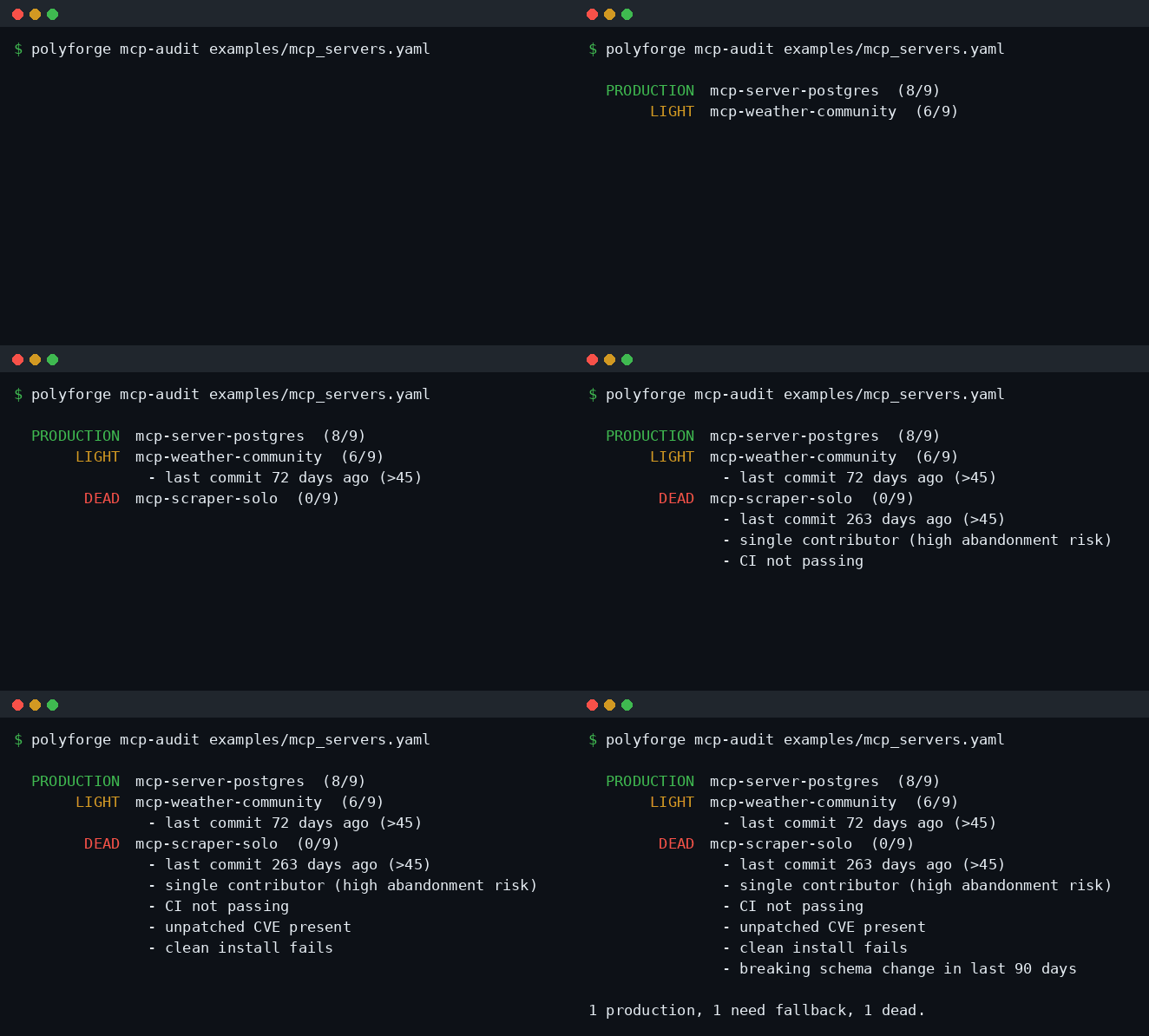
  PRODUCTION  mcp-server-postgres  (8/9)
       LIGHT  mcp-weather-community  (6/9)   - last commit 70 days ago (>45)
        DEAD  mcp-scraper-solo  (0/9)
               - single contributor (high abandonment risk)
               - CI not passing
               - unpatched CVE present
What it does
| Capability | What it does | Where |
|---|---|---|
| Reliability scoring | 9-point rubric per server → production / light / dead | mcp/scorer.py |
| Audit | Bucket all your servers; fail CI if any are dead | mcp/auditor.py |
| Fallback routing | Resolve a capability to the healthiest server, skip dead ones | mcp/auditor.py |
The scoring signals: commit recency, contributor count (a sole maintainer is the highest-signal abandonment indicator), CI status, unpatched CVEs, clean install, hosted uptime, and schema stability. Unknown signals are treated conservatively — unknown is never given credit.
Auto-gather signals from GitHub
Instead of hand-writing every signal, PolyForge can fetch the cheap, high-signal ones — last commit date, contributor count, and CI status — straight from a repo on GitHub:
# Score a single server straight from its repo
polyforge mcp-gather owner/repo

# Audit a whole manifest, enriching any entry that declares a `repo:`
polyforge mcp-audit examples/mcp_servers_gather.yaml --gather
Gathered signals are merged over the YAML (live data wins; the YAML still
supplies what GitHub can't — CVE status, clean install, hosted uptime, schema
stability). Because unknown signals get no credit, the three auto-gathered
signals alone won't reach a passing score — pair them with a YAML entry. Set
GITHUB_TOKEN (or pass --token) to avoid API rate limits. If a repo can't be
fetched, that entry falls back to its YAML signals with a warning rather than
failing the whole audit.
Library use
Install from source first (see Quick start above); PyPI publishing is planned,
after which pip install polyforge will work directly.
from datetime import date
from polyforge.mcp.scorer import ServerSignals
from polyforge.mcp.auditor import audit, FallbackRouter

servers = [
    ServerSignals("postgres-mcp", last_commit=date(2026, 5, 25),
                  contributor_count=12, ci_passing=True),
    ServerSignals("scraper-solo", last_commit=date(2025, 10, 1),
                  contributor_count=1, ci_passing=False),
]

report = audit(servers)
print("dead:", [r.name for r in report.dead])

router = FallbackRouter(servers)
chosen = router.resolve(["scraper-solo", "postgres-mcp"])  # skips dead, picks healthy
Why this and not an LLM gateway
The LLM-gateway space (routing/fallback across model providers) is mature and crowded — LiteLLM, Portkey, OpenRouter all do it well. MCP server reliability is the same fallback principle applied one layer out, to tools, where the problem is fresh and teams are still scoring servers by hand. PolyForge reuses the gateway's registry/status/fallback pattern there.
The model-gateway pieces (
gateway/,adapters/) still ship and work — they were the origin of the fallback pattern this is built on. The MCP auditor is the focus.
Honest limits (current phase)
- Commit recency, contributor count, and CI status can be auto-gathered from
GitHub (
mcp-gather/mcp-audit --gather); the remaining signals (CVE, clean install, uptime, schema stability) are still supplied via YAML. Gathering is kept separate from scoring, so the scorer stays deterministic and testable. - The rubric weights are a sensible default, not yet validated against a large labeled set of real servers.
- Fallback routing resolves the best server; it does not yet execute MCP calls.
Validation status
This targets a real, documented pain (silent MCP tool failures; >50% of public
servers abandoned per a 2026 audit), but the product-market fit is a hypothesis,
not proven. Next step is putting mcp-audit in front of real agent developers
before building further.
Roadmap
- Now: scorer, auditor, fallback router, CLI, manifest ✔
- Done: auto-gather commit recency, contributors & CI from GitHub
(
mcp-gather,mcp-audit --gather) ✔ — auto-gathering CVE/uptime/schema is future work - GitHub Action: fail a PR that wires in a dead MCP server
- Live MCP call execution through the fallback router
- Hosted registry of community-scored servers
Installing Polyforge
This server has no published package — it is built from source. Open the repository and follow its README.
▸ github.com/AryanGonsalves/polyforgeFAQ
Is Polyforge MCP free?
Yes, Polyforge MCP is free — one-click install via Unyly at no cost.
Does Polyforge need an API key?
No, Polyforge runs without API keys or environment variables.
Is Polyforge hosted or self-hosted?
Self-hosted: the server runs locally on your machine via the install command above.
How do I install Polyforge in Claude Desktop, Claude Code or Cursor?
Open Polyforge on unyly.org, pick your client tab (Claude Desktop, Claude Code, Cursor) and press Install — the config is generated automatically, no JSON editing.
Related MCPs
Fetch
Web content fetching and conversion for efficient LLM usage.
AWS KB Retrieval
Retrieval from AWS Knowledge Base using Bedrock Agent Runtime.
 by modelcontextprotocol
Spring AI MCP Server
Provides auto-configuration for setting up an MCP server in Spring Boot applications.
llm-analysis-assistant
A very streamlined mcp client that supports calling and monitoring stdio/sse/streamableHttp, and can also view request responses through the /logs page. It also
 by xuzexin-hz
Compare Polyforge with
Not sure what to pick?
Find your stack in 60 seconds
Author?
Embed badge for your README
Browse similar
All ai MCPs