
Rm Brain Server
FreeNot checkedEnables searching and exploring handwritten reMarkable notebooks through a natural conversation with Claude Desktop, with full-text search, classification, and

About
Enables searching and exploring handwritten reMarkable notebooks through a natural conversation with Claude Desktop, with full-text search, classification, and source citations.
README
🧠 rm-brain
A local-first "second brain" for your handwritten reMarkable notebooks — searched through a normal Claude Desktop conversation.
CI License: MIT Node PRs welcome
Built by Gabriel Anhaia · ☕ Buy me a coffee

The local web app — dashboard · search · notebooks · page detail · entities. Fictional example data.
rm-brain quietly syncs the notebooks you drop into a Brain folder on your reMarkable, transcribes and classifies the handwriting with the Claude API, and stores everything in a local SQLite database. You then search and explore your notes as an ordinary conversation in Claude Desktop — no separate app, no hosted service, using your existing Claude subscription.
You: "What did I decide about the Acme pricing model?" Claude: Pulls it from your notes and answers with receipts — notebook name, page number, date, and the scanned page.
It's designed to feel less like a search box and more like a system that quietly organizes itself and surfaces things you forgot about.
Why it's different
- Your handwriting, actually understood. Claude vision transcribes messy handwriting and diagrams far better than built-in OCR, and classifies each page (journal / meeting / idea / decision / …), extracts people & projects, and flags open loops.
- The interface is a conversation, not a dashboard. Search happens inside Claude Desktop via MCP — you get a world-class chat UI for free.
- Local-first and private by design. The database, page images, and manifest never leave your machine. See Privacy.
- Answers with receipts. Every answer cites the notebook, page number, and date, and can show you the scanned page — so you verify, not trust blindly.
How it works
flowchart TD
    A["☁️ reMarkable Cloud"] -->|"rmapi: list Brain folder · stat · get"| B["📦 .rmdoc archive<br/>(.rm v6 vector files)"]
    B -->|rmc| C["🖼️ per-page SVG"]
    C -->|rsvg-convert| D["🏞️ page PNGs"]
    D -->|"Claude vision · 1 call/page"| E["✍️ Extraction<br/>text · type · entities · open loops"]
    E --> F[("🗄️ SQLite + FTS5<br/>~/.rm-brain")]
    CLI["⌨️ CLI<br/>sync · search · backup"] --> F
    F <--> G["🔌 MCP server"]
    G <--> H["💬 Claude Desktop"]
    G <--> H2["🤖 ChatGPT"]
    G <--> H3["✦ Gemini"]
    F --> W["🖥️ Web app<br/>browse · search (localhost)"]

    classDef cloud fill:#e8f0fe,stroke:#4285f4,color:#1a1a1a;
    classDef local fill:#e9f7ef,stroke:#27ae60,color:#1a1a1a;
    classDef ai fill:#f3e8fd,stroke:#8e44ad,color:#1a1a1a;
    class A cloud;
    class B,C,D,F,CLI,W local;
    class E,G,H,H2,H3 ai;
The MCP server speaks the open Model Context Protocol, so any MCP-capable assistant can use your notes — Claude Desktop (the primary, best-tested target), ChatGPT, Gemini, and others. See docs/mcp.md.
reMarkable notebooks are stored as proprietary .rm v6 vector files (not PDFs), so pages are
rendered with rmc + rsvg-convert. See
ARCHITECTURE.md for the full design.
🔒 Privacy & safety
- Local-first, always.
db.sqlite, page images, and the manifest live in one folder (~/.rm-brainby default) and never leave your machine as a whole. - The only things that ever go over the network are (a) individual page images sent to the
Claude API during
sync, and (b) individual queries + retrieved snippets sent through MCP while you search in Claude Desktop. - Opt-in by folder. Nothing is indexed unless you put the notebook in your Brain folder.
- The folder is the source of truth. Remove a notebook from it and the next
syncprunes it from your local index — pages and images included. - Hard exclusion always wins. A notebook whose name matches
/^\./,/private/i, or/noindex/iis skipped entirely, even inside the Brain folder — and so is anything filed under a subfolder with such a name (e.g.Brain/private/…). - Read-only cloud access. rm-brain only ever reads from reMarkable (
list/stat/get); it never uploads or modifies anything. - No telemetry. rm-brain phones home to nobody. See SECURITY.md.
Prerequisites
✅ No jailbreak, rooting, developer mode, or SSH hacks — ever. rm-brain works entirely through reMarkable's official cloud sync (via
rmapi). Your tablet stays completely stock, stock firmware, and under warranty. Nothing is installed on or modified on the device.
| Tool | Why | Install |
|---|---|---|
| Node.js 20+ | runtime | nodejs.org |
rmapi (ddvk sync15 build) |
reMarkable Cloud CLI | ddvk/rmapi releases — reMarkable's newer sync protocol returns HTTP 410 with older builds |
| rmc | renders .rm v6 pages |
pipx install rmc |
librsvg (rsvg-convert) |
SVG → PNG | brew install librsvg |
| Anthropic API key | handwriting extraction (used only during sync) |
console.anthropic.com |
Quickstart
# 1. Install
git clone https://github.com/gabrielanhaia/remarkable-brain.git
cd remarkable-brain
npm install && npm run build
npm link            # puts `rm-brain` on your PATH

# 2. Guided setup (pairs rmapi, saves your API key, wires Claude Desktop)
rm-brain setup

# 3. On the tablet: create a "Brain" folder, move a notebook in, let it sync
rm-brain sync

# 4. Fully quit & reopen Claude Desktop, then just ask it about your notes
The setup wizard checks your tools, pairs rmapi, prompts for your API key once and saves
it (to ~/.rm-brain/config.json, chmod 600 — no re-export needed), helps you pick the
Brain folder, offers to run the first sync, and can write your Claude Desktop config
automatically. Re-run it anytime — it's idempotent.
Usage
Once a notebook is indexed and Claude Desktop is connected, just talk to Claude:
- "What are my open loops?" / "What did I forget to follow up on?"
- "Search my notes for the Atlas pricing decision."
- "How has my thinking on the onboarding flow evolved?" (entity timeline)
- "Show me the page where I sketched the architecture."
Web interface
Prefer to see your notes? rm-brain ships a local-first, read-only web app — an alternative way to browse and search your indexed notebooks and view the actual scanned handwriting in the browser. Its design is a quiet, fountain-pen-ink-on-fine-paper reading room that follows your system light/dark theme (scans always stay light paper, so handwriting never inverts). It complements the conversation, it doesn't replace it: asking questions still happens in Claude Desktop (over MCP); the web app is for seeing and searching.
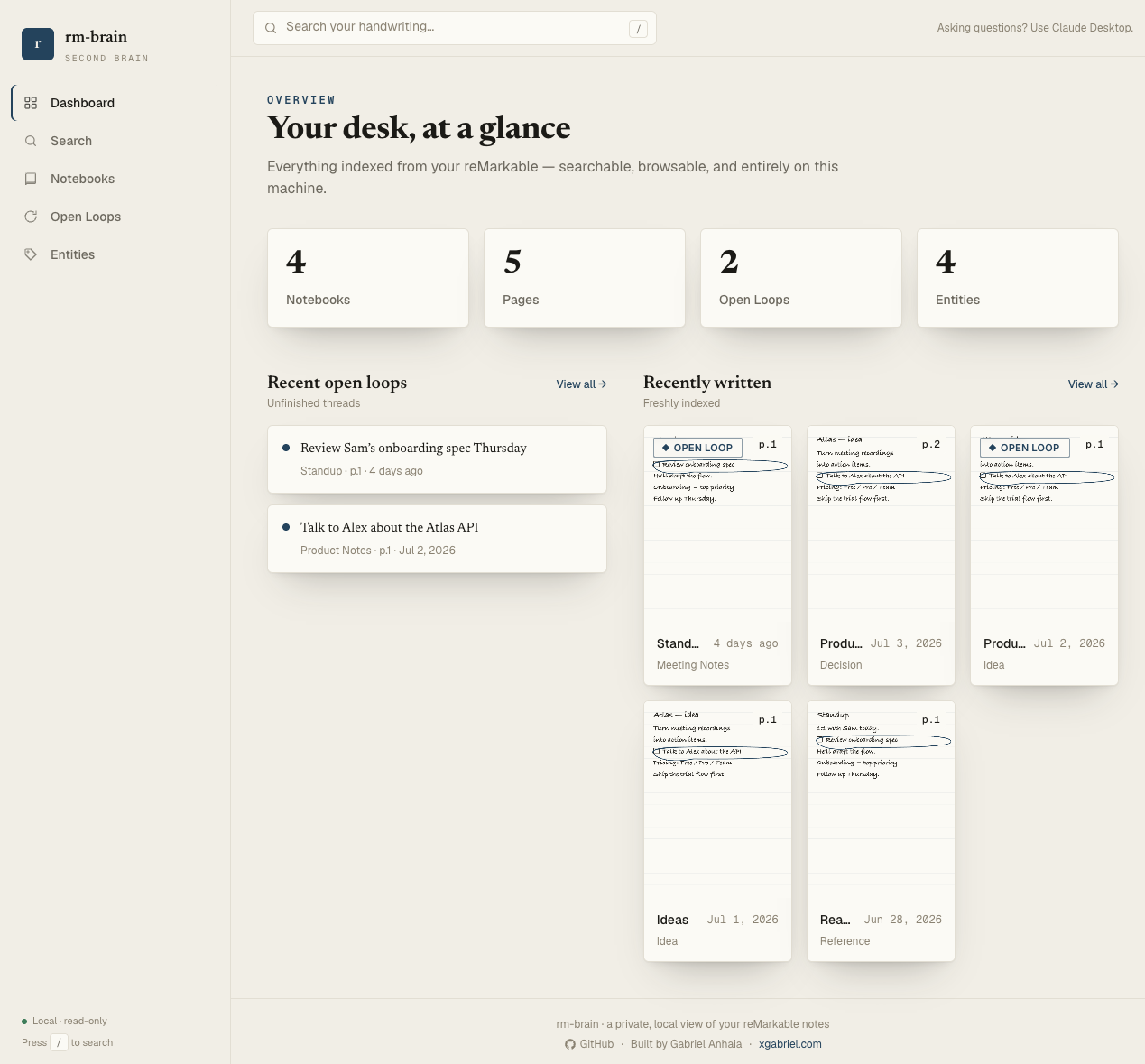


Screens shown with fictional example data. Everything runs on your machine.
rm-brain web                       # builds nothing — opens http://localhost:4123 in your browser
rm-brain web --port 8080           # pick a different port
rm-brain web --host 127.0.0.1      # bind address (localhost only, by design)
rm-brain web --no-open             # don't auto-open the browser
It serves the Dashboard (counts + recent open loops and pages), forgiving search — word forms (meeting/meetings), partial words, and small misspellings all match — with filters (notebook, page type, open-loop only), a Notebooks grid grouped by reMarkable subfolder, per-page detail (scanned image side-by-side with the transcription), Open Loops, and Entity timelines.
Same guarantees as the rest of rm-brain: it binds 127.0.0.1 only, exposes GET endpoints only,
has no auth surface, and makes no outbound network calls. The frontend ships prebuilt (in
web/dist), so there's no build step for end users — just run rm-brain web.
CLI reference
| Command | What it does |
|---|---|
rm-brain setup |
Interactive setup wizard (start here) |
rm-brain sync |
Pull Brain-folder notebooks, render, extract, index |
rm-brain reindex |
Re-extract all indexed pages (after a prompt/model change) |
rm-brain search "<query>" |
Search from the terminal (keyword + local semantic) |
rm-brain embed |
Build local semantic-search vectors (optional; on-device, no API) |
rm-brain list |
Show indexed notebooks and page counts |
rm-brain info |
Where the data lives + stats |
rm-brain backup [dest] |
Write a portable .tar.gz of the whole index |
rm-brain exclude "<name>" / include "<name>" |
Exclude (purges) / re-include a notebook |
rm-brain purge |
Delete the entire local index |
rm-brain doctor |
Check dependencies |
rm-brain mcp |
Start the MCP server (Claude Desktop runs this) |
rm-brain web |
Open the local read-only web app to browse & search your notes (--port / --host / --no-open) |
Configuration
All config is via environment variables (env wins) or the saved store (~/.rm-brain/config.json).
| Env var | Default | Purpose |
|---|---|---|
RM_BRAIN_HOME |
~/.rm-brain |
Where all local data lives |
RM_BRAIN_FOLDER |
/Brain |
reMarkable folder whose notebooks get indexed (case-insensitive) |
RMAPI_BIN |
rmapi |
Path/name of the rmapi binary (ddvk sync15 build) |
RMC_BIN |
rmc |
Path/name of the rmc renderer |
RSVG_BIN |
rsvg-convert |
Path/name of rsvg-convert |
ANTHROPIC_API_KEY |
— | Required only for sync (extraction) |
ANTHROPIC_MODEL |
claude-sonnet-5 |
Vision model for extraction |
RM_BRAIN_SEARCH |
auto |
auto uses local semantic search when available; keyword forces keyword-only |
RM_BRAIN_EMBED_MODEL |
Xenova/all-MiniLM-L6-v2 |
On-device model for semantic embeddings |
Portability & backup
The whole index is one self-contained folder, so:
- Back up:
rm-brain backup [dest.tar.gz], or just copy~/.rm-brain. - Roam / auto-backup: point
RM_BRAIN_HOMEat a Dropbox/iCloud/Syncthing folder. - Restore: extract the archive anywhere and point
RM_BRAIN_HOMEat it.
Troubleshooting
rmapi says "failed to build documents tree … status 410"
Your reMarkable account is on the newer sync protocol. Use the
ddvk `sync15` build of rmapi (a release binary is
easiest), not the original juruen/rmapi. Then re-run rm-brain doctor.
Claude Desktop gives empty results even though the note exists
Claude Desktop launches the MCP server once at startup and keeps it running. After any
rm-brain update, fully quit Claude Desktop (⌘Q, not just close the window) and reopen it
so it reloads the server.
Claude answers from the calendar/memory instead of my notes
Add a one-line personal instruction in Claude Desktop → Settings → Profile / Custom Instructions: "I keep my handwritten notes in rm-brain. For anything about my tasks, plans, or notes, use the rm-brain tools first." The server also ships proactive instructions, but a personal instruction is the most reliable nudge.
My notebook isn't being indexed
Make sure it's inside the Brain folder (case-insensitive) and that the tablet has synced
to the cloud (Wi-Fi on). Then run rm-brain sync. Notebooks named private/noindex/dotted
are skipped by design.
I changed the extraction prompt / model — old pages didn't update
A normal sync skips pages whose image is unchanged. Run rm-brain reindex to re-extract
everything.
Roadmap / not in v1 (on purpose)
Search is FTS5 keyword by default (stemmed, typo-tolerant, order-independent), with optional on-device semantic search you can turn on locally (see docs/search.md) — no cloud search, ever. No notifications or daily digests. The web app is a read-only way to see and search your notes — asking questions stays in Claude Desktop, so this remains a tool you reach for, not one that reaches for you. Ideas and PRs welcome — see CONTRIBUTING.md.
Documentation
Want to understand how it works under the hood?
- How search works — local keyword search, stemming (word forms), typo tolerance, and word-order independence, all offline.
- How rm-brain uses AI — where Claude vision comes in (indexing only), what it extracts from each page, and exactly what does and doesn't cross the network.
- How the MCP integration works — the read-only tools rm-brain exposes to Claude Desktop, and how a question becomes an answer with citations.
- ARCHITECTURE.md — the full system design and data flow.
Contributing
Contributions are very welcome! Please read CONTRIBUTING.md to get set up, and CODE_OF_CONDUCT.md. Security issues: SECURITY.md.
💛 Support
If rm-brain is useful to you, consider supporting development — it genuinely helps and keeps the project going:


You can also ⭐ star the repo — it helps others discover it.
License
Install Rm Brain Server in Claude Desktop, Claude Code & Cursor
unyly install rm-brain-mcp-serverInstalls into Claude Desktop, Claude Code, Cursor & VS Code — handles npx, uvx and build-from-source repos for you.
First time? Get the CLI: curl -fsSL https://unyly.org/install | sh
Or configure manually
Run in your terminal:
claude mcp add rm-brain-mcp-server -- npx -y github:gabrielanhaia/remarkable-brainFAQ
Is Rm Brain Server MCP free?
Yes, Rm Brain Server MCP is free — one-click install via Unyly at no cost.
Does Rm Brain Server need an API key?
No, Rm Brain Server runs without API keys or environment variables.
Is Rm Brain Server hosted or self-hosted?
Self-hosted: the server runs locally on your machine via the install command above.
How do I install Rm Brain Server in Claude Desktop, Claude Code or Cursor?
Open Rm Brain Server on unyly.org, pick your client tab (Claude Desktop, Claude Code, Cursor) and press Install — the config is generated automatically, no JSON editing.
Related MCPs
Fetch
Web content fetching and conversion for efficient LLM usage.
AWS KB Retrieval
Retrieval from AWS Knowledge Base using Bedrock Agent Runtime.
 by modelcontextprotocol
Spring AI MCP Server
Provides auto-configuration for setting up an MCP server in Spring Boot applications.
llm-analysis-assistant
A very streamlined mcp client that supports calling and monitoring stdio/sse/streamableHttp, and can also view request responses through the /logs page. It also
 by xuzexin-hz
Compare Rm Brain Server with
Not sure what to pick?
Find your stack in 60 seconds
Author?
Embed badge for your README
Browse similar
All ai MCPs