
Scern
FreeNot checkedProduct evaluation MCP server for US packaged food. Health scores, ingredient safety, regulatory flags, recall history, corporate ownership.

About
Product evaluation MCP server for US packaged food. Health scores, ingredient safety, regulatory flags, recall history, corporate ownership.
README
A product evaluation MCP server for US packaged food. Give your agent a barcode and get back a deterministic, cited verdict. Health scoring, ingredient-level safety, state regulatory flags, FDA recall history, and corporate ownership resolved to the ultimate parent.
Hosted, remote, no install, no auth.
https://api.scern.app/mcp
Paste that URL into Claude or any MCP client that supports Streamable HTTP and start evaluating products.
Live inside Claude
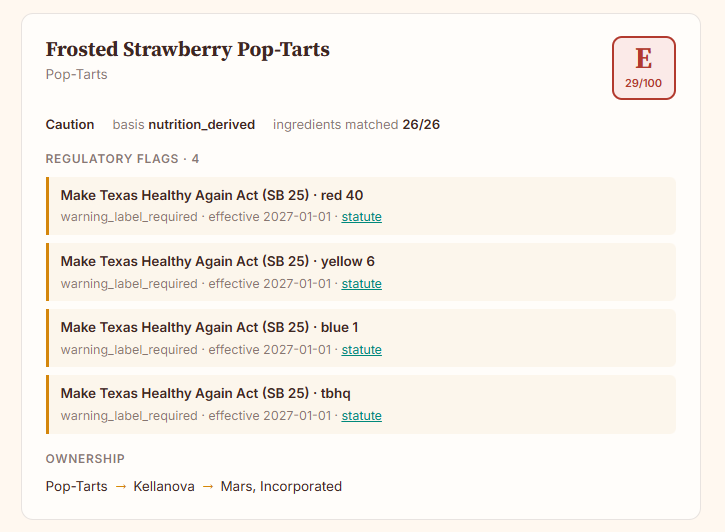
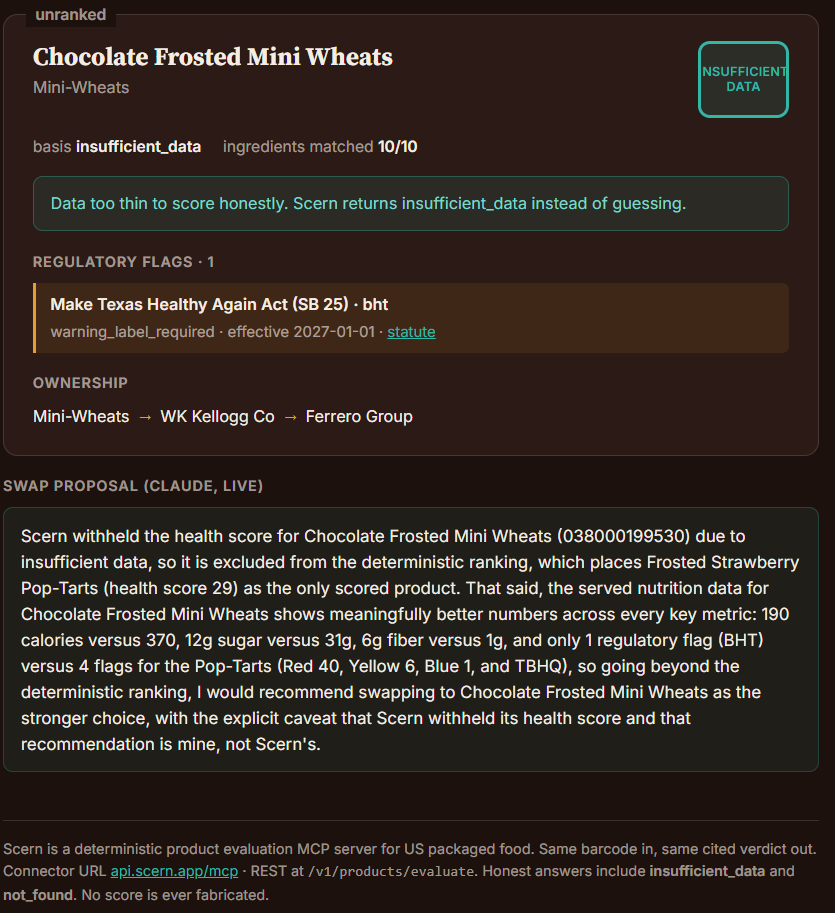
Claude artifacts can call MCP connectors directly. This is Scern powering a live evaluation and a compare-and-swap flow inside a Claude artifact, no integration code written.
Why this exists
Agents are starting to buy groceries. When someone tells their agent "order snacks for my kids this week," the agent has to translate a vague request into specific products. What informs that selection? Today the answer is mostly whatever ranked first in search results.
Scern is the evaluation layer for that decision. Same barcode in, same structured verdict out, every time. The agent can compare the options and explain its choice.
Tools
evaluate_product
Evaluate a single product by barcode.
| Parameter | Type | Required | Description |
|---|---|---|---|
identifier |
"upc" | "ean" | "barcode" |
yes | Barcode identifier type |
value |
string | yes | The barcode value |
jurisdiction |
string or string[] | no | Filter regulatory flags. Valid values CA, TX, WV |
context |
"retail" | "school_meals" |
no | Evaluation context, default retail |
Returns a full evaluation. Health score with Nutri-Score 2023 letter grade computed from manufacturer panel data, NOVA processing classification, per-ingredient safety review with plain-language explanations, state regulatory flags each carrying the law, effective date, penalty, and source URL, FDA recall history, packaging policy data, and the brand ownership chain resolved to the ultimate parent company.
When the underlying data is insufficient to score honestly, the API returns insufficient_data instead of guessing.
compare_products
Compare 2 to 5 products by health score. Returns all evaluations, a ranking by health score descending, and the best-scoring barcode. Products not found are included as { value, status: "not_found" } and excluded from the ranking.
| Parameter | Type | Required | Description |
|---|---|---|---|
values |
string[] | yes | 2 to 5 barcode values |
identifier |
"upc" | "ean" | "barcode" |
no | Applied to all values, default upc |
jurisdiction |
string or string[] | no | Filter regulatory flags. Valid values CA, TX, WV |
context |
"retail" | "school_meals" |
no | Evaluation context, default retail |
This is the swap flow. An agent scores the candidates from a search result, proposes the better-scoring alternative, and can explain why. "This one has a Red 40 flag, this alternative scores higher with no flags, want to swap?"
What an evaluation looks like
A real excerpt from evaluating a Pop-Tarts barcode:
{
  "name": "Frosted Strawberry Pop-Tarts",
  "brand": "Pop-Tarts",
  "healthScore": 29,
  "scoreLabel": "Caution",
  "score_basis": "nutrition_derived",
  "healthBreakdown": { "nutriScoreGrade": "e", "novaGroup": 4 },
  "matchStats": { "total": 26, "matched": 26, "matchRate": 1 },
  "regulatory_flags": [
    {
      "jurisdiction": "TX",
      "law_name": "Make Texas Healthy Again Act (SB 25)",
      "status": "warning_label_required",
      "effective_date": "2027-01-01",
      "ingredient_found": "red 40",
      "penalty": "Up to $50,000 per day per violative product",
      "source_url": "https://capitol.texas.gov/BillLookup/History.aspx?LegSess=89R&Bill=SB25"
    }
  ],
  "brandOwnershipChain": {
    "ownershipPath": ["Pop-Tarts", "Kellanova", "Mars, Incorporated"]
  }
}
Every ingredient in the product gets its own reviewed entry. Red 40, Yellow 6, Blue 1, and TBHQ each trigger a Texas SB 25 flag on this product, with the statute cited.
Connecting
Claude (web or desktop). Settings, Connectors, Add custom connector, paste https://api.scern.app/mcp.
Claude Code.
claude mcp add --transport http scern https://api.scern.app/mcp
Any STDIO-only client via mcp-remote:
{
  "mcpServers": {
    "scern": {
      "command": "npx",
      "args": ["-y", "mcp-remote", "https://api.scern.app/mcp"]
    }
  }
}
Plain HTTP. The server speaks Streamable HTTP JSON-RPC. An initialize followed by tools/list works from curl if you want to inspect the schemas directly. There is also a REST endpoint at POST https://api.scern.app/v1/products/evaluate accepting {"identifier": "upc", "value": "..."}.
What's behind it
- A human-reviewed ingredient dictionary covering roughly 90% of ingredients in US packaged food, each entry carrying a reviewed status and a plain-language explanation
- Nutri-Score 2023 scoring computed from manufacturer nutrition panel data, with the letter grade served in the payload
- Regulatory flag tracking for California AB 418, Texas SB 25, Texas SB 314, and West Virginia HB 2354, with jurisdiction filtering and a school meals context
- FDA recall history via openFDA, checked per evaluation and cached
- Corporate ownership trees resolved to the ultimate parent, current through recent acquisitions
- Packaging policy indexing including FCCdb chemical data where available
Determinism is the design constraint. No generative model sits between the database and the verdict. The same barcode returns the same evaluation until the underlying data changes, and every claim in the payload carries its provenance.
Coverage and honesty
Scern covers US packaged food with an emphasis on products marketed to children and families. Coverage is growing. When a product is unknown or its data is too thin to score, the API says so, not_found and insufficient_data are real answers you will see. If you hit coverage gaps that matter to what you are building, open an issue. Gap reports directly prioritize what gets added next.
Feedback
Issues and discussions are open. If you are building an agent that touches food, groceries, nutrition, or shopping, I would genuinely like to hear what works and what breaks.
Built by Cory Lewis. Contact [email protected].
Installing Scern
This server has no published package — it is built from source. Open the repository and follow its README.
▸ github.com/elcoryel/scern-mcpFAQ
Is Scern MCP free?
Yes, Scern MCP is free — one-click install via Unyly at no cost.
Does Scern need an API key?
No, Scern runs without API keys or environment variables.
Is Scern hosted or self-hosted?
Self-hosted: the server runs locally on your machine via the install command above.
How do I install Scern in Claude Desktop, Claude Code or Cursor?
Open Scern on unyly.org, pick your client tab (Claude Desktop, Claude Code, Cursor) and press Install — the config is generated automatically, no JSON editing.
Related MCPs
Fetch
Web content fetching and conversion for efficient LLM usage.
AWS KB Retrieval
Retrieval from AWS Knowledge Base using Bedrock Agent Runtime.
 by modelcontextprotocol
Spring AI MCP Server
Provides auto-configuration for setting up an MCP server in Spring Boot applications.
llm-analysis-assistant
A very streamlined mcp client that supports calling and monitoring stdio/sse/streamableHttp, and can also view request responses through the /logs page. It also
 by xuzexin-hz
Compare Scern with
Not sure what to pick?
Find your stack in 60 seconds
Author?
Embed badge for your README
Browse similar
All ai MCPs