
SemaphoreUI Server
FreeNot checkedEnables AI assistants to interact with SemaphoreUI for managing and running Ansible automation tasks through natural language commands.

About
Enables AI assistants to interact with SemaphoreUI for managing and running Ansible automation tasks through natural language commands.
README
A Model Context Protocol (MCP) server that connects AI assistants to SemaphoreUI - enabling natural language control of Ansible automation.
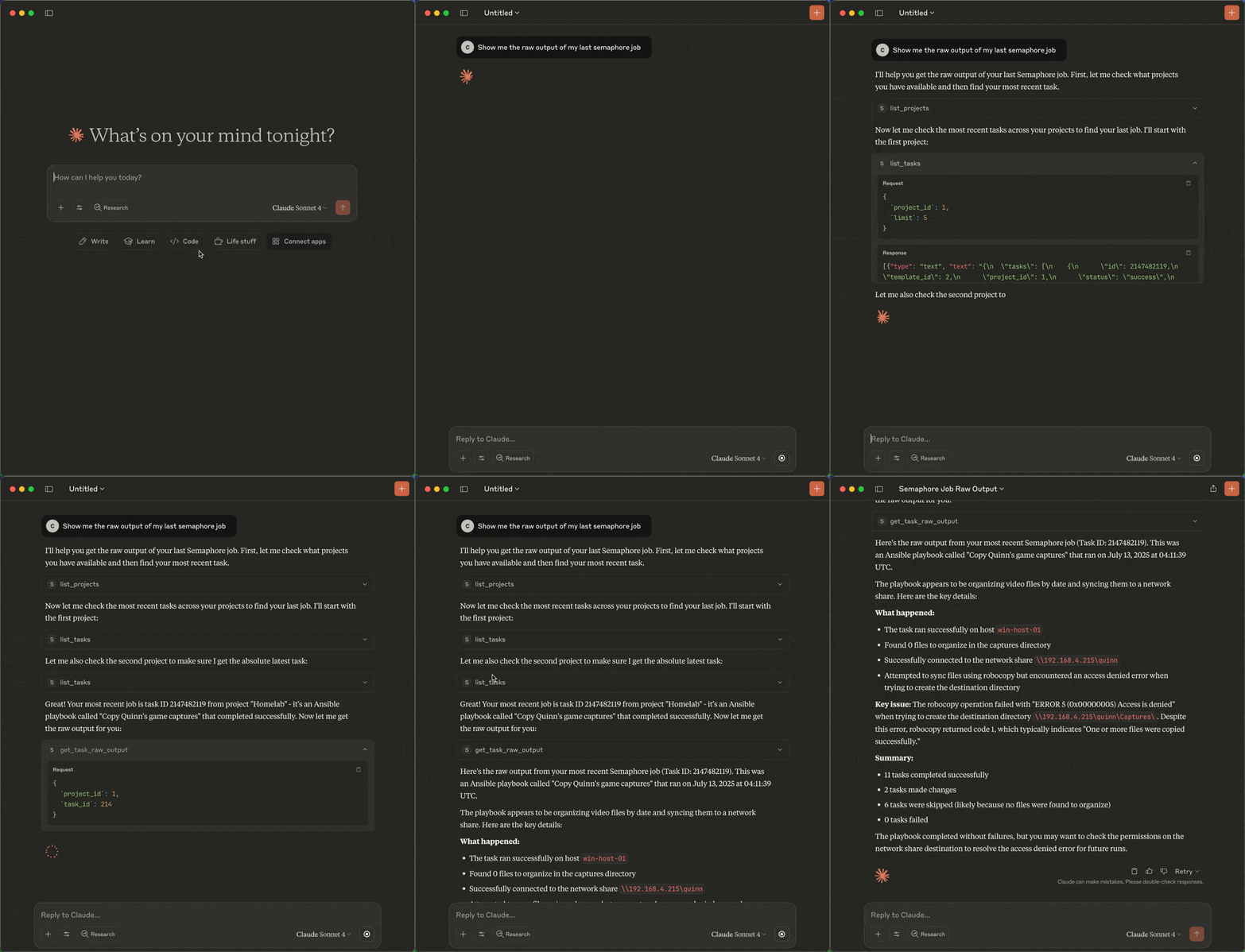
Quick Start
Prerequisites
- Docker (or Podman)
- A running SemaphoreUI instance with an API token
- Claude Desktop or Claude Code (or another MCP client)
- Node.js (for Claude Desktop only - required for
mcp-remote)
1. Get a SemaphoreUI API Token
- Login to your SemaphoreUI instance
- Go to User Settings
- Generate a new API token
2. Run the MCP Server
docker run -d --name semaphore-mcp \
  --network host \
  -e SEMAPHORE_URL=http://localhost:3000 \
  -e SEMAPHORE_API_TOKEN=your-token-here \
  -e MCP_PORT=8500 \
  ghcr.io/cloin/semaphore-mcp:latest
Note:
SEMAPHORE_URLis where the MCP server connects to SemaphoreUI.MCP_PORTis where the MCP server listens for client connections (Claude Desktop/Code). Use this port in your client configuration below.
3a. Configure Claude Desktop
Claude Desktop requires the mcp-remote proxy to connect to HTTP-based MCP servers. This requires Node.js to be installed (npx comes with npm).
Edit your config file:
- macOS:
~/Library/Application Support/Claude/claude_desktop_config.json - Windows:
%APPDATA%\Claude\claude_desktop_config.json - Linux:
~/.config/claude-desktop/claude_desktop_config.json
{
  "mcpServers": {
    "semaphore": {
      "command": "npx",
      "args": ["mcp-remote", "http://127.0.0.1:8500/mcp"]
    }
  }
}
3b. Configure Claude Code
Claude Code supports remote MCP servers directly:
claude mcp add --transport http semaphore http://127.0.0.1:8500/mcp
Verify it's configured:
claude mcp list
4. Test It
Restart Claude Desktop and try:
"List all projects in SemaphoreUI"
Docker Networking
The MCP server container needs to reach your SemaphoreUI instance.
SemaphoreUI on the same host:
Use --network host so the container can access localhost:
docker run -d --name semaphore-mcp \
  --network host \
  -e SEMAPHORE_URL=http://localhost:3000 \
  -e SEMAPHORE_API_TOKEN=your-token \
  -e MCP_PORT=8500 \
  ghcr.io/cloin/semaphore-mcp:latest
SemaphoreUI on a different host:
Use the IP or hostname directly (no --network host needed):
docker run -d --name semaphore-mcp \
  -e SEMAPHORE_URL=http://192.168.1.100:3000 \
  -e SEMAPHORE_API_TOKEN=your-token \
  -p 8500:8000 \
  ghcr.io/cloin/semaphore-mcp:latest
For more details, see Docker's networking documentation.
Configuration
| Variable | Required | Default | Description |
|---|---|---|---|
SEMAPHORE_URL |
Yes | - | URL to your SemaphoreUI instance |
SEMAPHORE_API_TOKEN |
Yes | - | API token from SemaphoreUI |
MCP_TRANSPORT |
No | http |
Transport mode: http or stdio |
MCP_HOST |
No | 0.0.0.0 |
Host to bind to |
MCP_PORT |
No | 8000 |
Port to listen on |
What You Can Do
Once connected, you can interact with SemaphoreUI through natural conversation:
Run automation:
"Run the database backup playbook on production"
Monitor tasks:
"Show me all failed tasks from the last hour and analyze the errors"
Manage infrastructure:
"Create a new staging environment with APP_ENV=staging"
Troubleshoot:
"Get the output from task 42 and tell me why it failed"
Available Tools
Projects: list_projects, get_project, create_project, update_project, delete_project
Project backups: backup_project, restore_project_backup, validate_project_backup, summarize_project_backup, clone_project
Project users: get_project_role, list_project_users, add_project_user, update_project_user, remove_project_user
Views: list_views, get_view, create_view, update_view, delete_view
Templates: list_templates, get_template, create_template, update_template, delete_template
Schedules: list_schedules, list_template_schedules, get_schedule, create_schedule, update_schedule, set_schedule_active, delete_schedule, validate_schedule_cron_format
Tasks: list_tasks, get_task, run_task, stop_task, get_task_raw_output, filter_tasks, bulk_stop_tasks
Analysis: analyze_task_failure, bulk_analyze_failures, get_latest_failed_task
Events: list_events, get_last_events, list_project_events, summarize_project_activity
Environments: list_environments, get_environment, create_environment, update_environment, delete_environment
Inventory: list_inventory, get_inventory, create_inventory, update_inventory, delete_inventory
Repositories: list_repositories, get_repository, create_repository, update_repository, delete_repository
Access keys: list_access_keys, get_access_key, create_access_key, update_access_key, delete_access_key
Troubleshooting
Container won't start or exits immediately:
docker logs semaphore-mcp
Can't connect to SemaphoreUI from container:
- If SemaphoreUI is on localhost, use
--network host - Check that the URL is reachable from inside the container
- Verify the API token is correct
Claude Desktop not seeing the MCP server:
- Ensure the container is running:
docker ps - Check the port is accessible:
curl http://127.0.0.1:8500/mcp - Restart Claude Desktop after config changes
Enable debug logging:
docker run -d --name semaphore-mcp \
  --network host \
  -e SEMAPHORE_URL=http://localhost:3000 \
  -e SEMAPHORE_API_TOKEN=your-token \
  -e MCP_PORT=8500 \
  -e MCP_LOG_LEVEL=DEBUG \
  ghcr.io/cloin/semaphore-mcp:latest
Development
For local development and contributing, see DEVELOPMENT.md.
For testing documentation (unit tests, E2E tests, CI/CD), see TESTING.md.
Resources
License
This project is licensed under the GNU Affero General Public License v3.0 - see the LICENSE file for details.
Note: Versions prior to 1.0.0 were released under the MIT License.
Install SemaphoreUI Server in Claude Desktop, Claude Code & Cursor
unyly install semaphoreui-mcp-serverInstalls into Claude Desktop, Claude Code, Cursor & VS Code — handles npx, uvx and build-from-source repos for you.
First time? Get the CLI: curl -fsSL https://unyly.org/install | sh
Or configure manually
Run in your terminal:
claude mcp add semaphoreui-mcp-server -- uvx semaphore-mcpFAQ
Is SemaphoreUI Server MCP free?
Yes, SemaphoreUI Server MCP is free — one-click install via Unyly at no cost.
Does SemaphoreUI Server need an API key?
No, SemaphoreUI Server runs without API keys or environment variables.
Is SemaphoreUI Server hosted or self-hosted?
A hosted option is available: Unyly runs the server in the cloud, no local setup required.
How do I install SemaphoreUI Server in Claude Desktop, Claude Code or Cursor?
Open SemaphoreUI Server on unyly.org, pick your client tab (Claude Desktop, Claude Code, Cursor) and press Install — the config is generated automatically, no JSON editing.
Related MCPs
Fetch
Web content fetching and conversion for efficient LLM usage.
AWS KB Retrieval
Retrieval from AWS Knowledge Base using Bedrock Agent Runtime.
 by modelcontextprotocol
Spring AI MCP Server
Provides auto-configuration for setting up an MCP server in Spring Boot applications.
llm-analysis-assistant
A very streamlined mcp client that supports calling and monitoring stdio/sse/streamableHttp, and can also view request responses through the /logs page. It also
 by xuzexin-hz
Compare SemaphoreUI Server with
Not sure what to pick?
Find your stack in 60 seconds
Author?
Embed badge for your README
Browse similar
All ai MCPs