
Skeletongraph
FreeNot checkedProvides function-level structural retrieval for coding agents using tree-sitter, with zero-LLM indexing and MCP serving, enabling exact function localization a

About
Provides function-level structural retrieval for coding agents using tree-sitter, with zero-LLM indexing and MCP serving, enabling exact function localization and cost savings.
README







Works with






Languages


Coding agents burn tokens reading whole files to find one function. SkeletonGraph indexes your repo with tree-sitter — no LLM — and hands the agent the exact function to edit, over MCP.

Index once (no LLM) → fuse lexical + semantic + structural signals → return the exact function, served to your agent over MCP.
SkeletonGraph is a retrieval engine purpose-built for coding agents, not a general
RAG library retrofitted onto code. It parses a repository into function-level
structure, a cross-file call graph, and PageRank centrality with zero LLM calls —
deterministic, cheap, and instant to rebuild after every edit. At query time it
resolves the symbols an issue names, walks the call graph outward, and reranks a
BM25 recall pool by structural confirmation so the agent lands on the right
function on the first try, instead of grepping and re-reading its way there. Its
leaner operating point, sg-rerank (the product default), skips the dense leg
entirely and still delivers the best file and function recall of any method we
benchmarked it against — at the lowest token cost of any of them.
The thesis: code-context tools have mostly been validated as a token-optimization game — how few tokens can you spend. SkeletonGraph re-centers the question on retrieval quality — did the agent land on the correct function — of which lower token cost turns out to be a consequence, measurable only end-to-end inside a real agent loop, not in an offline benchmark.
Results
All numbers below are regenerated from the released run artifacts
(python -m eval.scripts.make_paper_figures). The full verified ledger, including
withdrawn claims, is in docs/paper/FINDINGS.md.
1. Controlled retrieval ablation (react loop, open-weight model, 100 tasks)
Identical action space for every arm; only the retrieval backend changes. The
none arm gets no code access at all and establishes the memorization floor.
| arm | pass@1 | file recall@1 | function hit | tokens (k) | turns | $/task |
|---|---|---|---|---|---|---|
sg-fusion |
42.0% | .737 | 57% | 180 | 21.9 | .052 |
bm25 |
41.0% | .642 | 43% | 264 | 24.6 | .074 |
graphify (knowledge graph) |
41.0% | .223 | 9% | 275 | 25.6 | .078 |
grep |
39.0% | .647 | 0% | 282 | 22.4 | .079 |
aider (repo-map) |
36.7% | — | — | 1,126 | 18.1 | .160 |
none (no retrieval) |
35.0% | — | — | 345 | 23.6 | .066 |
sg-fusion is the top arm, the cheapest arm, and the only one that localizes to
the function (57% vs grep's 0% — lexical search is file-granular by construction).
Against the closed-book floor of 35.0%, retrieval is worth +7 points here.
sg-rerank's recall/cost profile is reported separately in the agent-free intrinsic
retrieval ablation in docs/paper/skeletongraph.tex
(Table 2, §5.1) — best MRR/recall@10 short of full fusion, at the lowest index cost.
2. Deployment: SkeletonGraph vs native Claude Code (MCP, Docker-verified)
The product itself — SG as an MCP server driving Claude Code (sonnet) against Claude Code on its own tools. 100 paired SWE-bench Verified tasks:
| arm | pass@1 | file recall@1 | turns | $/task |
|---|---|---|---|---|
native (Claude's own Grep/Read) |
74/100 | .663 | 14.5 | .434 |
sg-fusion (SkeletonGraph MCP) |
75/100 | .862 | 11.4 | .371 |
SG's first-search recall excludes 3 tasks where the agent never called SG at all — those are adoption events, not retrieval failures. Including them gives .836.
Equivalent solve rate at −14.6% cost and −21.4% turns. The saving is not spread evenly — it lives almost entirely in the tail:
| cost percentile | native | +SG | change |
|---|---|---|---|
| 50th (median task) | $0.255 | $0.260 | +1.9% |
| 90th | $1.010 | $0.752 | −25.6% |
| 95th (worst tasks) | $1.559 | $0.896 | −42.5% |
Retrieval does nothing for the typical task and removes over 40% of the cost of the worst ones. Paired bootstrap 95% CI on the mean: [−25.3%, −1.2%]; McNemar on pass@1: p = 1.0 (no difference).
3. The ceiling: what structural retrieval cannot do
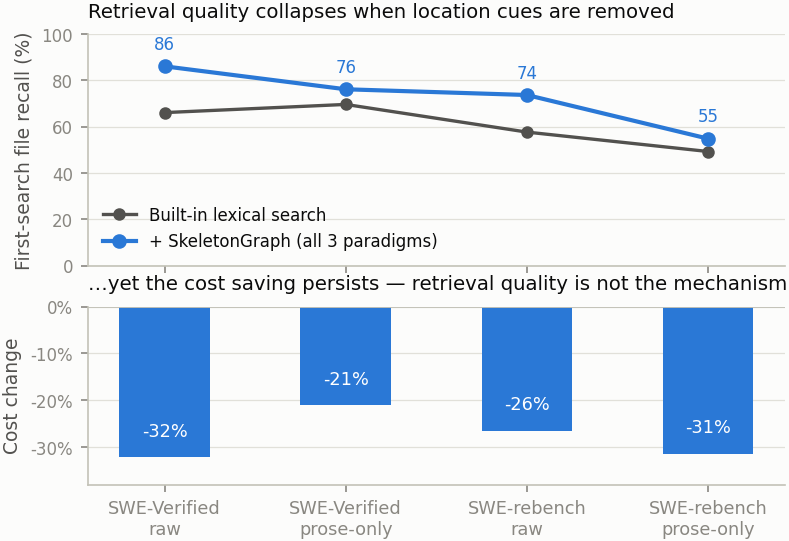
sg-fusion runs all three non-LLM retrieval paradigms at once — lexical (BM25),
semantic (code embeddings), and topological (call graph). Crossing memorization
(standard vs. decontaminated benchmark) against location cues (original vs.
prose-stripped issue text) shows the limit:
| condition | file recall native → SG | Δ recall | cost | turns |
|---|---|---|---|---|
| SWE-Verified, raw | .661 → .861 | +.200 | −32.2% | −38.5% |
| SWE-Verified, prose-only | .717 → .711 | −.006 | −21.1% | −22.6% |
| SWE-rebench (unseen repos), raw | .500 → .639 | +.139 | −26.4% | −35.6% |
| SWE-rebench, prose-only | .394 → .439 | +.044 | −31.3% | −29.3% |
Read the Δ-recall and cost columns against each other. The retrieval advantage collapses — a +.200 edge becomes −.006 once the symbols are gone, and the lexical baseline falls in parallel, so this is a property of the whole non-LLM category, not of one implementation. Yet the cost saving persists in every condition (−21% to −31%), including the one where retrieval quality is statistically identical to the baseline. On the decontaminated benchmark the point sharpens: the largest cost saving (−31.3%) sits in the cell with the smallest retrieval edge (+.044).
What the agent was missing was direction, not files. Memorization and location
cues look like two different factors, but they're the same quantity — knowledge of
where to look, held by the model or supplied by the issue. Order the four conditions
by how much of it is available and SG's recall orders exactly: .861 → .711 → .639 → .439.
And when direction isn't given, the agent acquires it by exploring. On the prose-only condition, native's cumulative recall reaches .967 against SG's .883 — given enough turns, the agent that grepped and read its way through the repo located the code better than the agent handed a ranked list. SG gets there in half the searches and for less money; it does not get further.
That inversion is the honest statement of what this tool is: a retrieval layer delivers candidate files, not knowledge of the repository — and a confident ranked list actively suppresses the agent's own acquisition of that knowledge (reads drop 3.86 → 1.55/task). The agent spends tokens until it's certain, not until it has files. That's why recall and cost decouple, and it's what the paper's title refers to — the honest ceiling is a finding here, not a caveat.
SWE-Verified rows are restricted to the same 15 tasks as the prose run so raw and prose are paired. That subset is not representative of the full 100 (SG saves −32.2% on it vs −14.6% overall) — do not compare it against the n=100 figure.
4. Deployment finding: slow MCP servers are structurally excluded
Two graph/LSP-based competitors wired as MCP servers never participated at all.
Claude Code's headless (-p) mode finalizes its tool manifest within ~2 seconds of
launch and never updates it; servers needing real bootstrap time (a language server,
a Node CLI + index) finish their handshake just past that window and are silently
absent for the entire run — confirmed via session-init transcripts and each server's
own logs showing it was ready seconds later.
This is a deployment-mode result, not a retrieval-quality one, and we report no
performance comparison for those systems: with zero tool calls, any such number would
measure their absence rather than their retrieval. A separately wired zero-LLM graph
competitor connected cleanly with all 14 tools visible, yet the agent never invoked
one across 10 tasks, defaulting to native grep every time. Fast connection and
actual adoption are prerequisites that retrieval quality cannot substitute for.
SkeletonGraph is wrapper-first: it returns a full context packet or exposes a retrieval index (AST skeletons + call graph + local summaries + optional embeddings) so the IDE agent or CLI can choose targets.
SkeletonGraph has two product surfaces:
- SG IDE: MCP context server for Cursor, Claude Code, Copilot, Codex, Antigravity, Windsurf, and other agentic IDEs.
- SG CLI: terminal pipeline for route, prepare, dry-run, provider execution, and cost-aware model selection.
Why SkeletonGraph
Most coding agents spend expensive turns discovering the repo:
search -> read file -> read neighbor -> read tests -> realize the target
SkeletonGraph moves that work into a deterministic graph pipeline:
prompt -> (optional) retrieval planner -> classify task -> find target nodes -> expand graph -> assemble packet
The goal is not only lower token cost. The useful product outcomes are:
- fewer exploratory file reads
- faster first useful answer
- better target/test/blast-radius context
- transparent routing reasons
- lower model overkill for routine tasks
- reusable packets for IDEs, CLIs, and other agents
Install
pip install skeletongraph           # core: indexing, MCP server, CLI (no API key needed)
pip install "skeletongraph[llm]"    # + litellm for sg run --execute / sg summarize --tier cloud
pip install "skeletongraph[all]"    # everything
Quick Start: SG IDE
Use this path when you already work inside Cursor, Claude Code, Copilot, Codex, Antigravity, or another MCP-capable coding environment.
cd your-project
sg init
sg build
sg doctor
sg init writes the MCP config and the agent instruction file for the selected
IDE. SG IDE does not require an API key. Your IDE subscription/model still does
the reasoning and editing; SkeletonGraph supplies the packet or retrieval
signals for efficient target selection.
Supported IDE setup targets include:
| IDE | Integration | Model switching |
|---|---|---|
| Cursor | MCP + rules | manual in IDE |
| Claude Code | MCP + CLAUDE.md |
/model command |
| GitHub Copilot | MCP + instructions | manual in IDE |
| Codex | MCP + AGENTS.md |
manual in agent |
| Antigravity | MCP + rules | manual in IDE |
| Windsurf | MCP + rules | manual in IDE |
Quick Start: SG CLI
Use this path when you want a terminal-first context and model-routing pipeline.
cd your-project
sg build
sg route "fix the auth token validation bug"
sg prepare "fix the auth token validation bug" --out .skeletongraph/context.md
sg run "fix the auth token validation bug" --dry-run
sg route, sg prepare, and sg run --dry-run do not need an API key.
To call a provider:
sg config --cli-provider anthropic
$env:ANTHROPIC_API_KEY = "..."
sg run "fix the auth token validation bug" --execute
To test locally without a paid provider key:
ollama pull qwen3-coder:latest
ollama serve
sg config --cli-provider local
sg run "fix the auth token validation bug" --dry-run
sg run "fix the auth token validation bug" --execute
Local execution is intended for cheap pipeline testing. Use provider models for quality benchmarks unless the benchmark is specifically for local models.
Model Dependency, Prewarming, and Keeping the Index Fresh
SG downloads two small embedding models on first use, both via
sentence-transformers (a hard dependency, not optional):
jinaai/jina-embeddings-v2-base-code(SG_DENSE_MODEL) — the semantic leg offusion/sg_search. Loaded onsg warmor on an agent's first dense-retrieval query. Loads withtrust_remote_code=True(Jina ships custom modeling code on the HF Hub) — this executes code from that model repo, same as anytrust_remote_codemodel.all-MiniLM-L6-v2(SG_EMBED_MODEL) — a smaller, separate model used only as a confidence-score tiebreaker at index time. Downloads automatically on the firstsg build, not onsg warm.
Both need internet access the very first time each is used on a machine — after
that, both are cached locally (Hugging Face's model cache, plus SG's own
content-hash caches: .skeletongraph/dense_cache for the dense leg,
.skeletongraph/embeddings.npz for the confidence tiebreaker) — so later builds
are incremental: only functions whose text actually changed get re-embedded.
Prewarm before launching an agent, so that cost lands during setup instead of on the agent's first real search:
sg build                 # parse + structural index (no LLM, fast)
sg warm --path .          # prebuild BM25 + dense caches (one-time; minutes on CPU)
sg warm --path . --mode rerank   # skip the dense leg entirely (no embedding cost)
Without this, the first sg_search call an agent makes pays the cold-encode
cost inline — on a large repo this can exceed the dense retrieval leg's
internal timeout (SG_DENSE_TIMEOUT_S, 20s by default), in which case it
silently degrades to a 2-signal (lexical + structural) result rather than
failing outright. Prewarming avoids relying on that fallback altogether.
Keeping the index current as files change — two options, pick based on how you work:
sg update --path .        # one-shot: re-index only files that changed since last build
sg watch --path .         # background daemon: auto-reindexes on save (needs `pip install "skeletongraph[daemon]"`)
sg watch is the hands-off option for active development — it debounces
rapid saves and calls the same incremental update path as sg update, so
editing a file is reflected in the index without a manual rebuild.
Model Routing
SkeletonGraph separates IDE-facing model labels from CLI provider model names.
For IDEs, model tiers are recommendations:
| Tier | Typical use |
|---|---|
| SLM | docs, explanations, simple lookup |
| MLM | normal coding, debugging, tests, review |
| LLM | architecture, broad migrations, low-confidence tasks |
For CLI execution, SkeletonGraph can route to provider model names:
sg config --cli-provider anthropic
sg config --cli-provider openai
sg config --cli-provider google
sg config --cli-provider local
Dynamic routing uses task mode, confidence, candidate count, token size, and complexity. Code-changing work keeps an MLM floor by default so cost savings do not come from making weak models edit code unsafely. Retrieval planning can use small models to propose targets over AST/summaries before the heavy model runs.
IDE Integration
After sg init and sg build, register SG as an MCP server and write IDE hooks:
sg install --ide claude-code   # Claude Code: hooks + MCP server + CLAUDE.md rules
sg install --ide cursor        # Cursor: MCP + .cursor/rules/skeletongraph.mdc + hooks
sg install --ide cline         # Cline: MCP config + rules block
sg install --ide roo           # Roo: MCP config + rules block
sg install --ide copilot       # GitHub Copilot: MCP + copilot-instructions.md
sg install --ide windsurf      # Windsurf: MCP + .windsurfrules
sg install --ide zed           # Zed: MCP config + rules block
sg install --ide continue      # Continue: MCP config + rules block
sg install                     # auto-detect all installed IDEs
codex and antigravity are accepted as aliases and currently route through the
Copilot-style MCP installer.
For any other MCP-capable client, or to configure it by hand, see
mcp.example.json for the raw server config
(sg serve --path /path/to/your/project).
After install, restart your editor. SkeletonGraph runs as a background MCP server
(sg serve --path .) that the IDE connects to automatically.
MCP Tools
Seven tools are exposed to the IDE agent. Use these instead of grep/glob/file reads:
| Tool | When to call | Returns |
|---|---|---|
sg_overview |
Session start — once per session | Constraints + top-N functions (by PageRank) + recent turns + index stats |
sg_search "query" |
Primary retrieval — almost every prompt | Top-3 matches with body excerpts + summaries + 1-hop callers; top-4..N as signatures + summaries. One call usually enough — no need to chain. |
sg_get "fqn" |
When the exact FQN is known | Signature + summary + 1-hop callers + callees |
sg_expand "target" |
When more body is needed than sg_search returned |
Full function body / file / line range (token-capped) |
sg_constraint list / propose |
Before proposing changes | Confirmed + proposed project rules |
sg_log |
Reviewing recent session turns | Last-N turn summaries with files touched |
sg_decision |
A design/implementation choice is made (picked or rejected, and why) | Recorded so it survives context compaction — recall later with sg_log(kind="decision") |
Smart context routing. On each UserPromptSubmit, SG classifies the prompt
(architecture / explain / decision / debug / test / review / general) and
includes the matching MD file from .skeletongraph/ — e.g. architecture.md
only for design/refactor queries, project.md only for "what is this codebase"
queries. Constraints + session digest + relevant functions are always injected.
Cold start. If no .skeletongraph/ index exists when an MCP tool is called,
SG auto-builds on first invocation (see auto_build_on_query in config).
CLI Reference
Indexing & status
| Command | Purpose |
|---|---|
sg init [--agent cursor] |
Configure project, IDE preset, MCP, constraints |
sg index |
Full index (alias for sg build) |
sg index --incremental |
Only re-index changed files |
sg build |
Full index with detailed output |
sg update |
Incremental update |
sg status |
Show index status |
sg doctor |
Check index, routing, provider, Ollama readiness |
sg overview |
Project skeleton: top functions, constraints, session |
sg install [--ide <name>] |
Write IDE hooks + MCP config |
Retrieval
| Command | Purpose |
|---|---|
sg search "query" |
BM25 + graph search (no API key) |
sg get "fqn" |
Get function signature, summary, callers |
sg expand "target" |
Expand function body / file / line range |
Constraints & session
| Command | Purpose |
|---|---|
sg constraint list |
List all constraints |
sg constraint propose "text" |
Add a proposal |
sg constraint confirm <id> |
Promote proposal → decisions.md |
sg constraint remove <id> |
Remove a constraint |
sg constraint aggregate |
Import from IDE rule files |
sg log [--last-n 10] |
Show recent session turns |
Summarization
| Command | Purpose | API key |
|---|---|---|
sg summarize --tier local |
Ollama Tier-0.5 (free, on-device) | no |
sg summarize --tier cloud |
Cloud LLM Tier-1 | provider key |
sg summarize --tier cloud --force |
Re-summarize all functions | provider key |
Model routing & execution
| Command | Purpose | API key |
|---|---|---|
sg route "task" |
Show task mode, tier, recommended model | no |
sg run "task" --dry-run |
Plan routed execution | no |
sg run "task" --execute |
Call configured provider | provider or local |
sg config [--agent cursor] |
Configure IDE and CLI models | no |
sg config --cli-provider anthropic |
Set CLI execution provider | no |
Background indexing
| Command | Purpose |
|---|---|
sg watch |
Daemon: auto-reindex files on save |
Provider output from sg run --execute is written to .skeletongraph/runs/.
Evaluation is currently done externally via a SWE-bench harness (see the
Evaluation section below).
Python API
from skeletongraph.engine import SGEngine

engine = SGEngine(project_root=".")
result = engine.query("fix the content-length bug", delivery="cli")

print(result.context_text)
print(result.query_mode)
print(result.model_tier)
print(result.recommended_model)
print(result.routing_reason)
Architecture
src/skeletongraph/
  parser/       AST extraction
  graph/        dependency graph and ranking
  storage/      .skeletongraph persistence
  retrieval/    classification, resolution, model routing
  assembly/     context packet construction
  session/      memory and dedup
  server/       MCP server
  install/      per-IDE hook + MCP config writers (`sg install`)
  hooks/        IDE hook handlers (prompt-submit routing, etc.)
  llm/          LiteLLM wrapper for optional CLI execution
  cli/          Click commands
  engine.py     unified query pipeline
Evaluation
The full methodology, verified results, and every withdrawn/superseded claim are in docs/paper/skeletongraph.tex and docs/paper/FINDINGS.md.
SkeletonGraph should be evaluated on both quality and cost:
- target recall and packet completeness
- missed tests/callers
- first useful answer latency
- file reads after SG context
- pass rate
- cost per passing task
- dynamic routing overkill/underpower rate
- IDE compliance with SG-first context usage
Cost savings are only meaningful when reported with pass rate.
License
SkeletonGraph is released under the MIT License — free to use, modify, and distribute, for commercial and private projects alike.
Citation
If SkeletonGraph is useful in your research, please cite:
@misc{doke2026skeletongraph,
  title  = {Retrieval Is Not Reasoning: The Localization Ceiling in AI Coding Agents},
  author = {Doke, Yash},
  year   = {2026},
  note   = {SkeletonGraph — zero-LLM structural retrieval for coding agents},
  url    = {https://github.com/yashdoke7/skeletongraph}
}
Install Skeletongraph in Claude Desktop, Claude Code & Cursor
unyly install skeletongraphInstalls into Claude Desktop, Claude Code, Cursor & VS Code — handles npx, uvx and build-from-source repos for you.
First time? Get the CLI: curl -fsSL https://unyly.org/install | sh
Or configure manually
Run in your terminal:
claude mcp add skeletongraph -- uvx skeletongraphStep-by-step: how to install Skeletongraph
FAQ
Is Skeletongraph MCP free?
Yes, Skeletongraph MCP is free — one-click install via Unyly at no cost.
Does Skeletongraph need an API key?
No, Skeletongraph runs without API keys or environment variables.
Is Skeletongraph hosted or self-hosted?
Self-hosted: the server runs locally on your machine via the install command above.
How do I install Skeletongraph in Claude Desktop, Claude Code or Cursor?
Open Skeletongraph on unyly.org, pick your client tab (Claude Desktop, Claude Code, Cursor) and press Install — the config is generated automatically, no JSON editing.
Related MCPs
Fetch
Web content fetching and conversion for efficient LLM usage.
AWS KB Retrieval
Retrieval from AWS Knowledge Base using Bedrock Agent Runtime.
 by modelcontextprotocol
Spring AI MCP Server
Provides auto-configuration for setting up an MCP server in Spring Boot applications.
llm-analysis-assistant
A very streamlined mcp client that supports calling and monitoring stdio/sse/streamableHttp, and can also view request responses through the /logs page. It also
 by xuzexin-hz
Compare Skeletongraph with
Not sure what to pick?
Find your stack in 60 seconds
Author?
Embed badge for your README
Browse similar
All ai MCPs