
Trapic Core
FreeNot checkedSelf-hosted MCP server for long-term memory in AI coding assistants, capturing decisions, conventions, and discoveries as structured traces with tag and keyword

About
Self-hosted MCP server for long-term memory in AI coding assistants, capturing decisions, conventions, and discoveries as structured traces with tag and keyword search.
README
Self-hosted long-term memory for AI coding assistants.
Your AI forgets everything between sessions. Trapic Core is an MCP server that fixes that — decisions, conventions, and discoveries are captured as structured traces, searched by tags and keywords, and recalled automatically at session start.
No vector database. No embeddings. No API costs.
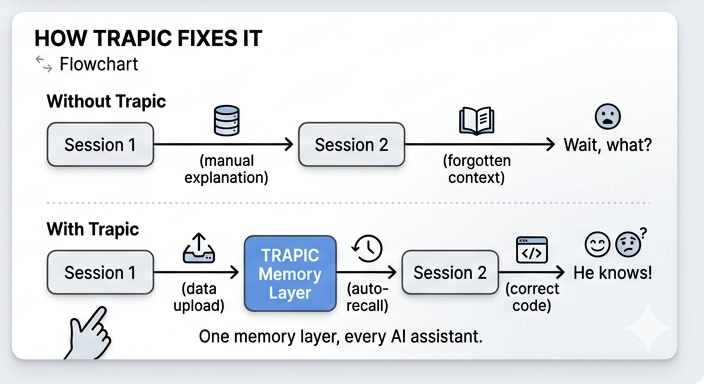
Table of Contents
- Quick Start
- How It Works
- MCP Tools
- Database
- Authentication
- Deployment
- Configuration
- Architecture
- Cloud Version
Quick Start
git clone https://github.com/trapicAi/trapic-core.git
cd trapic-core
docker compose up
Server runs at http://localhost:3000/mcp. Connect your AI tool:
{
  "mcpServers": {
    "trapic": {
      "type": "http",
      "url": "http://localhost:3000/mcp"
    }
  }
}
Save as .mcp.json in your project root (Claude Code, Cursor, Windsurf) or add to claude_desktop_config.json (Claude Desktop).
How It Works
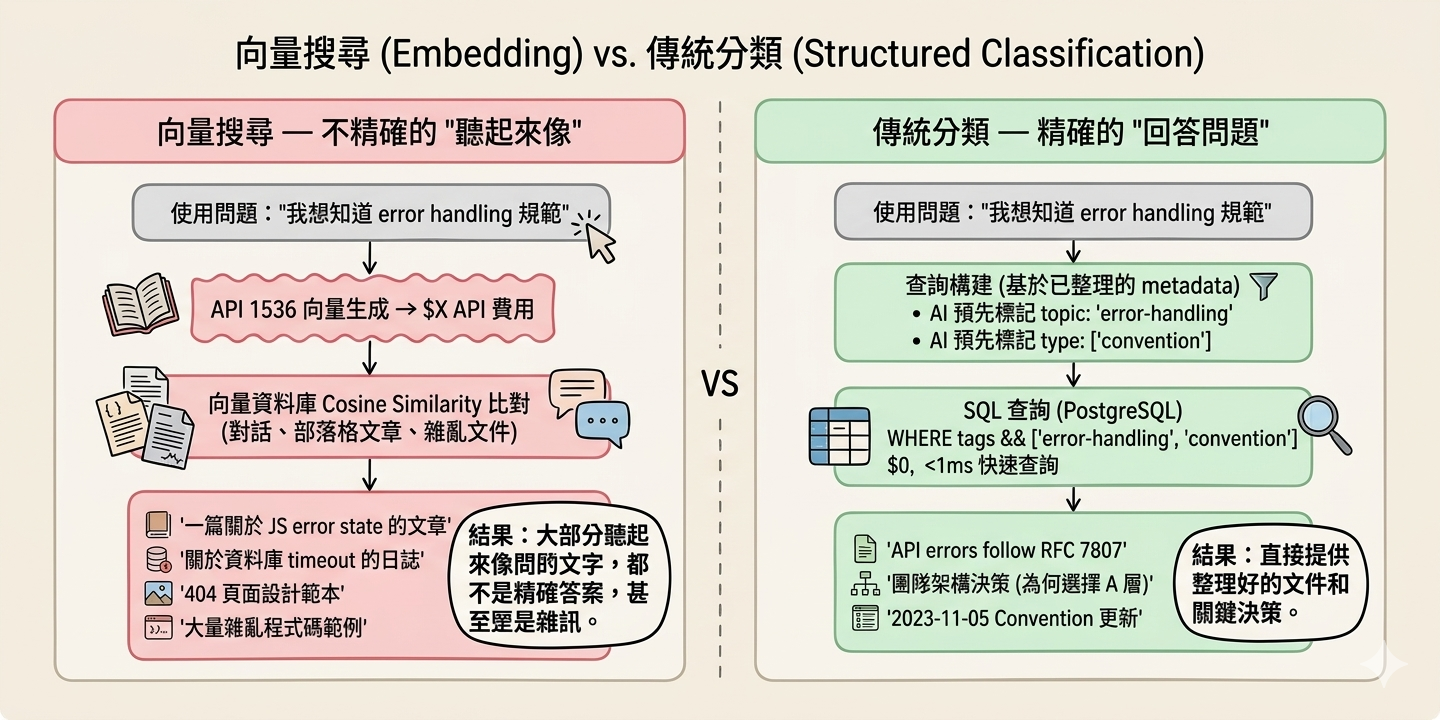
Traditional RAG embeds everything into vectors and hopes cosine similarity finds the right answer. Trapic takes a different approach — AI structures knowledge at write time, AI infers the right query at search time. The database in the middle stays simple.
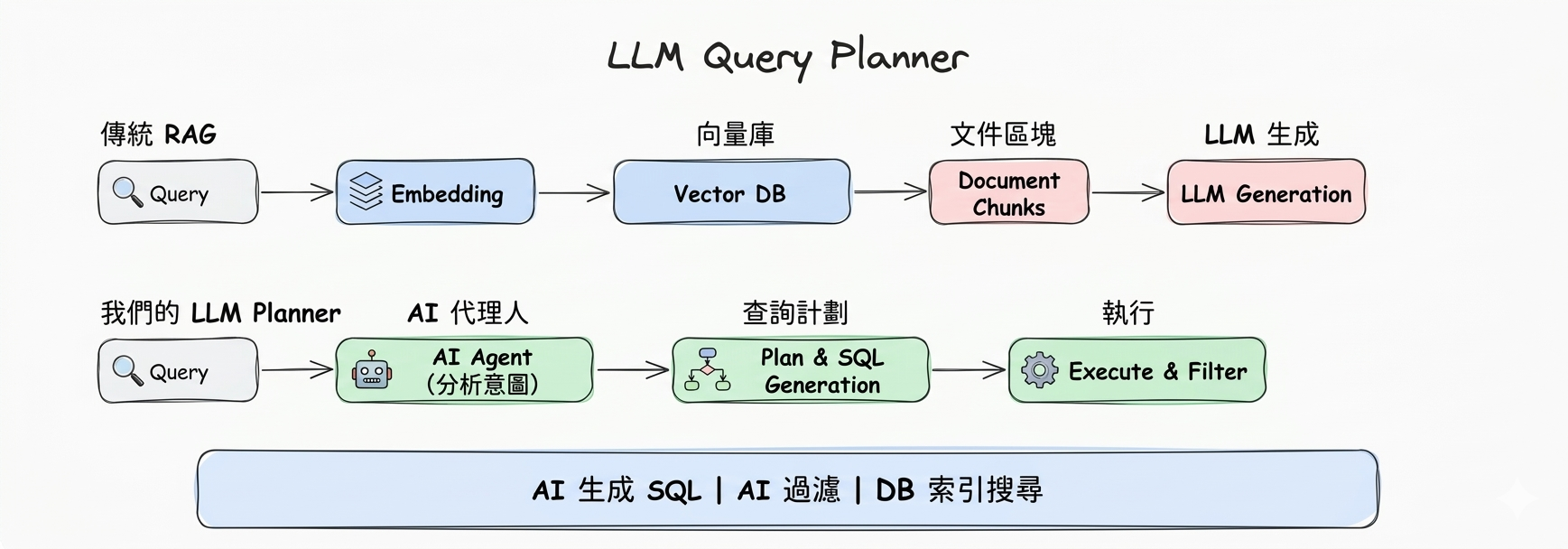
Each knowledge trace:
type:        decision | convention | fact | state | preference
content:     "Chose CSS custom properties over Tailwind theme config"
context:     "Tailwind doesn't support runtime theme switching"
tags:        [topic:theming, topic:css, project:my-app, branch:main]
confidence:  high | medium | low
Tags with project: / branch: use AND logic (must all match). topic: tags use OR logic (any match counts). Combined with full-text search and recency scoring.
MCP Tools
| Tool | Description |
|---|---|
trapic-create |
Create a knowledge trace |
trapic-search |
Search by tags, keywords, type, time range |
trapic-recall |
Session briefing — load project context on startup |
trapic-update |
Update content, status, tags, or supersede a trace |
trapic-get |
Get full trace by ID |
trapic-health |
Health report — type distribution, stale ratio, trends |
trapic-decay |
Scan for stale knowledge (type-specific half-lives) |
trapic-review-stale |
Confirm or deprecate a stale trace |
trapic-import-git |
Bootstrap knowledge from git commit history |
Full parameter reference
trapic-create
| Parameter | Type | Required | Description |
|---|---|---|---|
content |
string | Yes | The knowledge content (max 5000 chars) |
context |
string | No | Why — the causal explanation |
tags |
string[] | No | Type + topic + project/branch tags |
confidence |
high | medium | low |
No | Default: medium |
trapic-search
| Parameter | Type | Required | Description |
|---|---|---|---|
query |
string | No | Keyword search (max 500 chars) |
tags |
string[] | No | Filter tags (project/branch = AND, topic = OR) |
status |
active | superseded | deprecated |
No | Default: active |
types |
string[] | No | Filter by trace type |
time_days |
number | No | Only last N days |
limit |
number | No | Max results (default: 10, max: 50) |
trapic-recall
| Parameter | Type | Required | Description |
|---|---|---|---|
context |
string | Yes | What you're working on |
project |
string | No | Project name to scope |
tags |
string[] | No | Additional filter tags |
max_contexts |
number | No | Max context clusters (default: 5, max: 10) |
trapic-update
| Parameter | Type | Required | Description |
|---|---|---|---|
trace_id |
UUID | Yes | Trace to update |
content |
string | No | New content |
context |
string | No | New context |
status |
active | superseded | deprecated |
No | New status |
superseded_by |
UUID | No | ID of replacing trace |
tags |
string[] | No | New tags |
confidence |
high | medium | low |
No | New confidence |
trapic-get
| Parameter | Type | Required | Description |
|---|---|---|---|
trace_id |
UUID | Yes | Trace ID |
trapic-health
| Parameter | Type | Required | Description |
|---|---|---|---|
project |
string | No | Project name to scope |
tags |
string[] | No | Additional filter tags |
trapic-decay
| Parameter | Type | Required | Description |
|---|---|---|---|
project |
string | No | Project name to scope |
tags |
string[] | No | Additional filter tags |
threshold |
number | No | Decay score threshold (default: 0.3) |
dry_run |
boolean | No | Preview only (default: true) |
trapic-review-stale
| Parameter | Type | Required | Description |
|---|---|---|---|
trace_id |
UUID | Yes | Stale trace ID |
action |
confirm | deprecate |
Yes | Confirm (reset decay) or deprecate |
reason |
string | No | Reason for the action |
trapic-import-git
| Parameter | Type | Required | Description |
|---|---|---|---|
url |
string | Yes | Git repository URL (HTTPS) |
project |
string | Yes | Project name |
branch |
string | No | Branch (default: main) |
max_commits |
number | No | Max commits (default: 100, max: 500) |
since |
string | No | After this date (YYYY-MM-DD) |
dry_run |
boolean | No | Preview only (default: true) |
Database
Three backends, switchable via TRAPIC_DB_ADAPTER:
| Backend | Best for | Scaling | Full-text search |
|---|---|---|---|
| SQLite (default) | Local dev, single user | Single instance | FTS5 |
| PostgreSQL | Production, teams | Horizontal (multiple replicas) | tsvector + GIN |
| MariaDB | Production, teams | Horizontal (multiple replicas) | FULLTEXT index |
SQLite
Zero config. Data in ./data/trapic.db.
docker compose up
PostgreSQL
cp .env.example .env  # set PG_PASSWORD
docker compose -f docker-compose.postgres.yml up
| Env Variable | Default | Description |
|---|---|---|
TRAPIC_PG_HOST |
localhost |
Host |
TRAPIC_PG_PORT |
5432 |
Port |
TRAPIC_PG_USER |
trapic |
User |
TRAPIC_PG_PASSWORD |
— | Password |
TRAPIC_PG_DATABASE |
trapic |
Database |
MariaDB
cp .env.example .env  # set MARIADB_PASSWORD
docker compose -f docker-compose.mariadb.yml up
| Env Variable | Default | Description |
|---|---|---|
TRAPIC_MARIADB_HOST |
localhost |
Host |
TRAPIC_MARIADB_PORT |
3306 |
Port |
TRAPIC_MARIADB_USER |
trapic |
User |
TRAPIC_MARIADB_PASSWORD |
— | Password |
TRAPIC_MARIADB_DATABASE |
trapic |
Database |
Authentication
Open by default (localhost, no auth needed). Enable user management by setting an admin password:
TRAPIC_ADMIN_PASSWORD=my-secret docker compose up
Then open http://localhost:3000/admin to create users and teams.
How auth works
| State | Behavior |
|---|---|
| No users, no admin password | Open mode — all requests accepted |
| Admin password set, no users yet | Open mode — create users at /admin |
| Users exist in database | Bearer token required (sk-...) |
Users and API keys
- Open Admin UI (
/admin) - Create user — gets auto-generated API key (
sk-...) - Configure MCP client with the key:
{
  "mcpServers": {
    "trapic": {
      "type": "http",
      "url": "http://localhost:3000/mcp",
      "headers": {
        "Authorization": "Bearer sk-a1b2c3d4..."
      }
    }
  }
}
API keys are stored as SHA-256 hashes. The plaintext key is shown only once at creation.
Teams
Users in the same team can see each other's traces.
Team: backend-team
  ├── alice (sees bob's traces)
  └── bob   (sees alice's traces)
A user can belong to multiple teams.
Admin API
All endpoints require Authorization: Bearer <TRAPIC_ADMIN_PASSWORD>.
| Method | Endpoint | Description |
|---|---|---|
GET |
/admin/api/users |
List users |
POST |
/admin/api/users |
Create user |
DELETE |
/admin/api/users/:id |
Delete user |
POST |
/admin/api/users/:id/regenerate |
Regenerate API key |
GET |
/admin/api/teams |
List teams |
POST |
/admin/api/teams |
Create team |
DELETE |
/admin/api/teams/:id |
Delete team |
GET |
/admin/api/teams/:id/members |
List members |
POST |
/admin/api/teams/:id/members |
Add member |
DELETE |
/admin/api/teams/:id/members/:userId |
Remove member |
Deployment
Docker
Public image: ghcr.io/trapicAi/trapic-core:latest
# SQLite (default)
docker compose up

# PostgreSQL
docker compose -f docker-compose.postgres.yml up

# MariaDB
docker compose -f docker-compose.mariadb.yml up
Kubernetes
Manifests in k8s/.
SQLite (single replica):
kubectl apply -f k8s/namespace.yaml
kubectl apply -f k8s/pvc.yaml
kubectl apply -f k8s/deployment.yaml
kubectl apply -f k8s/service.yaml
MariaDB (scalable):
# Create secret first (copy from example, fill in passwords)
cp k8s/mariadb-secret.example.yaml k8s/mariadb-secret.yaml
kubectl apply -f k8s/namespace.yaml
kubectl apply -f k8s/mariadb-secret.yaml
kubectl apply -f k8s/mariadb.yaml
kubectl apply -f k8s/deployment-mariadb.yaml
kubectl apply -f k8s/service.yaml
Node.js
npm install && npm run build && npm start
Configuration
| Env Variable | Default | Description |
|---|---|---|
TRAPIC_PORT |
3000 |
Server port |
TRAPIC_HOST |
127.0.0.1 |
Bind address (0.0.0.0 to expose) |
TRAPIC_DB_ADAPTER |
sqlite |
sqlite, postgres, or mariadb |
TRAPIC_DB |
./data/trapic.db |
SQLite database path |
TRAPIC_USER |
local-user |
Default user ID (open mode) |
TRAPIC_ADMIN_PASSWORD |
— | Enables Admin UI at /admin |
Architecture
┌─────────────┐                    ┌──────────────┐                  ┌──────────────┐
│  AI Client  │  ── MCP/HTTP ──►   │ Trapic Core  │  ── adapter ──►  │   Database   │
│ Claude Code │  POST /mcp         │  MCP Server  │                  │ SQLite / PG  │
│ Cursor, etc │  ◄── JSON ──       │              │                  │  / MariaDB   │
└─────────────┘                    └──────────────┘                  └──────────────┘
- Protocol: Model Context Protocol (Streamable HTTP)
- Search: Structured tags + full-text search, no embeddings
- Decay: Type-specific half-lives (state: 30d, decision: 90d, convention: 180d, fact: 365d)
- Security: API keys hashed (SHA-256), admin rate limiting, constant-time auth comparison
Cloud Version
Don't want to self-host? trapic.ai offers a managed version with OAuth login and team collaboration.
Use the Trapic Plugin for one-click setup.
License
MIT
Installing Trapic Core
This server has no published package — it is built from source. Open the repository and follow its README.
▸ github.com/trapicAi/trapic-coreFAQ
Is Trapic Core MCP free?
Yes, Trapic Core MCP is free — one-click install via Unyly at no cost.
Does Trapic Core need an API key?
No, Trapic Core runs without API keys or environment variables.
Is Trapic Core hosted or self-hosted?
Self-hosted: the server runs locally on your machine via the install command above.
How do I install Trapic Core in Claude Desktop, Claude Code or Cursor?
Open Trapic Core on unyly.org, pick your client tab (Claude Desktop, Claude Code, Cursor) and press Install — the config is generated automatically, no JSON editing.
Related MCPs
Fetch
Web content fetching and conversion for efficient LLM usage.
AWS KB Retrieval
Retrieval from AWS Knowledge Base using Bedrock Agent Runtime.
 by modelcontextprotocol
Spring AI MCP Server
Provides auto-configuration for setting up an MCP server in Spring Boot applications.
llm-analysis-assistant
A very streamlined mcp client that supports calling and monitoring stdio/sse/streamableHttp, and can also view request responses through the /logs page. It also
 by xuzexin-hz
Compare Trapic Core with
Not sure what to pick?
Find your stack in 60 seconds
Author?
Embed badge for your README
Browse similar
All ai MCPs